Showing posts sorted by relevance for query mangosteen. Sort by date Show all posts

September 1, 2006

Mangosteen Revisited


Some questions have arisen since my last article on the Queen of the Fruit so I thought I would try to tie up some loose ends about mangosteen.

Mangosteens are not illegal in the U.S.!
Neither the tree nor the fruit are illegal to grow or to eat. The problem is that mangosteens do not grow very well in the mainland. They need the constant warmth and high humidity of a tropical area and cannot survive at temperatures below 40°F. Is it possible to grow them in southern Florida and parts of California that have climates like southern Florida. They just have not been successfully grown on a commercial level.

Importation of mangosteens to the U.S.
It is currently illegal to import the raw fruit to the U.S. from southeast Asia, where most of the commercial crops are grown, and Hawaii because of the threat of fruit fly infestation. Mangosteens don't typically have a problem with insects but they have stiff sepals on the top of the fruit which provide a perfect hiding place for fruit flies or other insects which could be devastating to other U.S. crops so that is the reasoning behind the ban.

Fruit can be imported from Puerto Rico and 18 Caribbean and Central American countries. This is a Catch-22, as, in general, those countries do not currently have the quantities to make it worthwhile to export to the U.S. A new friend of mine who does grow mangosteens has told me that his crops are sold out for the foreseeable future!

Importation to other countries
The fruit is sometimes available in Canada and Europe, although I have read that it isn't always as fresh as it should be. And for those of you who just perked up because you live near the Canadian border, it is illegal to bring the fruit into the U.S. from Canada, as well. Aussies are a little luckier; mangosteen is grown in the north Queensland area of Australia and also imported from Thailand. India is one of the major producers.

The U.S.D.A. is currently considering a revision to the law which would allow irradiated mangosteens to be imported from Thailand. It will probably take 6 months to a year before the law is changed, but I imagine that very soon after that, mangosteens will become more available in the U.S. Just don't think that they will be priced at 10 cents like I paid!


Serving Mangosteen
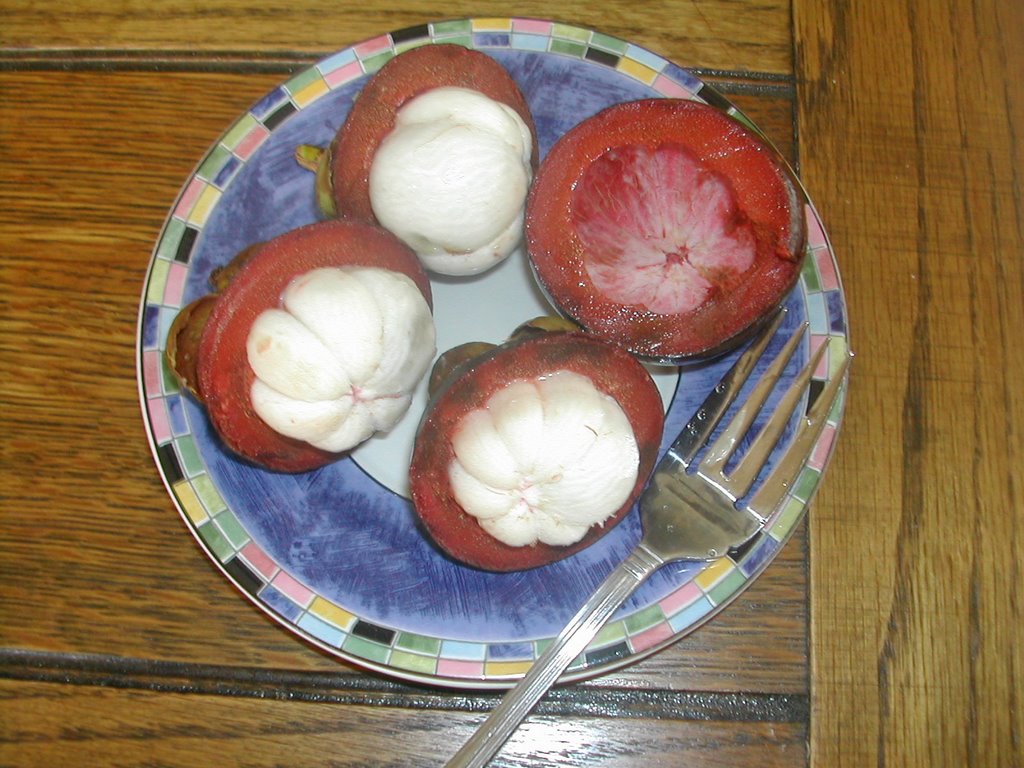
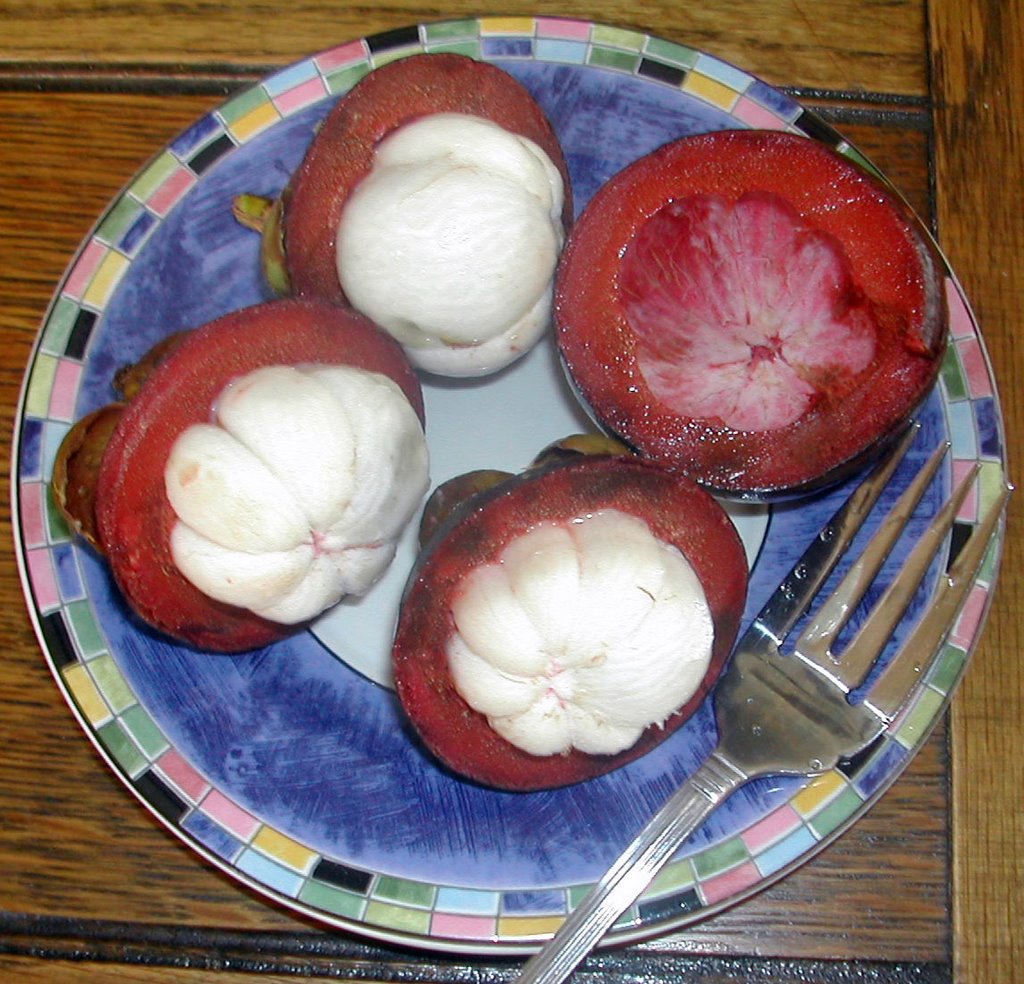
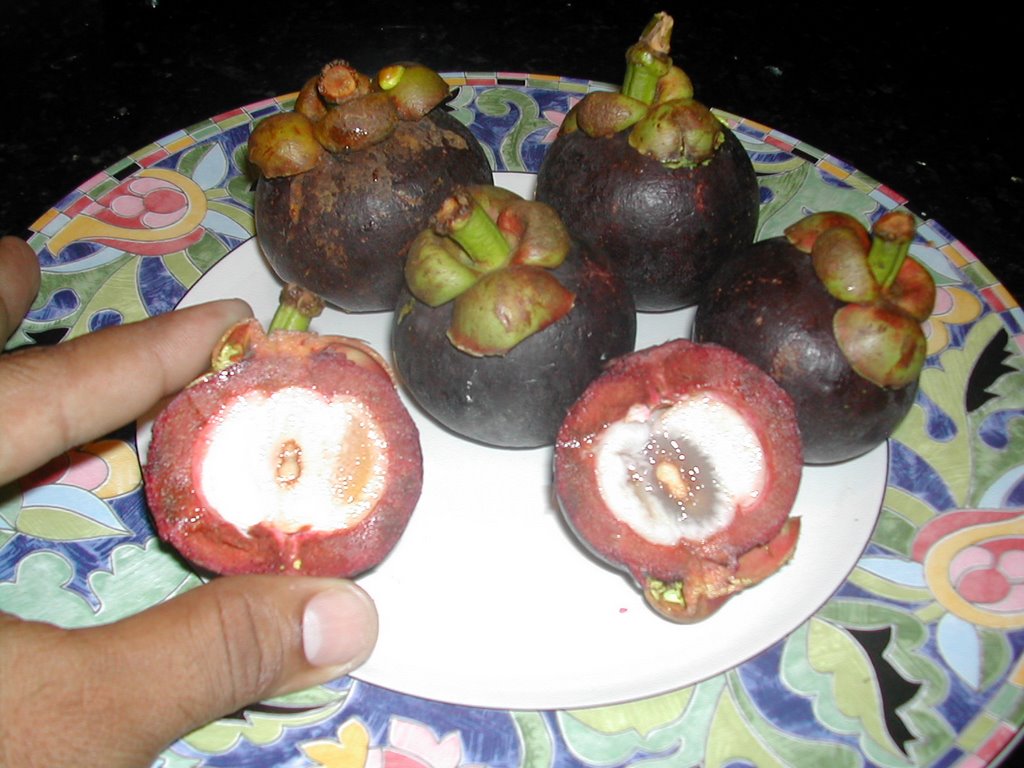
If you are able to find mangosteen, don't worry about recipes! Enjoy the pure, unadulterated flavor of it fresh. Mangosteen is most often served chilled, with the rind cut away to expose the fruit inside, as in the photo above. The contrast between the dark, rich purple-red of the rind and the creamy white fruit is really lovely.

From my experience, I would say that cutting the rind is preferable to tearing the fruit open. Make a careful cut around the circumference of the fruit to insure that you don't damage the fruit inside, remove half of the rind and serve it in the other half with a fork. My "Gardening in the Tropics" book suggests that in Malaysia the fruit is often accompanied with another tropical fruit called durian. I have not had durian so I can't say about that. The descriptions of the foul odor of durian have put me off trying it.


Mangosteen recipes
If you don't want to eat them fresh, they can be made into a very good juice (using only the white part), or used in mixed fruit salads or for making sorbets, jams or jellies. It is a very delicate fruit and I haven't run across any other recipes that I think would do them justice. If you are so lucky as to have an excess of mangosteen (not bloody likely!), I suggest juicing the white pulp and freezing the juice for another day.

Mangosteen juice
The prepared "miracle" juices that are on the market at exorbitant prices advertise that their juice includes the "whole fruit," including the rind. The rind is so bitter (yes, I tasted it. Yuck!) that I cannot imagine that this juice could be palatable unless it includes a sweetener or something else to mask the bitterness. The rind is used in homeopathic remedies, but there is a big difference between "taking your medicine" and enjoying a refreshing drink!

Other names
Mangosteen is also known as mangostá­n or mangostí­n (Latin America), mang khut (Thailand), mangis (Philippines), and mangoustan (France).

Wikipedia

Since I am now a mangosteen expert (haha!) I took the liberty of adding a description of the flavor to the Wikipedia Mangosteen article, which didn't include a discussion of the flavor at all. I'm sure that someone out there can do a much better job, so if you have tasted it, feel free to edit me! ;-o

My mangosteen tree
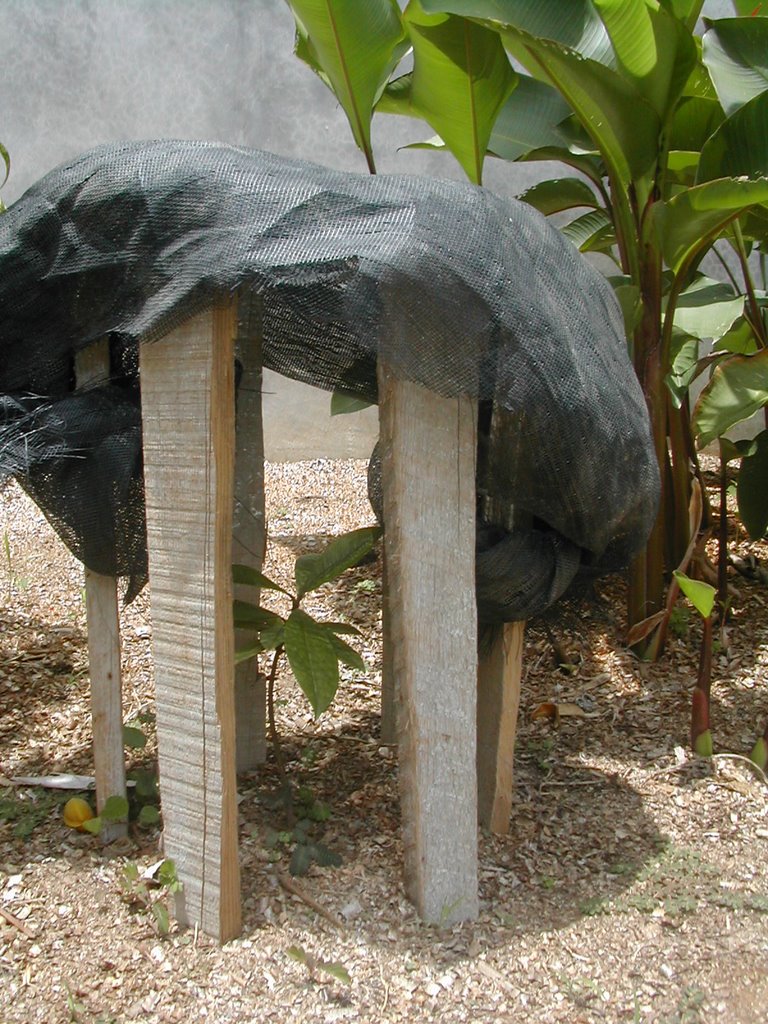
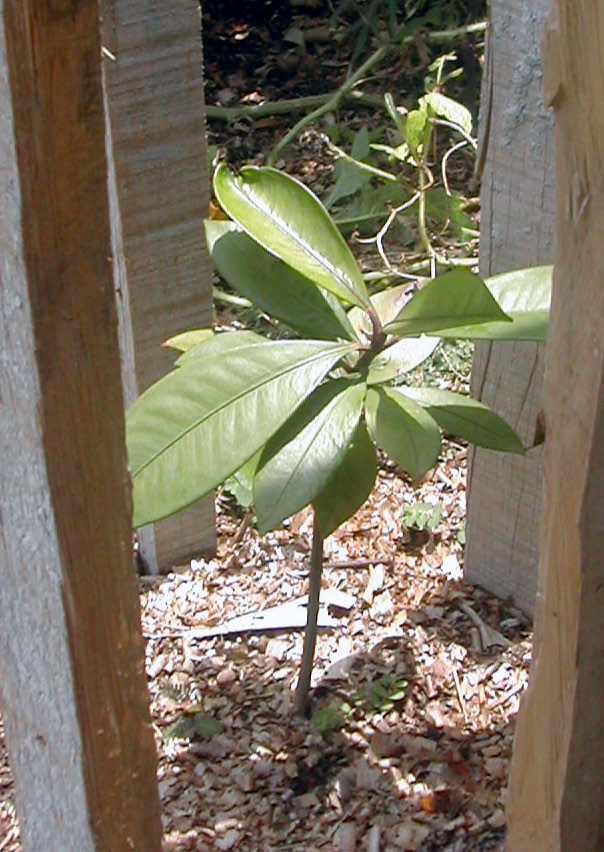
My new friend, Mr. Mangosteen, has analyzed my tree from its picture in the previous mangosteen article and informed me that it looked like it had recently been exposed to excess sun (Yikes, like since I planted it!), a lack of sufficient water (ditto), and worst of all that, at 9 inches (23 cm.), it is probably no more than one year old. So that invitation to stop by for a juice will still have to stand for 2014. Here's a picture of my new, well-cared for mangosteen tree being properly protected from the tropical sun.

August 20, 2006

Queen of the Fruit - Mangosteen

Queen of the Fruit

These beautiful fruits are mangosteens. Oddly, you don't eat that yummy looking red part − it's very bitter. The white part in the center looks like soft garlic cloves but don't let that fool you. It is melt-in-your-mouth luscious: very sweet and creamy, a little citrusy, maybe with a touch of peach flavor. Oh, here, I found a much better description:
"I cut open a thick rind to reveal six snowy white, almost translucent segments that were like little eggs nestled in a jewel box. The flavor was almost unbearably exquisite - a sweet-tart melding of elegance and opulence that had echoes of fruit of every climate. Think of cherimoyas, lychees, and peaches mingled into one soft, moist, fragrant mouthful. I understood at last why many people consider mangosteen the finest fruit in the world-and why Queen Victoria is said to have offered a knighthood to anybody who could bring her one."

-David Karp, The Fruit Detective, Meet the Mangosteens, Gourmet Magazine, July 2003, pp. 88-89
They were for sale yesterday at the local grocery store for the very first time that I'm aware of. It seems that a local engineer grows them for export (so what else is new?), but this time decided we lowly Ceibeños were Mangosteen-worthy. Hooray! They cost 2 lempiras each here (about 10 cents).

After doing some research, I found that this is the proper way to cut and serve the fruit. It does look more attractive this way, doesn't it?

Recently, a company has been promoting a mangosteen juice which costs $39.95 for a 25 ounce bottle! Another company sells a 'bargain' version, $24.95 for a 32 ounce bottle. If nothing else, this should tell you how good this fruit is! I'm not going to promote these companies by naming them, but I will tell you that they make wild claims about the health effects of this juice. I intended to say that they claim it does everything except cure cancer, but then I read further and it seems that they hint at that, too. It is true that the fruit is high in vitamins and anti-oxidants and has been used in many folk remedies for hundreds of years. But I don't believe the rest of that stuff for a minute.

Garcinia mangostana L. is a native tree of Malayasia and now is widely grown in southeast Asia, India and to a lesser extent in Hawaii and many other tropical countries in the Americas, Africa and Australia. It has not been successfully grown in Florida or California. Honduras is said to have one of the largest plantations in the world (500 trees) at the Lancetilla research gardens. Started in 1927, it still produces fruit today.

Despite the name, mangosteen is not related to the mango family. The fruit is the most generally esteemed of all tropical fruits, called the queen of the fruits in many countries. The tree is grown only in tropical areas that have heavy rainfalls. It is a dense shade tree, nicely pyramidal in shape, growing from 30 to 80 feet tall depending on the soil and climate. It fruits twice a year but not reliably so in climates that don't have a sufficient dry season. CURLA recommends it be grown in Honduras only from sea level to 500 meters in areas with at least 2 meters of annual rain. In other areas it has been grown to an altitude of 1,500 meters.

The most unusual fact about mangosteens is that they are dioecious but apparently no one has ever identified a male tree. Like many mysterious things in nature, the female tree has adapted and found a way to reproduce.

You might logically ask: "If mangosteens are so great, why don't we see them in the U.S.?" Good question, since all things good generally go to the U.S.

Fresh mangosteens are forbidden by the U.S.D.A. for importation from southeast Asia due to the possibility of importation of fruit flies. Currently, the fruits may only be imported from Puerto Rico and 18 Central American and Caribbean countries, none of which have many successful commercial growers. A change has been recently proposed to allow importation of irradiated fruit from Thailand. Mangosteens must be harvested fully ripe and the fruit does not ship, preserve, or process well.

It is a slow growing tree, requiring shade for the first two to three years. Tests over the last 75 years have proven that it cannot be reliably propagated vegetatively so growing from seed with the resultant long wait, is the best alternative. It can take 8 to 10 years, sometimes even up to 15 years, to produce fruit. The first few years of harvest can range from 300 to 500 fruits, increasing to about 500 for a full grown tree, and reaching optimum production of 1,000 to 3,000 fruits after 20 to 30 years. It takes a patient and optimistic farmer to decide he wants to grow mangosteens for profit.


This is a picture of my mangosteen tree. Actually it is better described as a Mangosteen twig. The wood slats around it are for Rottweiler protection. After reading all the research, I realize now that I need to give it more shade. It is not a well-known tree in Honduras. CURLA, the national agricultural university of Honduras, grows and sells a few plants to the public. Sadly, only these very small trees are available. The price was right, though: L. 20 (about $1.05 U.S.) In Honduras, mangosteens typically do not fruit until the 8th year so I have a very long wait for mangosteens of my own.

If you want to know more about mangosteens including it's history, culture, and folklore, check out Fruits of Warm Climates. For the straight scoop on those juice products, see Science, Nonscience and Nonsense at Mangosteen.com. Mangosteen.com also provides some interesting, well-documented history of the mangosteen, including a 1855 story of a greenhouse-grown tree in England that produced its first fruit after 22 years of growth. The author also debunks the Queen Victoria story above.

If you come to Honduras in 2014, stop by La Gringa's house and I may be able to offer you a mangosteen juice − for free!

More on Mangosteen: Mangosteen revisited

October 20, 2006

Google me


I love Google. Searches, images, maps, Gmail, everything Google.

I have this neat thing called Google Analytics. It tells me all sorts of stuff, half of which means nothing because I don't have advertisements on my blog. But the other stuff is interesting. For example, I know that I have had visitors from
71 countries and every state in the U.S. except Wyoming. Does that qualify as world famous? Know anyone in Wyoming?

Google tells me the questions to which readers need answers. Sometimes I was "spot on" as the Brits say. I had the answer "nailed" as the North Americans say. But I always feel kind of bad when I see that Google sent someone here and I know they didn't find their answer. So, better late than never, here are some answers:

La gringa means 'the foreign woman,' particularly of the North American or British type. El gringo means the same only it is speaking of a man.

El Jefe means 'the boss.' In the context of this blogicito, it's a term of endearment, not a job title. Also, since this is a macho society, you know that the men always have to be in charge, right? ;-D My El Jefe is cien por ciento Catracho (100% Honduran) and he's the biggest fan of my blog because he knows that I tell the truth, even when it isn't very flattering to his country. I like a man with a sense of humor.

No, you don't have to take the seeds out of eggplant before you eat it. I don't even know how you could. Don't make work for yourself when it isn't necessary.

I guess that you start a citrus grove by planting citrus trees.

If your eggplant won't fruit, the weather probably isn't warm enough or the plant isn't getting enough sun. I haven't fertilized mine so I don't think fertilizer would be your problem. If it looks wilted, water it. (Sorry, this one is probably too late.)

Pick your papayas when they begin to show patches of yellow . Wait longer if you don't have a problem with birds. Don't wait until they are completely yellow because they will be overripe. (I hope I'm not too late here.)

Once and for all, mangosteen is not illegal to grow or to eat in the U.S. It's only illegal to import the fruit from certain countries because of the risk of importing insects to the U.S.

If your taro is drooping, it probably needs more water. These plants like a lot of water and often grow in drainage ditches or swamps here.

As for "Dijon mustard expiration dates," "love," "peace corps and Belize," "dubai uruguay," and "eggplant tongue itch," sorry, you are on your own there, although I do appreciate the vote of confidence from Google. ;-)

August 16, 2009

It's back! Rainy season

rain, La Ceiba, HondurasNow, that is rain!

Rainy season has started a little early in La Ceiba, Honduras. Yesterday we had about 2 inches of rain (5 cm.) and at halfway through the month, we've already had almost 8 inches (20.3 cm.). It actually rained three separate times yesterday which is unusual for this time of year in La Ceiba. Generally, it only rains after 4 p.m. for some reason that I don't understand but like very much. I know this because of August construction and painting projects.

This late afternoon timing makes it nice for tourists who can do all the outdoor activities unhampered during the day and sit under a champa (palm frond roof) at a restaurant in the evening. Actually, when it does rain this time of year, it is usually only for maybe an hour. Nice, huh?

I love rainy season as everything turns bright green and looks so fresh and clean. Plants and trees seem to grow 12 inches (.3 m.) a week − a slight exaggeration, but not too much (except for my mangosteen tree).

Another reason to love rainy season is that the temperature cools down somewhat. It has almost been chilly at night, but keep in mind that my blood has thinned in the tropical heat so that over 85° F (29° C) feels hot and anything below 80° F (27° C) feels cool or even cold to me. Quite a change from Texas where the temperature might vary by 40 degrees in a day. ;-)

La Gringa's tropical-sized rain gauge, La Ceiba, HondurasSince there doesn't seem to be any official recording of rainfall in Honduras, I've been keeping track of the rain with my handy dandy tropical size (24" - .61 m.) rain gauge.

You can follow the count under "La Ceiba Rainfall" in the sidebar. I usually only update this page at the end of the month.

July 15, 2008

Happy Blogicito Blogiversary!

laughing children, El Porvenir, Honduras


Hey, today is my second blogiversary! I almost forgot about it like I did last year.


property, La Ceiba, HondurasThe beginning - the barren lot

I started out with
"The beginning" showing a photo of our bare property (above). What a struggle that was to build a house. I said in July 2006 that the house still wasn't finished and, guess what, two years later, it still isn't. Hahaha. It's not even like we are trying to get it finished. I think the perfect ebanista (carpinter) will have to fall into our lap before we ever do. Bad experiences will do that to you − makes you gun shy.

tall trees, La Ceiba, HondurasThe trees have grown

One interesting thing is that in the 2002 photo, I mention that the tops of the trees look like they were on the ground. Above is a photo from July 2008 and the tops of the trees are miles above the ground. I couldn't get a photo from the same angle as it only showed the house and muro (wall), but to give this photo some perspective, the Elephant Ears in the lower right are about 3 feet long (1 meter). Everything (except my mangosteen and macadamia nut trees) grows so fast here in La Ceiba, Honduras. Our views of the mountains are almost gone.

Next I wrote "What's a blog?" and it was a serious question. I had been five years without home internet. Internet cafes in Honduras are often crowded, uncomfortable, and very, very slow. I rarely even used them to check my email. After finally having home internet for a few months, late one night I ran across Blogger and the page said "Start your blog in three easy steps!" So, okay, what the heck: Let's see what happens. It was free!

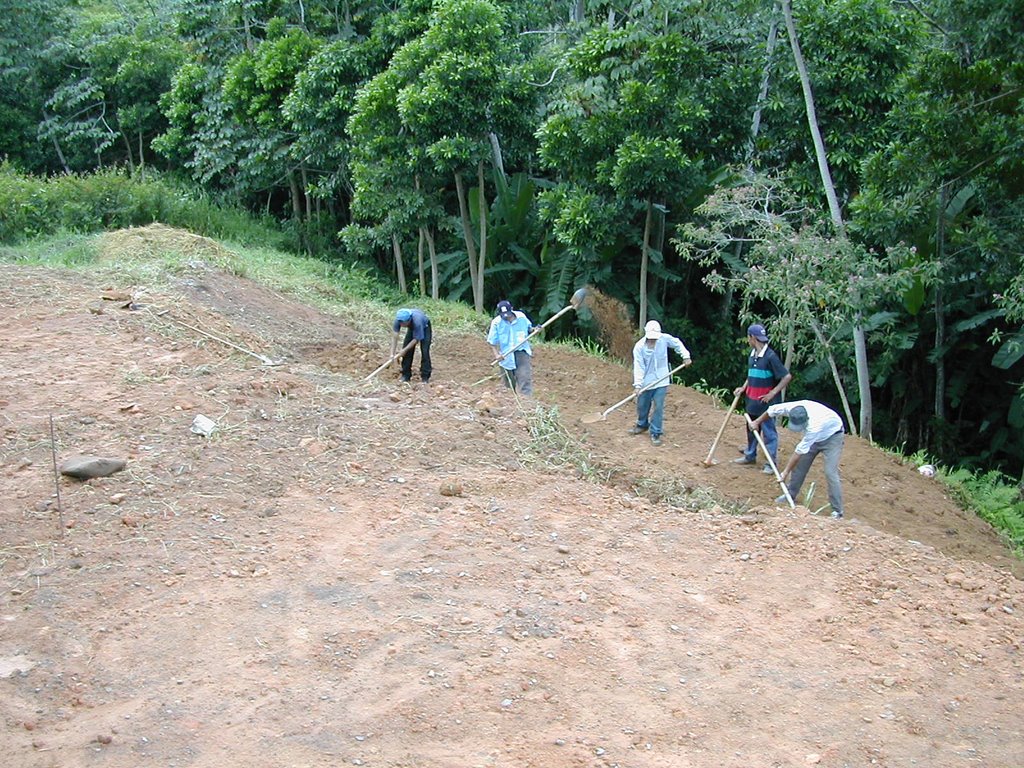
workers leveling the hill, La Ceiba, HondurasThen there was "Starting the garden" which was my initial half-hearted attempt to put some sort of order to the saga I was going to write. Heheheh. That attempt at chronological order didn't last long. El Jefe asked, "How do you remember these things?" I don't know. I have a good memory and because everything is new and different, it made a bigger impression on me.

My biggest regret is that we didn't take many photos during our first five years here, except for a zillion photos of our house construction (some can be seen in "Building a house in Honduras" and "More OSHA unapproved"). It was the whole focus our lives for several years. Now, it seems to be again but for different reasons.

Next I wrote my snippy "The good, the bad, and the ugly." I was in one of those moods. Yes, it's snippy, but it still holds up today. It does tend to make some people angry, though. El Jefe can laugh about it and he agrees with it so that's all that matters to me.

Rereading it two years later, I would have to amend the plastic bag section; we now have a few different colors and more and more stores are going to the flimsy, N. American style bags. Over the past two years, we have gotten a few more "thank yous" and the more rare "I'm sorry", but it's still like pulling teeth most of the time. I don't have any recent information on the mail deliverers so that could have changed as well.


Mountains, La Ceiba, HondurasWhat a view!

Looking back at
"Where to live", I think it is embarrassingly long and rambly (the real me?). Today I would cut that into two or three blog articles. Only the most devoted readers have time to read those long articles. I really should go back and edit, but where's the time?

After I had those articles posted, I announced to the world that I was a Blogger! Well, to be more precise, I announced to my two internet gardening pals and El Jefe. :-)

El Jefe started reading the blog out loud and to my horror, he read the title as "Blow-hee-see-toe" using the Spanish pronunciation. I realized that in my attempt to invent a clever 'Spanish' word, my title was the worst kind of Spanglish. I admitted my error in "Title delimma," though over the years, numerous readers have felt compelled to write me to point out the error again.

I suppose that was what started my long trend of writing about my screw-ups. Oh, well, most N. American readers have no problem at all in pronouncing 'blogicito' the way I do. In fact, it's very similar to 'blogiversary', isn't it? I googled 'blogversary' (21,000 results), 'blogaversary' (41,000 results), and 'blogiversary' (182,000 results), so that settles it!


A month and about 20 articles later, I thought, "What on earth will I write about now?" Something came to me and the ideas have been coming ever since.

Now here we are, two years, 752 articles, almost 104,000 visitors, and 358 subscribers later. I think that I learned to stick to the subject at hand a little bit better. I've learned a little HTML, prettied up my blog, and "met" a whole lot of people. I notice more all around me and pay more attention to the news since I now feel it is my duty. I've learned more about Honduras, more about myself, and more about people in general. I hope you've learned something, too, and even more importantly, I hope that you've enjoyed your visits to my life.

If you have enjoyed the Blogicito, please do a favor for me and sign my guest book. You don't have to, but you can upload a photo from your computer (it's easy − just follow the instructions). It doesn't have to be a photo of you, if you are shy. Show me your garden or your favorite flower or....something interesting. There is no spamming. It just makes me happy. (You may have to wait a moment for it to magically appear below.)


If you've really, really enjoyed the Blogicito, you can even buy me a present from my Amazon Wish List! People often ask if they can bring something to me, but it's just so embarrassing to ask, so I thought I would try this. Just click the link below, browse the items, and click to buy one. It will be shipped to Texas, where it will be later shipped to me at my cost. If you are coming to La Ceiba and want to bring something with you, that's fine, too.


My Amazon.com Wish List

Thanks for visiting the Blogicito wherever you are!

September 17, 2006

La Gringa's empty guest map

¡Que lástima! (How pitiful!) There have been 100 visitors from 18 countries and 15 U.S. states since I wrote the last article mentioning La Gringa's Guest Map but only three people have placed a pin on the map. Boohoo! I wonder if I wasn't clear and visitors have been clicking on the world map instead of the globe in the 'Something New!' section.

Guests can be anonymous

Just in case you are shy (or the paranoid type, as I am) the notations on the map can be completely anonymous. Only two fields are required, name and comment. Name can be fake ('La Gringa fan' is even better ;-D ). Comment can be 'Hello from Kampala, Uganda' (or wherever you are from) if you can't think of anything clever to say.

You don't have to enter your email address, in fact I suggest that you do not since I have read that spam bots search through websites gathering email addresses. You may enter your blog's URL for display, if you wish. And don't forget to select your country from the drop down list so that your flag will show with your entry − not required, but nice.

It's easy to put your pin on the map

I'm doing all the work here. Don't you think it's the least you can do for me? Here, I'll even put another copy in this article so you don't even have to go to the sidebar to look for it:


Just click on the globe and read the instructions. It's not so hard and if you make a mistake you can cancel your entry and start over.

Hundreds of prizes

The first 100 visitors will win the right to a healthful, refreshing mangosteen juice served on my lovely tropical orange terraza as soon as my crop comes in (currently estimated to be in the year 2014). You, too, could be lounging in that colorful handmade Honduran hammock (see photo below).

More begging

Okay, please? Have I begged enough? Will you put your pin on the map just to make me happy? The sooner you do it, the sooner I'll quit whining!

July 26, 2006

Vegetable Gardening - Tropical Style


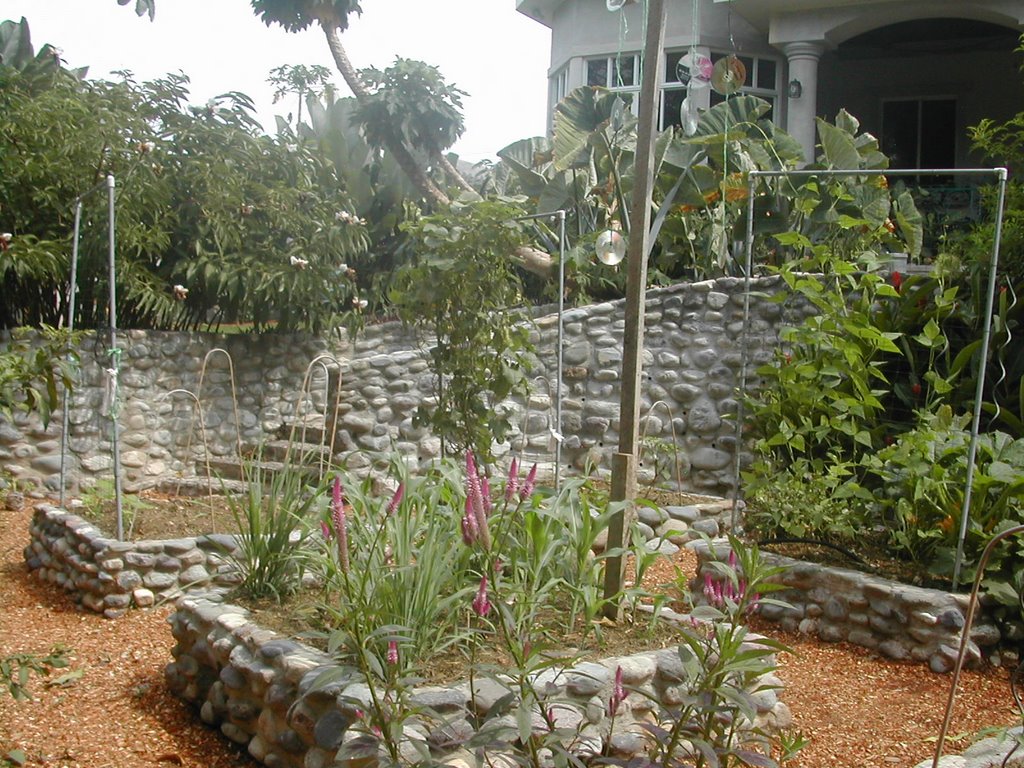
The vegetable garden is on a level about five feet below the main backyard level. We can just see the tops of the corn and the trellises from the house. I like this because vegetable gardens don't always look so nice. We built six 4x4 foot bottomless boxes out of large river rocks mortared in place, since that material is what is most readily available and most durable here in the tropics.

During the rainy season we can get 20 inches of rain in 3 or 4 days so a raised bed is really necessary for good drainage. Most vegetables couldn't take being saturated for days at a time. During the dry season, the soil in the boxes get a little hotter than I would like but I have a system of soaker hoses in them so that helps to compensate for the heat. I was lucky enough to find a piece of shade cloth that I use to cover lettuce and other things that just can't take the intense sun.

I grow my vegetables organically using the square foot method in these raised beds. I think the close planting helps to keep the soil cooler but I have to watch out for all kinds of mildew because of the frequent rain and high humidity. I've planted corn as close as four to the square foot, although a friend tells me that is much too dense. I don't know − I get corn! There are no organic products available here, so we make do with compost and manure and use soap or garlic sprays to try to control the insects.


Originally I filled the boxes almost completely with compost because the orange laterite soil is so poor, but the compost kept decomposing and before long the boxes were only half full. I bought some tierra negra (black soil, or top soil) to add to the beds and that has helped stabilize the soil level, although I don't think it was very good quality soil. I still have to add some compost and/or soil each time I rotate crops. I also add cow or sheep manure when I can get it. I've actually been thinking about getting some chickens (for the eggs and manure) or rabbits (for the manure). I'm basically a city girl, so that would be a big step for me. Also, with three dogs, I will have to figure out a way to protect the chickens from the dogs, and vice versa.

I like the boxes with a 4 foot width because that is as wide as I can reach into the center of the box without stepping into it and compacting the soil. One thing I will do differently on the next one we build is to make it longer. That will help keep the soil a little cooler because the corners are where the box becomes
the hottest. The wide stone rim is about a foot high and is nice for sitting on the side when I'm planting or pulling weeds.

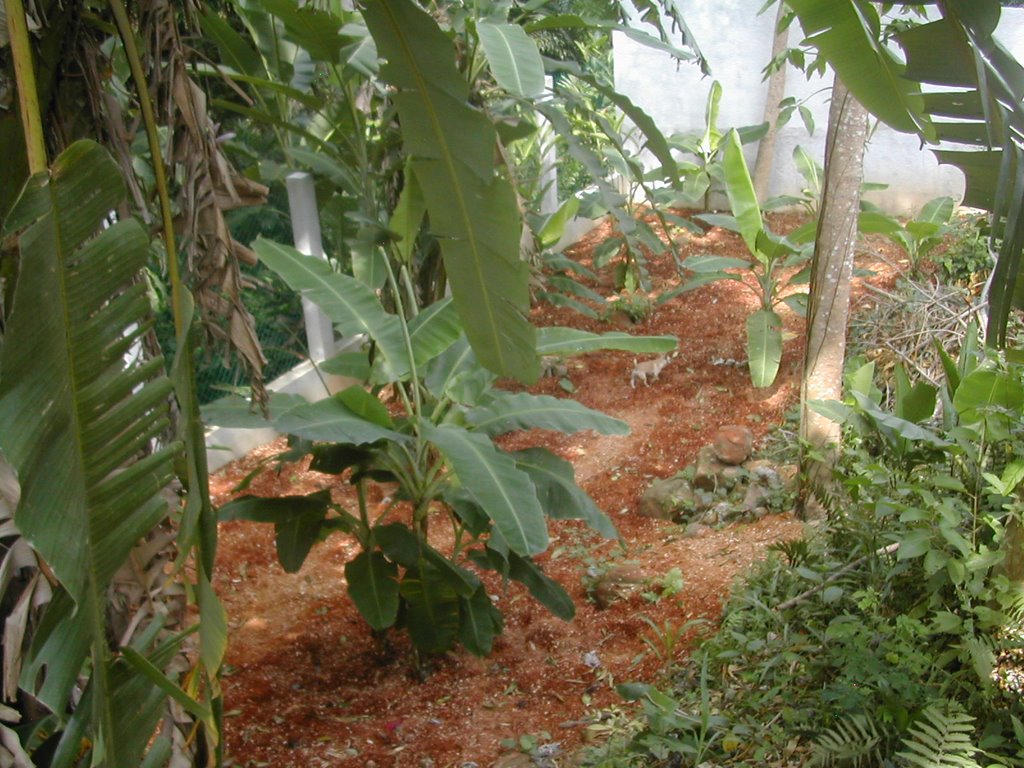
On the lowest level we have our banana plantation. Our handyman/gardener Carlos really wanted to plant bananas down there and
since I'm still busy with the main parts of the garden, we got the plants for him. The area below is on the edge of a jungle-like creek area and had lots of very tall jungly trees. Several of them fell down during some heavy rainstorms last winter (that made me very sad) so now the area is a part-sun situation which bananas like here. (Okay, the "plantation" is about 10 banana and plantain plants.) ;-)

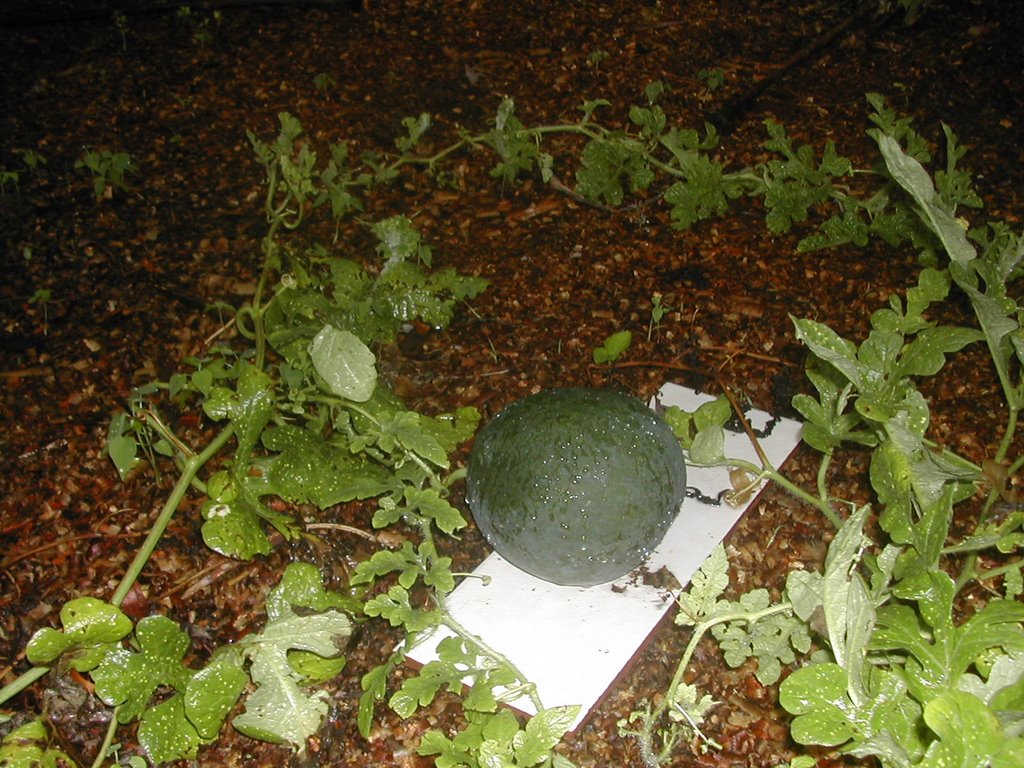
We also have vegetables and fruits growing in the front yard: Moon and Stars watermelon (the first one was 28 pounds!), jicama,
papayas, a vanilla vine, and some young trees: two avocados, a cinnamon, and a mangosteen. I have some herbs in the raised beds and some in a jardinera (window planter box). We have more papayas, a guayaba, and two types of coconuts in back and malanga (taro) everywhere. Lemon grass is planted in several areas − my dogs love to eat it. The low-growing cilantro which is used for much Honduran cooking is in the shade on the side of the house.

I've tried direct planting seeds in the garden, planting in cell packs, and presprouting seeds in paper towels. Direct seeding is tough in this climate: either a downpour comes and washes all the seeds into one corner of the bed, the hot tropical sun dries out the seeds before they emerge, or the thousands of giant millipedes devour the seeds or seedlings. Cellpacks are problematic in that potting soil is only rarely available and my compost seems to be too heavy and holds too much water. If the seedlings emerge, the cellpacks have to be moved out into the sun. No matter how many times I rush out into the rain to bring the trays in, there is always one time I forget and find half empty cells with the poor seedlings completely uprooted and broken by the heavy rain.


Now for most seeds, except beans, corn, and very small seeds like lettuce or herbs, I presprout the seeds in damp paper towels. First I write the variety names with a permanent marker on the paper towel, moisten it, and place the seeds below each name. Another damp paper towel is placed on top of the first and the whole thing is folded up and placed in a sealed plastic bag, which is then kept in a warm place. In my case it is on top of a small electric water pump in a closet. The bag needs to be opened and checked each day.

Generally by the second day something has started to sprout and others usually sprout each day until about the eighth or ninth day. My experience with vegetable seeds has been that if they haven't sprouted by the ninth day, they probably aren't going to. As soon as the tiny root begins to show, the seed should be planted in a small pot, cellpack, or in the ground, being sure to water thoroughly so that the root doesn't have a chance to dry out. I usually keep them in pots until the seedling looks strong enough to withstand the rainstorms.


I'm a CPA by profession and a listmaker by nature so in the beginning I kept meticulous records of every seed planted. How, where, when, how many days to germination, to harvest, diagrams of the planting beds, etc., etc. It was partly due to my nature and partly trying to learn more about vegetable gardening in the tropics. I cut back somewhat because it was a little depressing to later write,"one radish, one carrot, two tomatoes!"


My first efforts were pretty pathetic. I've since begun to use a gardening by the moon calendar and have seen remarkable improvements. I don't know if gardening by the moon works or not because there are so many factors that affect growth and germination, but I think I'll keep doing it. It can't hurt! I also like the calendar because it has suggested activities every few days which help to keep me organized.

While the lack of seasons is great for gardening year round, it is a little too easy to procrastinate when you don't have to worry about that frost deadline. There are no calculations of days to first or last frost here! I can grow pretty much any warm season vegetable year round. Lettuce and things that like cooler temperatures can grow during the rainy season (roughly September to March), or a little longer if I cover them with shade cloth. Another good thing is that compost takes no time at all to finish and there are tons of raw materials available since hardly anyone composts.

A bad thing about the lack of seasons is that there is no cold season to kill off or even slow down the bugs. We have cucumber and squash beetles year round. Our average temperature here in La Ceiba is about 86°F and the humidity averages about 86%, too. During the "winter," say December to February, the temperature usually drops a few degrees from that, but it's only gotten below 70°F a few times since I've been here. This is a hoot: Whenever the temperature falls below 80°F, the newspaper reports a frente frio (cold front). I call it a frente tibia. Once the temperature gets down to the low 70's, people will wear winter coats!

I'm feeling my way through all of this. Tropical gardening is so different in many ways, but dealing with the heat in Texas has helped prepare me a little. I have a bookcase full of gardening books but I am most guided by these books:

Texas Organic Vegetable Gardening by J. Howard Garrett
Gardening in the Tropics by Holttum and Enoch
Square Foot Gardening by Mel Bartholomew
The New Seed Starters Handbook by Nancy Bubel

My moon phase calendar is from this site. It's a very informative site for getting a better understanding of moon planting.

Gardening by the Moon

I also belong to several internet gardening groups from which I've learned a lot, but it seems that there aren't many tropical gardeners on these groups. If anyone knows of any groups for tropical gardeners, I'd love to hear from you.


Home

Related Posts Plugin for WordPress, Blogger...