skip to main |
skip to sidebar
 Shouldn't that be a straight line?
 The second and third lots are steeply sloped and I've seen the measuring guys scratching their heads as they compare the diagram to their measurements and adjust and readjust the markers.I know nothing about how land surveys are done but I know enough math to know that this won't work.
Just look at the photo! You can see that the markers at the top of the property bear no relation to the one at the bottom on the slope. In fact, the two markers on the level part of the property don't even make a straight line when compared to the line of the (straight) street in front. They must have had the tape measure snagged up on a weed or something.How is this supposed to be done anyway? Anyone know? I suppose if your property is on the side of a mountain there would be no other way but to measure the distance down the hill. Does that mean if we filled in our sloped property we would miraculously then have more property? But obviously in this case where most of the property is level and one side slopes it can't be measure purely by distance down the hill.The original developer placed markers, most of which our constructors just pulled up and threw away because they "were in the way." The developer told us to just go ahead and take an extra meter or two at the back by the creek since no one would care. Seriously! He told us that.
No, we didn't. I was too worried about someone coming along later and telling us that we had to knock down and move our muro (concrete fence).So if you find that your neighbor has built his fence across the middle of what you thought was your property, don't say that you weren't warned!
 Typical house, Rancho Lima, La Ceiba, Honduras
 I don't get around all that much, so I notice the change more. One day there is an empty field. The next time I see it, 50 houses are being built. The next time, it is a full blown colonia with landscaping, kids outside playing, people washing their cars − as if it had been there forever.It's not as if El Centro was empty and everyone has moved to the suburbs. It's also not as if people are moving here from the country for jobs, because there just aren't that many jobs in La Ceiba. I have a terrible feeling that it has to do with credit and that the overextending of credit is going to crash Honduras down worse than Hurricane Mitch. Most Honduran people just don't understand credit and in my opinion the banks are making it way too easy for people to overextend themselves at very high interest rates. (Credit card rates run around 60% annual interest.) Our US brother- and sister-in-law were crushed to find out that these houses ran from US $81,000 to $102,000. These are nice houses, don't get me wrong, but they are very small 3-bedroom, 2-bath homes with almost no property other than a small front yard. The smallest house is 98 square meters or 1,055 sq. ft. The largest is 141 square meters or 1,518 sq. ft. − that is a small house by US standards.The interest rate on a 20-year mortgage is 10.5% in Rancho Lima, with 10% down. I haven't heard that 30-year mortgages are available in Honduras. The sales rep said that 10.5% was the best rate that can be had in Honduras and that it was way down from 20-22% a few years ago.He calculated the payment, after some strange wranglings with a "discount" and a "reserve", to be US $917 per month with a 20-year mortgage or $1,015 with a 15-year mortgage. That is L.17,331 (or L.19,184 on the 15-year loan) in a country where an average middle class salary is, oh, around L.7-10,000 per month and a salary of L.17,000 per month is considered very good. It is much less common for both the husband and wife to work in Honduras than it is in the US.
 Okay, I know Bob will bring this up and I've mentioned it before: There is a lot of speculation that drug money is behind the construction boom in La Ceiba. I don't doubt that at all, but I don't think that everyone is involved with narcotrafficking. It just can't be....Can it?Another aspect is the remesas (cash remittances) from family members in the US. Those funds coming from the US allow many families to live way beyond what they could ever hope for, working or not. The sales representative implied that many of the homes were being purchased by Hondurans working in the US and foreigners from other countries. A million of those Hondurans live in the US very tenuously and could lose their job or be sent home at any time. Unless their house is paid for before they move back to Honduras, they'll have a very tough time replacing that US salary in La Ceiba.Our architect told us once that real estate never loses value in (mainland) Honduras. I kind of chuckled at the time, but who knows? The price of construction materials has had huge increases since we built our house. The price of concrete alone, one of the biggest expenses, had more than doubled and the cost of iron has increased tremendously.It's all very confusing to me. The country is poor, people are starving, there are no jobs, yet in a blink of an eye, thousands of new houses are sold and paid for at huge interest rates. What is going on? Wow. I wonder what our house is worth? It must be worth about 5 million by now − lempiras that is, not dollars. :-D
 House in El Porvenir, Honduras
 At first I thought I was seeing things. Then I thought the house must be vacant and abandoned, but no. This tree apparently started growing in the downstairs porch area before it was enclosed. That is my guess anyway. Now it has grown through the downstairs ceiling and out the upstairs terraza.
Interesante!
 I wish I had $10 for every time I was asked that question!
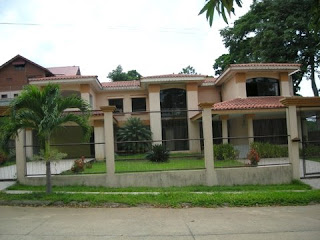 It can cost the same, or more, or less than it costs to buy or build a house in the U.S. How much does it cost to buy a house in Ohio? How much does it cost to buy a house in Dallas? It is impossible to answer to those questions either without knowing a whole lot more details.
The cost of a house, simply put, will depend upon what kind of house you want, what size of house, and where it is. The price of land varies tremendously. A tiny lot on the beach on the island of Roatan might cost vastly more than several acres in a secluded mainland location which, incidentally, might not have access to water or electricity.
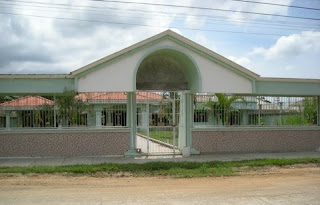 If you want a replica of an 'American' style house complete with all the quality amenities, you could pay even more than it might cost you in the U.S. as you might have to import those quality items that aren't available here and might even have to bring in experts to install them.
Living in or near a big city or popular area will probably mean that labor costs will be higher while living in a smaller remote town will probably mean that material costs will be higher (lack of competition plus transportation costs). So even cost per square foot will vary a lot depending upon what part of the country you are considering.
 I'm not a real estate agent and I don't have any reason to keep up with prices. Right now in La Ceiba, judging by the ads in the newspapers, there are many houses available in the US $50-60-70,000 range. As to whether those houses would suit your needs or whether you would want to live in those areas, I have no idea.
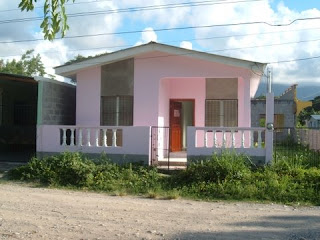 There are houses even less expensive than that, but if you are partial to electricity, like to have water at least most of the day, want a kitchen with more than 18 inches of counter space or a lot with more than a postage stamp-sized yard, you might have to increase your price range.There are just too many variables for me to even attempt to guess! I would say, however, that if you are thinking you can build or buy a house for US $10-20,000, it ain't gonna happen! US $100-200,000 is more likely to get you a house like you are used to.
 I have included a few articles on my blog about some of the colonias (neighborhoods) around La Ceiba. I plan to do more of that just because so many people seem to be interested in houses. I enjoy looking at houses and because we have so much new construction going on, there is a lot of material out there. In fact, I'll add a "Housing" topic in the sidebar to make the articles easier to find.
 For those of you serious about moving to Honduras who want to see what is available, I have a few suggestions.
1. First and foremost, do not ever consider buying property in Honduras without seeing it in person (especially during rainy season), talking to neighbors, hiring a good attorney, and doing all the other due diligence (plus some) that you would perform anywhere else.  2. I always recommend that everyone come down and rent for 6 months to get familiar with the area and find out if living here is what you really want. Renting is cheap and much less expensive than finding out later that you've made a terrible mistake.3. Google "Real Estate Honduras" or "Real Estate La Ceiba." Not all real estate companies have websites in English, so also Google "Bienes Raices Honduras."
 4. The online Honduran newspapers include the classified advertisements (under Bienes Raices). Many properties are sold by owner. Ads won't tell you much, but may give you an idea of prices. (Here are the newspaper links.)5. If you are taking my advice from #2, while you are here, drive around. See what areas you like. Talk to several agents. Look at as many houses as you can to see what is available in your price range. Talk to people that you meet. They may know of something available or may know of problems in the area that you are considering.If you are interested in seeing a particular colonia, let me know. If it is close by and if I can, I'll do an article and take some photos of the houses and neighborhood in general. I won't do your due diligence or make appointments with real estate agents, though!
Now here is a house that you might be able to get for under US $10,000, but chances are that the homeowner does not own the property that it is sitting on.
 House construction
 Not ever. Not if you have the best contractor in the world. Not even if your father-in-law is going to build it. The only circumstance in which you should consider this is if you are a millionaire and can afford to build another house after you do get down here.I've obviously failed miserably if anyone would think of sending money down here to have a house built. I've peppered my blog with vague references to construction problems and dishonorable people but I guess I haven't been clear enough.Everything that can go wrong, will go wrong if you aren't here to check on the construction every day, and I do mean every single day, no matter how long it takes. Not only do you need to be here, but you need to know something about reading plans and construction or hire someone who does.
If you aren't here, corners will be cut, work will be shoddy, your materials will be stolen, and you'll be overcharged, or out and out robbed of your money. Probably two or more of those things will happen, but at a minimum, best case, you won't get what you expect.
 Do you expect your roof to keep out the rain? Then you need to be here and make sure that it does before you pay for it. Don't want your window frames to have a gap wide enough to put your hand through at the edge? Don't think that the water pipes should be on the outside of the walls? Believe that all of your electrical outlets and wall switches should be connected to something? Ditto, ditto, ditto.
Do you have those unreasonable gringo fondnesses for electric grounding, PVC pipe glue, level floors, and toilets that actually will flush something? Need to be here.
Here are some real life examples:One Honduran friend of ours tried to build a house from the U.S. Over the time of construction, she paid the entire amount the house was supposed to cost but when she got here, all she had was walls and most of them were in the wrong place. She had no floor, no roof, no doors, no windows. She sued the thieving contractor to no avail. Another Honduran friend (note that I say Honduran just to specify that it isn't only unsuspecting gringos that these things happen to) left US$30,000 with her contractor uncle to buy materials and start on construction. When they arrived a few months later, they found that the uncle had stolen their money and was nowhere to be found. The little work he had done, they had to pay to have torn down because it was so shoddy.Other gringo friends had a good, trusted friend to build their house. Mistakes were made, it wasn't getting finished, it was costing too much. Through a lucky fluke, they found out that the friend was building his own house with their money, their materials, and the labor that they were paying for. Oh, and they were here in Honduras the whole time.
 No doubt someone will comment on this article with a story about how they built from afar with no problems. Sure, it might happen, maybe once in a blue moon, but trust me, Ginger, don't expect to be one of the lucky ones. Not in La Ceiba.Now as far as finding someone to build your house, you should do the same thing that you would do in the U.S. Get bids, interview contractors, get references, look at their prior work, AND, most importantly, talk to their prior customers.
I always recommend using an architect. They aren't near as expensive as they are in the U.S. The money you spend on an architect will be well worth it in the long run and he will know who are the more reliable contractors, how to deal with them, and how things should be done. But check out the architects' references just like you would do the contractors.
Learn how to read the construction progress reports (hopefully you will get them) and learn how to keep your own accounting records of the money that you spend. Make sure that you have contracts for everyone you hire and that the amount and conditions of payment are spelled out, in Spanish, because English contracts are not legal in Honduras.If you receive a bid much lower than the others, don't take it. All that means is that the person made a mistake in their estimate. They will either ask for more money or will quit as soon as they realize that they won't make a profit and will leave you high and dry. That is the only guarantee that you'll get in Honduras. It's not easy to build a house anywhere and most people who have done it have their horror stories. In Honduras, however, if things go very wrong, there is no one here to protect you. In general, people do not worry about their reputation. They know that you are probably not ever going to build another house, so future business from you is not an issue. There is no Better Business Bureau. The laws and the courts will not protect you. Right now you are probably thinking that I'm exaggerating, that I'm too cynical or too demanding. Yup. That's what two of the people I referred to above thought as well.
I don't want to hear "You were right!" from anyone else.
 View from Rancho Lima (click to enlarge)
 The location is just off the main highway going toward Trujillo, maybe five miles outside of town, in the aldea Peru. The highway turns closer toward the ocean in this area. While the colonia is not on the beach, it has a slight view of the ocean and a great view of the mountains. The streets are laid out in a nicely curving fashion and we noticed that they had a very large community water tank.
 After passing a long, nicely landscaped driveway, we reached the guard house and guard. Interestingly, most of the lots were not walled yet and neither were the windows barred, but that may be just because it is a new colonia with not too many occupied homes yet.
 Most of the houses are similar, and appear to be a typical size, probably 3 bedroom, 2 bath, but we didn't go inside. The guard told us that the houses sold for U.S. $60,000 - $72,000 llave en mano (key in hand). I'm pretty sure, but not positive, that that price represents the price of the home construction and the price of the land. The lots themselves were not very big but the houses are set back on the lots unlike most colonias so it gives the impression of spaciousness.
 I was impressed with the stone trim on some of the homes. Very attractive, I think, and unusual in the La Ceiba area. The work is so neatly done. I wasn't able to figure out if the stones were something artificial or whether the work was done by hand with actual river rocks. They certainly look like the real thing that we see in the rivers here around La Ceiba.
 The large tiled 'garage' in front is typical of La Ceiba homes. The garage area is often used as an outdoor sitting, play, or party area as well. With the cost of tile and installation, ceramic garage floors probably seem like a big luxury to many U.S. Americans, but they are very typical here in middle and upper class homes.
 I did find a website and more photos, but these sites don't have much information. The houses range from 1,055 to 1,587 sq.ft. A typical lot is 609 varas cuadradas (about 4,600 sq.ft. or approximately 1/10 of an acre) and there are 112 lots. I don't have much concrete information about the colonia, but I thought you might enjoy seeing the photos.
 Will there be light?
On second thought, although it is common to read articles about a village that wants to have or will have or now has electricity or water service, I realized that for most of my readers it would be amazing to think that a village that has been around for 105 years could still lack electricity.The article stated that the villagers had been clamoring for electricity for the past 10 years. At the inauguration of the L.2.2 million project (US $116,400), the mayor stated that 124 families who have been living by candles and kerosene lamps for generations now will be able to turn on a light bulb. Several nearby mayors attended the inauguration as witnesses to this historic event.
La Arada is in the Departamento (state) of Santa Barbara where it is said that more than half of the villages have electricity. Hopefully the project will be completed and there won't be another follow up story a year or two or five from now relaying that they ran out of money and the project was never finished.
 Residencial San Gabriel, La Ceiba, Honduras
 Well, it turns out this is not the place she was interested in, but since I went to the trouble to take a bunch of photos and ask around about prices, etc., I thought I would show it to you.
 It is called Residencial San Gabriel. "Residencial" used to mean a more upscale development than a colonia, usually with larger lots and custom homes. As you can see from the small cookie cutter houses, the word is being used a little more loosely now.
 The first thing that I noticed about this development was the bright colors and the attractive entrance and muro (fence). I really like them. Next I noticed the cookie cutter houses, each one exactly the same. I've seen other developments like this and wonder why they can't at least use two or three different designs or a little bit different style on the exterior, but over time, the houses will look very different with different styles of muros, gardens, and ironwork.
Driving through the development, we were amazed to see an open house sign. El Jefe and his friend were a little leery about me going in to look. They were afraid I would get into trouble. But being the bold U.S. American that I am, I know that "Open house" means that you can look! Apparently the person who was supposed to be attending to the house was gone somewhere and left the most pathetic of dogs to guard the place. The dog was so sound asleep that I didn't even notice him for the first 5 minutes. The houses are three bedrooms, a combined dining/living area (shown in this photo), and possibly two baths. Unfortunately, the master bedroom was locked so I couldn't see how big it was or whether it had a separate bath. The key was in the door but it wouldn't turn. Maybe the attendant was sleeping in there.
 The kitchen is just impossibly small for a family or even a couple, in my opinion. Many men who design houses here apparently never ask for input from lowly women and consider the kitchen a wasted use of space. The closest gap in the counter space is where the refrigerator goes and the second gap is where the stove will go. There is not an inch of counter space near the sink.
The kitchen has approximately 24" of counter space on which to work, most of which will be taken up by the microwave. You can see the size of the cabinets and imagine how much space will be left above for overhead cabinets.
There is only one electrical outlet showing. Hopefully there is a separate one for the refrigerator as most people who could afford this house would have at least a microwave oven and a blender. This is the entire kitchen. There is about one tile width (12") not showing which is also the walkway to the back door. Kitchens (and garden space) are the main reason that we had to build instead of buying a house. Builders! What are they thinking? The two bedrooms are about 8' x 8' (2.4 x 2.4 m.), a little smaller actually, judging by the tile. The living area is not a bad size as long as the furniture isn't oversized. The entire house has a ceramic tile floor and aluminum and glass jalousie windows.
 The bathroom includes an averaged sized shower and no storage space. Houses rarely have a bathtub and in the more expensive homes are more likely to have a jacuzzi.The backyard, which includes a pila for washing clothes, is approximately 6' deep (1.8 m). The front yards will be partly used as a driveway as there are no carports or garages on these houses.

 The side yards are about 2 1/2' wide (76 cm). Once the muros are up between the houses (where that row of cement blocks is sticking up), passing through the side yard will be difficult.
 One very interesting thing that I've seen in this and several other houses is that the exterior color is the same color used on the interior. In this case all the rooms except the bathroom and kitchen were this same color. They may just not have painted the final coat on those two rooms yet. (Another interesting fact, this color is almost the same as I have used in some areas of my house!)
I have to wonder if the hot pink, bright green, and bright orange houses are also painted the same color inside. We once looked at a very nice, large peach-colored house once and I was amazed to see that every single room in the house was the same peach color. Builders! Men!
 After seeing the house, I went across the street to speak to some of the neighbors. One said that houses were selling for L.700,000 (US $37,000) and another said that they might be L.750,000 (US $39,700). I was surprised. They are nice houses, but the price seems high to me based on the size and the size of the lot. The development is located right on the highway, which makes it good for catching a taxi or bus, but it will also be loud from the traffic noise.
 Jiovana, apparently the attendant/ salesperson, left this highly professional sales material on the table. On the back of a ceramic tile brochure, she has written:"Do you want more information? About the houses. Call by telephone 9-859-1821 with Jiovana."
There are several empty lots available. If you buy one, be sure to tell the developer that he owes me a commission. Hah!

 Shouldn't that be a straight line?
 The second and third lots are steeply sloped and I've seen the measuring guys scratching their heads as they compare the diagram to their measurements and adjust and readjust the markers.


 Welcome to my Blogicito —




