Showing posts sorted by relevance for query rain gauge. Sort by date Show all posts

December 13, 2008

La Gringa finally gets her rain gauge

La Gringa's tropical-sized rain gauge, La Ceiba, HondurasLa Gringa's tropical-sized rain gauge

I can't help myself, I like facts and figures. It annoys me that there is no official recording of rainfall amounts for Honduras. Why? Panama has measurements! Of course, it varies a lot by area, so even if there were "official" measurements at the La Ceiba airport, I would want to do my own. It often rains in town when it doesn't here and vice versa.
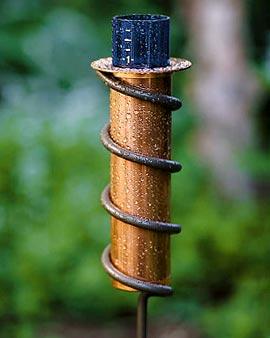
rain gaugeI searched the internet for ages looking for a tropical-sized rain gauge with no luck. Some gauges are very large but still only measure 5-6 inches (13-15 cm.) of rain. I fell in love with this copper design in August 2006 but it was too small. When you are in the midst of a tropical storm, you don't exactly feel like going out in the rain to empty the gauge two or three times a day.

Then in March 2007 I joked about my 55-gallon drum rain gauge. While functional, I was looking for something just a bit more attractive than that. I was going use a 12-inch straight-sided vase that I had and have a base made similar to the copper one. Anxious to get started with my gringa-obsession of measuring, one day I stuck the vase out in garden, partially obscured and protected from dogs, I thought. But nothing escapes Chloe in her domain. Need I say more?

One day we saw these huge 24 inch (61 cm.) straight-sided vases at a hardware store and bought two of them − one will get broken, right? So, half the problem was solved. I was still talking about "my" rain gauge in March 2008. Who says I don't have patience? It only took us 28 months to get this rain gauge made.

El Jefe talked to several iron workers about making it. Some didn't have the right equipment to do the curves, some didn't want to bother with a small job, and two took our drawing and measurements and just never bothered to make it and lost the drawing. (When will we learn to keep a copy?)

La Gringa's tropical-sized rain gauge, La Ceiba, HondurasWe finally found someone willing to do it. Of course, he completely ignored our drawing and measurements but it turned out nice just the same. The base is about 5 feet (1.5 meters) so that it goes into the ground very deeply and is secure even when the ground is saturated.

El Jefe painted it for me and he was so eager to put it out that I didn't get a chance to mark the inches on it. I'll do that when this rain stops (check back with me in 6 months or so) and in the meantime, I'm carrying a ruler out there to measure.

I like it. I'm happy.

By the way, from sometime early Thursday morning until Friday morning, we had a whopping 16 inches of rain (41 cm.)! And that is a fact, not a guess.

March 19, 2013

2012 La Ceiba, Honduras rainfall statistics

La Gringa's tropical-sized rain gauge, La Ceiba, Honduras
La Gringa's tropical-sized rain gauge
La Ceiba, Honduras

I haven't mentioned my rainfall statistics in a long time. I check my rain gauge every single day and have done this for 4-plus years! I keep a daily spreadsheet and update my La Ceiba rainfall tables on the Blogicito every now and then. Can you tell I was a former auditor? I like to keep track of those numbers.

I don't have one of those fancy electronic weather stations. I just do it with my tropical-size 24-inch (610 mm.) rain gauge and a ruler marked to the 16th of an inch. So don't expect that it will be accurate to a millimeter, but I think it is good enough for gardening or tourist purposes. I try to be accurate. If it is between marks, I estimate a 32nd of an inch. ;-)

Here is the 2012 update:

March 7, 2007

Rain gauges

When you move to a foreign country, there are a lot of adjustments to make. You have to change your thinking even about something as simple as a rain gauge.

First of all, I don't know anyone here who would ever dream of measuring the rain. Even the guy at the airport who records the official temperature doesn't do it.


Typical U.S. rain gauge,
measures 5 inches of rain (12.7 cm.)


Honduran rain gauge, 55 gallon drum


rain gaugeI never have made that rain gauge I talked about way back here. It will be like this, without the copper part. I have an 11 inch (28 cm.) glass vase (which means I may still need to empty it two or three times a day!).

I just need to get the iron part made. I'll have to tell the iron guy that I'm making a vase to put plastic flowers in. He'll believe that.

As long as the vase is straight-sided, I just need to mark the inches on it, right? That will give an accurate measurement, won't it? Darn! I need to get on that project!

January 3, 2010

2009 Rainfall Data, La Ceiba, Honduras

La Gringa's tropical-sized rain gauge, La Ceiba, HondurasLa Gringa's tropical-sized rain gauge

Long-time readers have read the saga of La Gringa's rain gauge. If not, you can read a summary of the two-year saga at La Gringa finally gets her rain gauge.

I lamented that there was no official rain measurements in La Ceiba so I was determined to do my own unofficial measurements. Being a former CPA (For the crazies out there: note that is C-P-A, Certified Public Account, not C-I-A), I like numbers, facts, and statistics. Saying, "Man, we had a ton of rain yesterday!" just doesn't do it for me.


I finally have a year of rain data to give you. For those who don't know what an inch is, or those who don't know what a centimeter is, I've given the data in both measurements.

2009 Monthly Rainfall
La Ceiba, Honduras
La Ceiba, Honduras
MonthAmount (in.)Amount (cm.)
January20.12551.12
February9.12523.18
March4.37511.11
April7.25018.42
May4.06310.32
June2.7506.99
July8.00020.32
August14.25036.20
September4.12510.48
October16.50041.91
November25.00063.50
December12.18630.95
Annual total
127.750 in.
324.49 cm.


I actually began keeping the data in December 2008, which was the biggest month I've measured: 26.375 inches (67 cm.). The highest rainfall day that I've recorded so far was also in December 2008, with 16 whooping inches of rain (41 cm.) on December 10, 2008. The highest rainfall day in 2009 was October 19, with 10.75 inches (27 cm.), followed closely by November 27, with 9.25 inches (24 cm.).

The longest that we went without rain in La Ceiba was 29 days, from March 8 to April 7. We had another dry spell of 25 days from April 15 to May 9 and one of 23 days from May 21 to June 12. May is typically the driest month in La Ceiba. It is usually the only month that I have to water the lawn and even then it is often only once or twice.

I don't have any prior year statistics with which to compare this, but my sense is that we had less than the normal amount of rainfall in 2009. That would jive with the rest of country which has experienced a severe drought this year which is badly affecting food crops.

To read more about the drought, water rationing (in Tegucigalpa), and the food shortage, please see Democracy is Hollow without Food to Eat and Mobilizing to the Face of Hunger at HondurasWeekly.

~~~~~~~~~~~

Best of the weather related articles in which you can hear me sound like Goldilocks (it's too hot, it's too cold, it's too wet, it's too dry!):

40 days and 40 nights (December 2008)
Still hot (September 2008)
How hot is it in La Ceiba? (September 2008)
Tropical rain in La Ceiba (includes video, October 2007)
Hurricanes are good for business (October 2007)
Cold front again, sorry (November 2006)

For a semi-serious discussion of the weather in La Ceiba:

How is the weather in La Ceiba?


And if you want to read all of the weather related (and earthquake) articles:

Weather

January 5, 2012

2011 Rainfall in La Ceiba, Honduras

My tropical-sized 24-inch rain gauge

In the past, I lamented that there was no official rain measurements for La Ceiba so I was determined to do my own unofficial measurements for my own information. Being a former CPA (For the crazies out there: note that is C-P-A, Certified Public Account, not C-I-A), I like numbers, facts, and statistics. Saying, "Man, we had a ton of rain yesterday!" just doesn't do it for me. It took me a while to get a tropical sized rain gauge — I had to have my own made. Prior to that, I made an effort but between the small gauges overflowing during the day and dogs knocking over or eating the plastic gauges, it was hopeless. Now I have the dog-proof 24" rain gauge shown above.

I don't have one of those fancy electronic weather stations, but, hey, it's better than nothing, right? So continuing La Gringa's official unofficial rain statistics for La Ceiba, here you go:

Monthly Rainfall La Ceiba, Honduras Inches
Month 2012 20112010 2009Average
Jan0.0025.7530.5620.1325.48
Feb0.00 8.8816.639.1311.54
March0.00 2.6220.884.389.29
April0.00 0.004.387.253.88
May0.00 0.693.754.062.83
June0.00 6.126.882.755.25
July0.00 9.1212.138.009.75
Aug0.00 7.388.7514.2510.13
Sept0.00 9.7519.04.1310.96
Oct0.00 21.8112.6316.5016.98
Nov0.00 17.0017.6325.0019.88
Dec0.00 16.1313.3112.1913.87
Totals000.00 125.25166.50127.75139.83


For those who think in centimeters instead of inches, check out the centimeter chart on my Rainfall page.

The most unusual La Ceiba, Honduras, rainfall activity in 2011 was a severe drought in the spring time. Our rainy season is roughly September through March and May is usually the month with the least rainfall, but in 2011, we had not a drop of rain for a 48 day period from March 19 through May 5. We had a few sprinkles in May but no real tropical rain until June 6 when we received a much appreciated (by the thirsty tropical plants) 1.5 inches.

The days with the largest amount of rain were January 15 with 9.5 inches, January 22 and 28 with 3.5 inches each, February 11 with 5.5 inches, September 10, 3 inches, October 7, 3.75 inches, December 9, 5.25 inches, and December 10, 3.25 inches. The largest rainfall day is much reduced from the past in which I recorded 16 inches in December 2008.

The number of rain days per month were: January 12 days, February 7 days, March 4 days, April 0, May 4 days, June 7 days, July 22 days, August 11 days, September 13 days, October 18 days, November 18 days, and December 21 days, for a total of 137 days. Many of these days, however, were just a light afternoon sprinkle that dried up in 10 minutes.

This part of Honduras totally missed the severe tropical storms and hurricanes this year and we had no lengthy periods of heavy rain days. I think we only had one or two days of mopping up rainwater from leaky windows this year. What a treat!

Weather in general

I have a little weather widget in the sidebar which gives the current La Ceiba temperature and "real feel" (in the far right column, about 6 clicks down). You can also click the links in the widget to get the Accuweather forecast.

My monthly rainfall tables (in inches and centimeters) can be found on this page. I keep a daily chart but usually only update this page at the end of the month.

How is the weather in La Ceiba? gives an overview of the weather in this part of the country and links to a good overview of Honduras weather — which despite what many websites imply, is not the same all over the country. "When is the rainy season?" cannot be answered without first asking "What part of the country?". Here is an overview from Countries of the World:

Although all of Honduras lies within the tropics, the climatic types of each of the three physiographic regions differ. The Caribbean lowlands have a tropical wet climate with consistently high temperatures and humidity, and rainfall fairly evenly distributed throughout the year. The Pacific lowlands have a tropical wet and dry climate with high temperatures but a distinct dry season from November through April. The interior highlands also have a distinct dry season, but, as is characteristic of a tropical highland climate, temperatures in this region decrease as elevation increases.
And to skim through everything I've written on weather (and earthquakes), check out the 'weather' topic.

August 14, 2006

Rain, rain, go away!

La Ceiba gets something like three meters of rain a year. Maybe more. I don't think anyone really keeps track of it. And where we live, I guess because we are closer to the mountains, we often get rain when they don't in town. I know that in December 2005 we received more than 20 inches in four days. I had a 5 inch plastic rain gauge and it overflowed every day.

Since then, Chloe the rottweiler decided it would make a nice snack. I need another one! A big one. I've been searching the internet, and do you know that no matter how large they are, almost all rain gauges only measure 5 or 6 inches of rain. I have an idea to make one, an attractive one of glass and iron (non-snack materials) that would measure 12 or more inches. Kind of like this without the copper. But like most of my ideas, it may be another year or so before I get around to it. I should do it now, though, before the real rainy season starts.

In town, an hour of rain can, and often does, flood some streets to knee level − hip level after a few hours of heavy rain. Our house is on the highest street in the colonia and our property and the areas around us have good drainage, so we never have to worry about flooding, thank goodness! We only have to worry about rain coming in the windows.

For some reason I don't understand, rain usually comes after 4 p.m. During the dry season, we rarely get more than a sprinkle during the day. Even during the rainy season, it is more apt to rain in the late afternoon or evening, although it can rain for days on end. The past two months, we generally have received at least one good heavy rain and several smaller rainstorms a week. We've only had to water the yard a couple of weeks in May. It seems an unusual amount of rain to me but maybe it is only because we have been painting the outside of the house and have noticed the rain more.


When this little mountain in the center....


begins to look like this....


.... we know that rain is imminent. This is a picture of an average rain coming off the roof. I feel selfish with so much rain (during the dry season yet!) so give me your location and I'll send it to you.

August 16, 2009

It's back! Rainy season

rain, La Ceiba, HondurasNow, that is rain!

Rainy season has started a little early in La Ceiba, Honduras. Yesterday we had about 2 inches of rain (5 cm.) and at halfway through the month, we've already had almost 8 inches (20.3 cm.). It actually rained three separate times yesterday which is unusual for this time of year in La Ceiba. Generally, it only rains after 4 p.m. for some reason that I don't understand but like very much. I know this because of August construction and painting projects.

This late afternoon timing makes it nice for tourists who can do all the outdoor activities unhampered during the day and sit under a champa (palm frond roof) at a restaurant in the evening. Actually, when it does rain this time of year, it is usually only for maybe an hour. Nice, huh?

I love rainy season as everything turns bright green and looks so fresh and clean. Plants and trees seem to grow 12 inches (.3 m.) a week − a slight exaggeration, but not too much (except for my mangosteen tree).

Another reason to love rainy season is that the temperature cools down somewhat. It has almost been chilly at night, but keep in mind that my blood has thinned in the tropical heat so that over 85° F (29° C) feels hot and anything below 80° F (27° C) feels cool or even cold to me. Quite a change from Texas where the temperature might vary by 40 degrees in a day. ;-)

La Gringa's tropical-sized rain gauge, La Ceiba, HondurasSince there doesn't seem to be any official recording of rainfall in Honduras, I've been keeping track of the rain with my handy dandy tropical size (24" - .61 m.) rain gauge.

You can follow the count under "La Ceiba Rainfall" in the sidebar. I usually only update this page at the end of the month.

March 1, 2009

When a cup is not a cup

Measuring cups
When is a cup not a cup?

When the measuring cup is made in China!

I broke the handle off my old 4-cup plastic measuring cup. I used this large one quite a bit, to measure beans or pasta and to mix up liquid ingredients so I had to get a replacement right away.

I bought this one at Paiz grocery store. They actually had two different styles which appeared so different in size that I was a little suspicious about their accuracy from the beginning.

One day I was trying to figure out how to mark the measurements on my rain gauge. I discovered that the glass container isn't completely level on the inside bottom − something I didn't notice when I bought it. :-/ I was thinking that if I could figure a standard measurement for an inch of rain, I could pour that amount in and mark a line for the first inch, half inch, etc.

La Gringa's tropical-sized rain gauge, La Ceiba, HondurasLike, for example, if I determined that one cup of water added exactly an inch to the container at a higher level, I could pour in one cup and mark that first line even if it measured more or less than an inch with the ruler. After the first inch, an inch of liquid is an inch of rain. Does that make any sense? I'm probably not explaining it very well. Theoretically, I think it SHOULD work since the sides of the container are perfectly vertical.

Anyway, I played and played and played with that thing and it never came out the same. I thought I was losing my mind. I would add exactly one inch to the container and then check the measuring cup to see exactly how many cups I added. I tried it over and over again. It never seemed to come out the same.

Finally I checked the accuracy of the new measuring cup by filling it from a Pyrex measuring cup to see if one cup was really one cup. It wasn't! The first cup is actually 1 1/4 cups, while the rest measure exactly one cup each.

March 9, 2008

Rainy season reappeared

rain on the windowRain on the window - click for a closer look

It rained non-stop all day yesterday. We seemed to have been firmly into dry season, so the rain was welcomed by me. Checking the Blogicito's archives, I see that we had three days of heavy rain at just about this same time last year.

filling the water buckets Since we hadn't had running water since we went to bed on Thursday night, El Jefe took the opportunity to clean and refill all of our water storage buckets with nice clean rainwater.

It took only about 2 minutes to fill each 5-gallon bucket from the downpour from a valley of the roof. Just as he had filled the pila for current use and refilled most of the buckets, our running water was restored.

Oh well, you always need a fresh stash of clean water in Honduras.

He thinks there may have been a problem with the well pump. I think it is more likely that the construction workers just forgot to turn the water back on when they left on Friday and they didn't come to work Saturday because of the rain.

I'm so disappointed that I still haven't gotten my rain gauge made. (The one I talked about a year ago and seven months before that, too!) We finally took a drawing to a welding shop and the darn place has kept it for a month and hasn't even given us a quote yet.

The last time I put the 12" (30 cm.) glass vase out in a hidden spot without the iron holder, Chloe, the Rotten Rottweiler, apparently found it, picked up the vase, and dropped it on the concrete leaving broken glass everywhere so I don't dare try that again.

My new straight-sided glass vases are 24" (61 cm.). I bought two just in case one gets broken and I can't find another to fit the holder − if we ever can get a holder made. Hopefully, that will be sufficient. But, hey, we are in Honduras, where you can get iron things made or even altered pretty reasonably priced. That's a good thing.

Prepare yourself for boring posts next rainy season (September - February) saying, "We had 14 inches of rain yesterday!!"


By the way, isn't that so typically U.S. American to feel the need to measure the rain?


September 4, 2007

Felix is no match for the Honduran mountains

Tropical Storm Felix predicted path at 8 p.m. EDT
Weather Underground

Hurricane Felix slammed into Nicaragua as a Category 5 hurricane early this morning but has been losing steam after making landfall and hitting the mountains of Nicaragua and Honduras.

Felix has now been downgraded to a tropical storm. Not that tropical storm force winds (39-73 mph/63-119 kph) are anything to sneeze at, but it was greeted as great news by the local television stations.

Now for you hurricane neophytes (Floridians can skip this part ;-) ), let me point out a couple of things about the map above. The large circles don't mean that the storm is getting bigger as it progresses. It just means that the further out in time that the predictions go, the less accurate the predictions are. The possible tracks that the storm may follow could be further to the north or south part of those circles.

Also, be sure to compare the color of the little swirl in the middle of the circles with the chart at the top and you'll see that tropical storm Felix is expected to be downgraded further to tropical depression Felix. That's good. (BTW, I just learned all this stuff in the past few weeks and it occurred to me that some of you might not understand either.)


This is the latest from the National Hurricane Center:

HURRICANE FELIX DISCUSSION NUMBER 18
NWS TPC/NATIONAL HURRICANE CENTER MIAMI FL AL062007
500 PM EDT TUE SEP 04 2007

FELIX CONTINUES ITS TREK OVER LAND AND THE CENTER IS NOW APPROACHING THE HONDURAS BORDER. THE CLOUD PATTERN HAS REMAINED QUITE WELL ORGANIZED UP TO THIS TIME AND THERE ARE STILL SOME IMPRESSIVE SPIRAL BANDS EVIDENT ON SATELLITE IMAGERY. HOWEVER...THE CYCLONE WILL BE ENCOUNTERING SOME FORMIDABLE MOUNTAINS OVER THE NEXT 24 HOURS...SO RAPID WEAKENING IS LIKELY. THE SYSTEM SHOULD BE REDUCED TO A TROPICAL DEPRESSION TOMORROW. MY INTENSITY FORECAST CALLS FOR A SLIGHTLY FASTER RATE OF WEAKENING DUE TO THE PRESENCE OF HONDURAS' HIGH MOUNTAINS. DISSIPATION IS LIKELY IN 36-48 HOURS...IF NOT SOONER.


Here in La Ceiba, the rains have become more steady and, at times, heavier, but still no winds. Some weathergirl I am! I meant to put out my giant rain gauge and completely forgot. I put it out at 6:22 p.m. and I'll report tomorrow what we have.

Here are a few new reports. The times are Honduran time, which I think right now corresponds with US Mountain time. I'm including the Honduran map again so you can compare the reports with the locations:

Tegucigalpa: I hear the rain slowly fall from my roof in my house. Nothing heavy right now. TV says we still have to be on the lookout for the next 24 hours. But right now it hasn't actually "rained" , only drizzle , drizzle , drizzle. No wind or anything like that. --Angel (8 p.m.)

Siguatepeque, Comayagua: The weather has turned cool no rain at this time. Clouds moving SE fairly fast. Satellite shows we are in between two of the major feeder bands right now. Will fire up the Isuzu later and make a recon run checking out water flow at some critical bridges.. They don't have water gauges here but you can get a idea from the trash in the trees from previous
high water conditions. Will give the river conditions here in town later tonight. --Dennis (6:45 p.m.)

San Pedro Sula, Cortés: The mayor, interviewed on TV, said that they had received only about 1 1/2 hours of heavy rain but their concern was when the rain falling in the mountains comes down in the rivers.

Tela, Atlantida: Intermittent rain right now. The skies were partly blue at sunset. I cannot believe the internet is still working. --A's Daddy (6:30 p.m.)

Tocoa, Colon: I just spoke with a niece (who is 13) and she said that it had rained, but that it had
stopped, and all in all they were fine. They live in Barrio El Tamarindo. --Jen (6:00 p.m.)

Roatán, Bay Islands: All reports have been that they have received sporadic rains and no heavy winds.

Gracias, Lempira:
Our power was off for a couple of hours this afternoon - not the whole city, just our neighborhood. Since it is back on right now, I thought I should take this opportunity for a brief update. It has been raining here since around 3:30(our time), but not very hard. The temperature has dropped and it is quite pleasantly cool. We had a bit of a breeze as the rain first started, but no real wind, and there's not even a breeze now.--Trish (5:45 pm)

Other areas: I don't have any specific reports but I've had the TV on all day. They have been taking reports by telephone from officials all over the country. They mostly report light or heavy intermittent rain and really no serious problems anywhere in the country yet. I heard a report that 25 homes were destroyed in La Mosquitia near where the hurricane hit but there were no deaths.

I haven't heard about any power outages anywhere except for the one Trish mentioned above. I think we are all thrilled and amazed that we have maintained power and internet connections so far (fingers crossed), especially those of us in La Ceiba and further along the north coast to the east, since our electrical power seems to be so precarious even under normal circumstances.

Mel (President Zelaya) has definitely earned some points with the public today.
I've been impressed with the reporting and organization and planning of COPECO (the national emergency agency) that we are hearing about on television. Matthew saw it in person in Juticalpa and was impressed, too. Of course, they haven't had a real test yet, but I feel much more comfortable that there IS a plan and that people who need help will get it after watching TV yesterday and today.

Honduras isn't out of danger yet because of the threats of flooding
and mudslides from the rain falling in the mountains, but the prognosis looks much better than yesterday.

Think "dry."

September 30, 2010

Heavy rains in La Ceiba

Photo, about 3:30 pm, September 30

The noise is deafening and really interfering with my Spanish comprehension of the Ecuador news. If you don't know about the Eucador news, I've posted a bunch of articles on Facebook and Twitter. Follow me!


Here is the same shot at 4:00 p.m., 30 minutes after the photo above. The creek is overflowing but it is much below the level of the few houses around here. It is probably more of a danger downstream.


Here is the view about 4:30 p.m. The rain has slowed but not stopped. The grading that they have done for this new road is completely washed away.


Luckily we discovered that our rain drain in front of the garage was stopped up before the garage was completely flooded. (Driveway is on the left of the grate; garage is on the right.) This excellently designed in-ground gutter about 8 inches deep connected to a 4 inch drainage tube has protected our garage from flooding for 8 years. We have to keep a screen over the end of the drainage gutter to keep the tube from clogging up with leaves, dirt, plastic, frogs, birds, and baby chicks. (Yes, I have pulled all of those things out of the gutter.) The water was only about an inch deep, but it had reached about two feet into the garage. If this had been at night and we hadn't noticed, I hate to think what would have happened.

I haven't gone out to check the rain gauge, but peering at it from the terraza, it appears that we have had more than 6 inches, possibly 7 inches, in the past 2-3 hours. There is no doubt that downtown La Ceiba is flooded as it only takes about 20 minutes of heavy rain to do that.


Most ironic of all, we have been ten days (10 DAYS!) without running water. While we have none inside the house, we have more than we need outside. Looking at the bright side, it only takes about 2 minutes to fill a 5-gallon bucket in the rain. That's good for two toilet flushes. ;-)


Update 4:50 p.m.: I spoke too soon. The rain has increased in force again.


Afterthought: Those photos are a perfect example of how the flooding and mudslides are NOT natural disasters, but man-made disasters. There is no flooding or mudslides in my yard or any place else I can see from the dryness of my house. Why? Because they haven't been cleared by man
of all grass and trees and all the natural protection from flooding. The area in these photos had been cleared for a new road, but are a good example of what is seen in the mountains and elsewhere in Honduras.


November 4, 2008

Weather - more of the same and I'm cold

We are going to reconstruct"We're going to reconstruct the country."
(In case you don't know, those are hurricane names)
Cartoon by: Dario Banegas, La Prensa, Honduras

The rain, floods, and washing out of roads and bridges continue in Honduras. I put out a 5-gallon bucket to measure the rain - after the worst of it was over - and we've had an additional 10.5 inches of rain in the past 4 days, assuming that Chloe the Rottweiler didn't drink some of it. That much rain is a big problem because the ground is so saturated, the water can only flow to the rivers, which are already overflowing.

The weather has been really cold and wet in La Ceiba and we've barely seen the sun for 2-3 weeks. I've been wearing sweat pants and socks for the past three days and flannel pj's at night. I'm convinced that I have that mental disease - what's it called? SAD? The one where people feel good when the sun shines and are depressed when its cloudy for long periods. Luckily I live in La Ceiba were we normally don't get more than a week or two of this kind of weather each year.

The humidity has ranged from 95-99% for the past two weeks according to my gauge. Everything in my house is molding: furniture, doors, clothes, shoes, light switches, packaged food, the outside of the house, the fence, the sidewalks, and on and on.

I live in a relatively dry house with (crappy, leaky) windows and have warm clothes to wear. Lots of people don't have either. I feel especially depressed in that I believe that these weather disasters and the poor who suffer from them are used to suck more money into the corruptos' hands, without the corresponding help to the poor or improvement to the conditions that cause these problems to start with. I would guess that some of the things that need to be done to prevent these disasters could have been paid for 2-3-4 times by aid from other countries, which is what I think Dario is alluding to in the cartoon above.

You can see some photos from the Trujillo area at Así es la vida, a Peace Corps worker's blog, and Hope for Honduras, a missionary blog. Dave from Helping Honduras Kids sent me this photo.

Cangrejal river road washed out, Honduras
This is − or was − the same road that we traveled in the Cangrejal River road trip series of articles, so if you take a look at those articles, you can see how the road and the river normally looks. Dave, who has lived in La Ceiba for more than 30 years, had this to say:

"This is the Cangrejal river road above Playa Venado (well before El Naranjo). The washout is less serious this time, but for the moment only bikes, motorcycles and pedestrians are able to cross here. Buses and cars are not able to get by, so the people in the cuenca are cut off. There are about 22,000 people that live in the Cangrejal river area. It will take a while before the gov't sends equipment to repair this damage.

"Back in the seventies, it could rain hard for two weeks and the Cangrejal river never came up so fast and furious as it does now with just 16-18 hours of steady rain. Too much deforestation has occurred. Not good news for anyone."


It's all a big depressing mess and now to make matters worse, Tropical Depression 17 is headed for Honduras. It's expecting to become a tropical storm in the next 24-36 hours and may drop 2-3 inches of rain on Honduras, or up to 6 inches, according to the National Hurricane Center.

I'll leave you with this. Read carefully.

Foreign aid might be defined as a transfer of money from poor people in rich countries to rich people in poor countries.
--Douglas Casey, Classmate of Bill Clinton at Georgetown University


August 1, 2011

Rainfall July YTD 2011

Mountains, La Ceiba, HondurasMountains behind the pineapple fields

I updated my rainfall table for July if anyone is interested. We've been getting rain almost everyday, but mostly very light. It usually rains between about 4-6pm for a few minutes, hardly enough to register in the rain gauge. Often by the time I go around shutting windows on the east side of the house — the direction the rain almost always comes from — it has already stopped.

I always think that it is perfect timing for the tourists: Beautiful sunny days and then a little rain around the time they are going back to their hotels to get ready to go out for dinner.
Home

Related Posts Plugin for WordPress, Blogger...
