Showing posts with label in the news. Show all posts

January 6, 2014

Price increases and mysterious changes to the new tax law


Honduran news is announcing price increases right and left due to the modest increase in minimum wage, electricity increases, and the massive new tax law which includes an additional 3% sales tax (for a total of 15%), income tax increases, fuel tax increases, loss of import duty and tax exonerations as well as new taxes on many previously tax-free items.

Minimum wage

The legal minimum wage varies based on the size of the business (number of employees) and the category of industry. In businesses with 1-50 employees the increase will be 5%. For businesses with 51-150 employees, the increase will be 6% and for businesses with more than 150 employees, the increase will be 7.5%. Slightly larger minimum wage increases were also set in advance for 2015 and 2016.

As a middle of the road example, the wage for category 7 (retail, hotel, and restaurant workers) in businesses with 11-50 employees will be about L.7,300/month in 2014 (~US $354/month) or L.243 per day (~US $11.80/day), or slightly less than US $1.50 per hour. Three exceptions are agricultural workers, maquila (factory) workers, and those in special "regional" zones who will earn much less. I'll be posting another, more detailed article about minimum wage in the next few days.

Nacer en Honduras has the Ministerio de Trabajo tables (complete with obvious typos) posted here. I haven't been able to find a copy of the law posted online yet – not even on the Ministerio de Trabajo website – but hopefully the typos were corrected in the final published version.

April 23, 2013

Honduras' Gag Law

President Porfirio Lobo
President Pepe Lobo, "What's the worry? It's for democracy!"

President Lobo is pushing hard for a 'gag' law that would seriously curtail freedom of speech and freedom of the press in Honduras, in emulation of what Hugo Chávez accomplished in Venezuela. Under this proposed gag law, media sources speaking critically of the government could face fines in the millions and even loss of their license under what the press is calling confiscatory measures. The proposed law is said to call for a censure committee and to also give the President discretionary rights to regulate all media, including deciding what is information and what is not, who is granted frequencies and who is not, as well as the final discretion to revoke or confiscate media as he sees fit. While the law will apply to online news sources, it's unclear whether it could be also applied to personal blogs.

While Lobo claims there is no intent to previously censor any news or confiscate private property, fines for violating the new rules range from 3% to 5% of gross annual income! The penalty for repeat violations can mean license revocation. Self-censorship among reporters is already a huge problem in Honduras where dozens of radio, television, and print journalists have been murdered in the past 10 years and where lucrative government advertising contracts can make or break a radio or television station and likely has a major effect on the slant given to the news.

December 19, 2012

'Technical' coup against Supreme Court (Part 3)

Juan Orlando Hernandez, President of Congress, with Porfirio Lobo, President of Honduras
Juan Orlando Hernandez (left), President of Congress,
with Porfirio Lobo, President of Honduras
Photo: El Heraldo

What is behind the coup against the Supreme Court?

President Porfirio Lobo and Congressional President Juan Orlando Hernández (JOH) have been at odds with the Supreme Court ever since their administration began. The Sala Constitucional and/or the full Supreme Court have ruled seven times that projects of this administration were unconstitutional, not really surprising since this Congress is known for mentioning a law one day and passing it the next without even allowing its own members time to read and analyze it. Government contracts have been approved without congressmen even being allowed to read them.

Lobo has proposed, among other things, instituting his own judicial review board to review and presumably reverse rulings of the court. Congress has ignored decisions of the court in the past. The 2010 issue of Canal 8 (television channel) [my summary and followup in english] is just one example of the blatant lack of respect for the court's decisions and the executive and legislative branches' use of emotional and nationalistic propaganda to sway public opinion.

The situation has become even more heated in the recent months with the court's ruling that the charter cities law was unconstitutional and in recent weeks with the police purification law. After the decision, in a meeting of his ministers, in front of media cameras, he ominously announced the inclusion of the four magistrates one by one by name on the government's "black list". In addition to public statements that the court was on the side of criminals and against security for 'the people', President Lobo even took to tweeting threats against the court [english]. The court responded by issuing a press release in which they classified Lobo's statements as a direct threat against the court. Pepe wanted to take the purification law to a referendum of the people, but that would have taken too long so he used Congress to fire the judges instead.

Every judge who has spoken about this issue has clearly stated that absolutely no one is against police purification, that it is badly needed, but that any law enacted to do so must not violate anyone's constitutional rights.

Why now?

Marvin Ponce clubs the court
Cartoon by Dario Banegas, La Prensa
Late on Tuesday night (December 11), La Prensa reported that UD party Congressman Marvin Ponce [article in español] was the first to sound the alarm, stating "There is a real political crisis in Honduras and it is possible that we will go to the middle of the night to make decisions regarding the Supreme Court of Justice". He confirmed that congressmen wanted to fire at least four judges and that with the support of Yani Rosenthal's congressmen, they would have the 86 votes needed.

Congressman Ponce said that at stake is the presidential candidacy of Juan Orlando Hernández, which is being disputed by the other front running Nacionalista candidate Ricardo Álvarez, current mayor of Tegucigalpa. Álvarez disputed the results of the November 18th Nacionalista primary due to numerous irregularities but after receiving no satisfaction from the election commission (TSE), he announced that he would ask the court to rule that a vote by vote recount was needed. "The problem is the division in the Nacionalista party and Juan Orlando believes that the court will keep the party divided. The Nacionalistas seek to avoid that this [Álvarez's] appeal will reach the Supreme Court", explained Ponce. While Ponce exposed this ulterior motive to the media, in the end, he voted for the firing of the justices.


December 17, 2012

Congress to pass new police purification law

The three two powers of state
Cartoon by: Dario Banegas (congressman!), La Prensa, Honduras


Just a quick one to apologize for not getting that last part of the "coup" story posted. The last part has turned into two parts. Research, including watching a bunch of television news and talk shows (the juiciest stuff comes from the latter) has taken time and more annoying internet outages haven't helped either. I'll get at least one part posted tomorrow for sure.

Today's update:

Wasting no time today, Monday, December 17, Minister of Security Bonilla introduced a new extension of the same police purification law [español], which still includes polygraph testing. A congressman told reporters that the law will be discussed and approved in Congress tonight or no later than tomorrow. When a reporter questioned the congressman about the court finding the original law contained many errors, the congressman said, "No, no, no! The law didn't contain errors. Remember that the court erred in reviewing a law which had already expired." So, that's that. History is being revised and it has only been a week. I'm watching the session right now on the government propaganda channel, complete with JOH campaign commercials paid out of the public budget during the breaks.

Right now Julieta Castellanos is presenting the Observatorio de la Violencia report which states that 149 people have been murdered by the police in the past 23 months.

Quote of the day

Eduardo Stein, former President of the Truth Commission which investigated the facts before, during, and after June 28, 2009, has the best quote. Referring to Honduras, he said "We are in front of another train wreck. Maybe some engines change, but they are on the same road, again in confrontations with consequences that could not only be terrible for the Honduran people, but for the entire region."

As recommended in the final Truth Commission report, he said that "more than ever" Honduran authorities must develop the "appropriate mechanisms" in the law and constitution so that any conflict between the powers can be resolved through the law and not coups or interference in another branch of government.


December 14, 2012

'Technical' coup against Supreme Court (Part 2)

Juan Orlando Hernádez, Porfirio Lobo, Jorge Rivera Avilés, Luis Rubí
in cadena nacional today
image: El Heraldo

[See Part 1 here]

What has been the reaction to firing of Supreme Court judges in Honduras? Who knew what and when? Who is behind this latest action of congress?

JOH claims organized crime conspiracy

Juan Orlando Hernandez, Honduran President of Congress
Juan Orlando Hernández,
President of Congress and
Nacionalista presidential candidate
image: El Heraldo
About 8:00 a.m. on Wednesday, Congressional President Juan Orlando Herández (JOH) called in [audio in español] to a morning television talk show to justify the firings by making an accusation that these judges were involved in an organized crime controlled conspiracy with police and Fiscales (public prosecutors). He wouldn't say where he got his information or name any other names. This accusation has been more vaguely made in the past numerous times, but has never resulted in investigation or prosecution. Additionally, whatever information that the accuser (generally the President or a congressman) has, it never seems to reach the Attorney General for an official inquiry. Similarly, an accusation has been made that approximately 40% of the members of congress are involved in or controlled by organized crime.

Interestingly, the investigation report [español] given to congress did not make any accusations of wrong-doing or criminal activity by the judges. The report stated that their decision was made two days after the law expired, implying administrative irregularity because the law was no longer in force, but they did not fire the fifth judge who voted the way the Congress and President wanted. The report declared that the court's decision was "incongruent with the security policies of the legislative and executive branches of government" and could result in huge legal claims from those who had already been fired under the law. Yesterday it came out from the Supreme Court that JOH had sent a note requesting a report on the four judges sometime after the vote to fire them had already been taken. Of course, no report has yet been sent back to congress.

Wednesday's scheduled hearing on the police purification law by the full Supreme Court was postponed until Friday. The court system closes down for two weeks at the end of every year. Today it was announced that the review will be postponed until next year, giving the 15 judges plenty of time to ponder whether or not they, too, want to be fired and publicly defamed.

'Technical' coup against Supreme Court (Part 1)

"They gave a coup to the court"
La Prensa headline, Wednesday, December 12, 2012

I woke up Wednesday morning to a newspaper with a 2-inch headline which said that the Honduran Congress had executed a "technical" coup d'etat against the Supreme Court. I also woke up to no electrical power, just as on the morning of June 28, 2009. While short power outages are nothing unusual in Honduras, this one lasted all day. Many have been feeling a sense of deja vu lately with the events in the news. The actions and accusations flying around have been very similar to pre-June 28, 2009. I wanted to see what the television and online news were reporting! Did we have another coup in Honduras?! With constantly updated news and a series of more annoying cable and internet outages, it took me a couple of days to get this done.

Background:

Last fall when the stuff hit the international fan about crime in Honduras with the UN homicide report, there was a lot of hot air flying around with promises of cleaning up the police department in six months. Initially the police were responsible for cleaning their own house, which everyone knew was going to go nowhere because corruption goes to the highest level of the police. A new independent organization was set up, the DNIE, in typical fashion with no budget, few personnel, and basically no powers. Even back in January 2012, there were claims that the manner in which 'purification' was being implemented was unconstitutional. (See the 'Purification' section of this article.)

Congress passed a badly needed police purification law last May. Very few criminal cases against police are ever prosecuted and fewer are successfully prosecuted. It has been well documented and it is widely known that many police are directly involved in corruption, robberies, kidnappings, drug trafficking, and even murder, as well as being under the control of organized crime factions. Police under criminal investigation and even those with pending criminal cases often continue working, wearing a uniform, and carrying a gun. (See my crime series beginning October 2011 and a series of documented police crimes in November 2011.)

The law provided the ability to test police for drug use, administer polygraph and psychological tests as well as audit their finances and to remove those who don't pass the tests. It also provided for paying them for one year after dismissal. The law expired in November 25, 2012, (with very little action taken [article in english]) but President Lobo wanted to extend the law for another six months. Only two weeks ago did officials finally begin testing police in La Ceiba, the third largest city in Honduras and the city with the highest murder rate in the country.

Potential targets of those firings filed appeals with the Supreme Court. On November 27, the Constitutional Chamber, in a 4-1 decision, declared the law unconstitutional because it does not allow for the right of police to defend themselves against the charges, i.e., there is no due process. As provided by law, the issue was to go before the entire 15-member Supreme Court for a final decision on Wednesday because the initial decision was not unanimous.

January 10, 2012

Liar, liar, pants on fire

Honduran congress
Honduran congress


Here I am, lowly blogger, doing the job the Honduran media should be doing — exposing the big fat lies of Honduras' elected representatives. [All links in Spanish unless otherwise noted.]

On Monday I received a mea culpa sent out by the congress stating several things, the most amusing of which was that they will set up a committee to make sure that in the future they read the things they are approving before they approve them. Now there is a concept! They blamed approval of the Securiport contract and new $34 security tax on the President and told us that they are always working for the pueblo. Numerous congressmen have been in the news crying that they didn't know what they were voting on, blaming it on President Lobo, who later decided not to the tax after the uproar, and President of Congress, Juan Orlando Hernández, who interestingly did not vote at all on the issue.

The missive also stated that the decree was passed at 2:26 in the afternoon, not in the madrugada (middle of the night) as the news had reported (though the new exit tax passed the same day was passed at 11:30 pm). As proof, they included a link to the main page of the voluminous Congressional website. So after navigating the congressional website, I found the 24 pages of files of attendance and votes for December 2011, a mere 472 PDF files. Luckily, the latest file uploaded and one of the only file names with a date, was the attendance record for December 14.

Plowing through the records

Imagine my surprise to see that the "attendance" record is 114 pages long, logging all the ins and outs, requests to speak, time of speaking, etc. of the congressmen during the approximately 14-hour session. It was in time order, not by name. No way could I determine who was there without doing a multi-page spreadsheet logging the 114 pages of ins and outs, and I wasn't interested in doing that.

Even the 10-page individual records of the votes on each issue are not in alphabetical order, making finding the several hundred votes for that day very difficult. Each voting record is in a separate 10-page PDF image file that can't be searched and is not in alphabetical order!

The 472 PDF files have titles like "Art. 52" and similar which give no indication of what the issue was much less any details within the files. Article 52 of the constitution, Article 52 of a contract, or Article 52 of a law or regulation, and which one and what was the change? Your guess is as good as mine, there is no information whatsoever.

So while this congress continually claims to be the most transparent ever, they manage to present mountains of information in such a way that it would take a full time staff to find and wade through and document their votes and still there is not enough information for even the congressmen to determine what they were actually voting on.

They also like to refer to their televised sessions as transparent but the truth is that even if you have the time and patience to watch their TV channel 24 hours a day (and be subjected to hours of Juan Orlando Hernández government-paid presidential campaign propaganda commercials), you still won't know how congressmen voted unless you take a photo of the TV at each vote and have the seating chart (by which the for and against votes are shown in green or red) memorized to compare against the photo later. There are no names shown for votes, so while a diputado (congressman) could publicly rail on and on against something during the televised session, he could actually electronically vote for it and no one would know unless they have the time to search the voluminous files at the website.

The congressional website has only posted four laws in the past 5 years and none at all for this congress which started in January 2010 and brags that they have passed more new laws than any congress before. What were those laws and where are they? Under "Conozco su diputado" (Know your congressman), pages of photos with a name underneath are presented with no information about what departamento (state) they represent, what they stand for, what their voting record is, nothing at all except which party they are with. If you want to know who your elected diputados (congressmen) are, you won't find out at the congress website, because the sad truth is once you elect them, they cease to be your representatives and become the "party's" diputados.

Information on motions, dictamens, decretos, actas, and so forth are similarly lacking with little or no information posted in 2010 and 2011 and none in 2012. The little information that is there is presented in such a manner that only the most determined would spend the days or weeks required to sift through. Only in the rarest of cases are proposed laws made public in advance or published on the congressional website after they approved. So you might find out, as I did for example, that they approved several acts conceding "amnesty for debts with the state" (there were several of these in the madrugada on December 14), but good luck finding out who got the amnesty or for how much.

One of the biggest factors of non-transparency is La Gaceta, which is the government's official publication of laws, regulations, and so forth, which could easily be online but is not. Individual organizations of the government include publication of some laws on their websites, but you have to be a detective to find them and often they are not posted for months or years after they are passed. I know because I've spent more hours than I care to admit trying to find the text of various laws. Transparent? No way.

Who voted how?

In Big Brother comes to Honduras [in English], I mentioned that two of the three congressmen that Proceso Digital interviewed didn't know about the new US $34 travel/migratory/security tax and the third voted against it.

From Proceso Digital's interviews earlier this week, here is a translation of what they wrote:
"Meanwhile, the Liberal legislator Waldina Paz expressed that she voted against this decree. "I am against more taxes. That was approved in Interairports package. I asked them if what they wanted was the buildings constructed with dollars of the people," she said."
Go to page 8 of the vote results and you'll see that Jariet Waldina Paz also voted 'si' on this issue. She did vote 'no' on the increase to the InterAirports exit tax.

Proceso Digital also wrote (translated):
"Another of the interviewees was the Nationalista parliamentarian Antonio Rivera, who said he was unaware of what the decree in question referred to, adding that "I have no knowledge of the decree because I was not present at the parliamentary session."
Not only was Diputado Rivera present, but he voted in favor of the decree. Go to page 4 of the vote results and you'll see that Antonio César Rivera Callejas voted 'si'. Rivera did not vote for or against the InterAirport increased exit tax. He now says he doesn't remember voting on it. He's joined by Diputados Carlos Martínez Zepeda, Celí Discua Elvir, and others who say they just don't remember voting on this issue.

Scanning through the yes votes, a couple of diputado names caught my eye. You might think that congressmen elected in tourism areas would look unfavorably upon additional taxes for travelers which could serve to harm the tourism industry, but I found that the sole diputado for the Bay Islands, Romeo Silvestri of Roatan, and Gonzalo Antonio Rivera of La Ceiba, Atlántida, also voted in favor of this travel tax. In fact, there was only one vote against it. Of the 109 diputados present, 68 voted for the tax, one abstained and 39 didn't vote at all.

Of the other seven Atlántida diputados, only Ramon Antonio Leva Bulnes (PN) voted in favor of the increased tax. Rodolfo Irias Navas (PN), Margie Dip (Margarita Dabdoub Sikaffi- PN), Marcio Rene Espinal Cardona (PN), Daniel Flores Velasquez (PN), Jorge Alberto Elvir Cruz (DC), and María Aracely Leiva Peña (PL) did not vote at all.

Then I became curious about the votes on the other travel tax passed that same day, the increase in the exit fee proposed by the executive power and then later vetoed by the same. I waded through pages of documents to find the vote on the increased exit tax, though it was identified only as "approve 2nd modification to InterAirport contract". The vote on this issue was 88 in favor, 15 against, 8 abstained, and 14 did not vote, for a total of 125 diputados present.

Of the nine Atlántida and Bay Islands diputados, Romeo Silvestri of the Bay Islands and Ramón Leva, Marcio Espinal, Daniel Flores, Margie Dip, Gonzalo Rivera, and Jorge Elvir of Atlántida all voted for the increased exit tax to be paid to InterAirports. Rodolfo Irias and Maria Leiva did not vote.

Excuses, excuses

Some of the gem excuses that have been given to reporters:

Juan Orlando Hernández, President of the Congress: "the $34 should be absorbed by the airlines and in no manner is to affect the final users." Oh, please, that is such a huge insult to the intelligence. He also made a dismissive comment that most of the pueblo (voters) can't afford to fly anyway so it won't affect them.

Secretary of the Interior, Áfrico Madrid: "there was no public bid because Securiport is the owner of the technology." Are we to believe that Securiport is the only company in the world that provides the technology for immigration control in every airport in the world?

Olancho Diputado Francisco Rivera: He blamed the media for not reporting on the issue when it was discussed in session. Now that's really hypocritical. The media has been denied all information about this contract and only found out about the tax after the airline association was notified that they must begin collecting it. José Francisco Rivera Hernández incidentally voted for both travel taxes.

Cortés Diputado Wenceslao Lara (PL): "I am sure that this Nacionalista government is the worst that we have had in the history of Honduras, because they are in charge of disgracing our country, making our already impoverished society even more poor." Proceso Digital quotes him as saying that he voted against the new travel tax, but the voting records show that Lara did not vote on either tax issue.

Francisco Morazán Diputado German Leitzelar: lamented that they continue playing with the dignity of a noble pueblo and qualified those who approved this law as bats. "They operate in the night and sink their teeth into the heart of the Honduran pueblo." Diputado Leitzelar did not vote for or against either tax issue.

January 7, 2012

Big brother comes to Honduras


Update, January 9: President Lobo has just announced that he is suspending the sanction of this decree pending review. No mention yet what this will mean for the new migration measures.


~~~~~~~~~~~~~


Just yesterday, we surprisingly learned that another 'travel tax' was approved on December 14, 2011 (in the middle of the night, says El Heraldo), adding $17 to the cost of a airline ticket for each international passenger on entry and exit, for a total of $34. The tax is to provide for new migratory control security measures which will be put into force not only at the airports but at all immigration checkpoints in Honduras.

Last month, a law was passed by congress to increase Honduras' exit fee from US $37.80 (for foreigners) to US $60.20 but ultimately was vetoed by President Lobo because of public outcry even though it was Lobo's own decree. It was felt that the tax would have a detrimental effect on tourism and voluntourism, already suffering from the crime situation in Honduras, especially so since Honduras' tax is not hidden in the airline ticket price as many countries are, but must be paid separately at a bank in advance or by standing in line at the airport which tends to leave a bad taste in some visitors' mouths. So now instead of the $22 increase, air travelers will be facing a $34 increase in their travel costs. I don't know if the original plan was to increase air travel taxes by a total of $56 to $94 (!) or if the right hand didn't know what the left hand was doing.

The new tax is in addition to the security tax law [in English] passed in September last year which primarily affects businesses and citizens and residents of Honduras who have bank accounts or credit cards. This law, which was initially expected to generate some L.4.5 billion (about US $237 million) over 5 years for strengthening the justice system and crime prevention, still hasn't gone into effect. Some people, like President of Congress Juan Orlando Hernández, are asking why implementation has been delayed.

Honduras has contracted for 10 years with a US company called Securiport whose president is Enrique Segura, and in which a majority ownership is held by the ENSE Group. This was another one of those "emergency" situations where public bidding wasn't required and apparently not even the congress was really aware of it. Two of the three congressmen contacted by Proceso Digital didn't know anything about the new tax and the third voted against it.

Africo Madrid, Honduras Secretary of InteriorSecretary of the Interior and Population Áfrico Madrid said that the content and details of the contract can't be given to the public because he could incur civil, administrative, and criminal penalties since this is a matter of security. Reporters were only asking why there wasn't a public bidding process, not details of the company's patented technology, so I think that Madrid is really stretching this secrecy thing to avoid being transparent, as usual. Passing the law in the middle of the night when many congressmen were not there and keeping it under wraps for three weeks also makes it look like there is something fishy going on.

As part of the deal, Securiport will make an investment of US 31.6 million in equipment. Translated from La Tribuna, under Decreto 252-2011, Securiport will ...

"provide and install in all of the windows of migration attention, a system of control of the entrance and exit of the persons to and from the national territory, which includes the scanning equipment, computers, programs, training of migration personnel, adaptation of installations and server requirements for the digitalization of the images, archives, obtaining and comparing of fingerprints of said persons. This also includes the installation of equipment and programs based on the same technology to control the access of persons to the zones reserved to the Dirección General de Migración y Extranjería. The technology referred to is supported in the employment of ultrasound scanner developed by Ultra Scan Corporation, strategic partner of Securiport."
The decree refers to Executive Accord 29-2011 dated March 24, 2011, in which the Secretary of the Interior was authorized by the President to directly contract with Securiport for the operation of system of control of the entrance and exit of persons to or from the national territory at any of the international airports and the 22 land and maritime frontier points of the country. It also states that Securiport will be paid directly by the airlines collecting the taxes. That was a wise move by Securiport or they might have ended up like the company who formerly provided the gun registration technology to Honduras.

Secretary Madrid stated, "The charge of US $34 will serve to avoid the free circulation and entrance of persons related to organized crime, narcotraffickers, assassins, kidnappers, money launderers, and arms traffickers that have utilized the country as a center of operations due to the lack of a modern and scientific system of migration control". He went on to say that the tax would be charged only to foreign citizens. Madrid is also quoted as saying, "we don't have the economic resources so someone has to pay for it".

El Heraldo unfortunately published an article quoting at length the President of CANATURH (tourism business association) Epaminondas Marinakys who apparently did not have his facts straight. He says that all who enter Honduras will pay the $17 tax on entry and exit, that he supposed that bus passengers would be off-loaded to pay at the frontier, and even that the one million annual cruise ship passengers would pay $34 for the privilege of setting foot on Honduras soil for a day. Either Madrid is lying or Marinakys did not actually see the decree and was only supposing based on what he had heard.

Better migration controls (if they can be enforced) is probably a good thing. Based on the number of people who have been captured with 10s of thousands of dollars strapped to their bodies or hundreds of thousands in their suitcases, there have probably been lots more who got away. There is a lot of corruption in Immigration, where many agents seem to make up their own rules as they go, and where official 90-day visa renewal stamps in passports can be bought for varying prices — there is legally no such thing as a 90-day visa renewal. I've heard from various people that in San Pedro a stamp allowing someone to stay an additional 90 days costs L.2,000 (about US $105) and in Roatan about US $150. Not all immigration agents are corrupt, but many are, especially those in the outlying areas. A bigger issue than perpetual tourists are the wanted criminals who are able to get away even when there is a migratory alert out for them.

It sounds like those who have been living 'undocumented' in Honduras might need to get their paperwork in order. Or maybe not. You never know how these things will work out in practice in Honduras. Where there's a will (bribe), there's a way. If only some of the brain power used by corruptos in thinking of ways to lie, cheat, and steal was put to use pulling Honduras out of poverty instead!

On a final ironic note, with these new measures, Honduras may be protected from its criminal visitors, but who is going to protect its visitors from Honduras?

January 6, 2012

What has been going on in Honduras?

Pepe Lobo, Esdra Amado López, Hugo Chávez
President Pepe Lobo, Esdras Amado López, 'journalist',
and Venezuelan President Hugo Chávez


The following are some tidbits about what has been going on in Honduras lately to catch you up-to-date after my much needed news break. All of the links are to articles in Spanish, unless otherwise noted.

Deja vu all over again

Talk about rejoining Hugo Chávez's ALBA and Petrocaribe has picked up again after Honduras failed to qualify for US Millennium Challenge program funds because of corruption, human rights violations, and other issues — which resulted in an angry response from President Lobo, just as back in 2008 when Zelaya said he wasn't getting enough cash from the US and needed to look elsewhere. Even more worrisome, Chávez is getting a direct foothold in Honduras territory, specifically the Bajo Aguán, noted for militant campesino groups and Venezuelan narco plane landings [article in English], a place ripe for Chávez propagandizing.

As Proceso Digital so delicately put it, "These funds, since they are placed in trust, beyond the strict budgetary control, are coveted by rulers not inclined to fiscal rigor." Evidence of the lack of transparency is the fact that though these funds were received in 2008-2009, the public was just informed for the first time on January 5, 2012, how much money was available from Petrocaribe (originally US $183 million and now zero), when it was spent (the last of it 8 months ago), where it went, and what it was actually spent on (we still don't know).

William Chong Wong and Maria Elena MondragónIn a press conference apparently impulsed by rumors of a 'missing' US $150 million, Minister of Finance William Chong Wong and President of the Central Bank Maria Elena Mondragón went to great pains to differentiate between Petrocaribe funds (which have to be paid back) and ALBA funds (which don't), but were only very vague about when and where the ALBA funds were spent, of which US $49.8 million supposedly remain. The ALBA funds were to be used for such things as providing housing for the poor, so you might wonder why it has been sitting in a bank account since 2008. The first article states that Honduras indebted itself with Venezuela for more than US $263 million, but second states that the current remaining amount is US $200 million. Chong Wong said that La ENEE authorities are responsible for detailing where its US $51 million was spent (since there is some speculation about misuse of funds there, too).

Also interesting is that in May 2011 during one of the many pushes for rejoining Petrocaribe [Blogicito article in English], the media was led to believe that the 2008 Petrocaribe funds were still in the bank. Yesterday in the press conference apparently prompted to dispel rumors, the public found out that the funds had actually been spent in 2009, 2010 and April 2011. Very deceitful of the government.

Pepe says Petrocaribe is a go. He likes the "flexibility" of Petrocaribe and the fact that it doesn't come with any conditions on what they do with the money or anti-corruption measures like the US money does — which he resents greatly. Putting the country into further long term debt for current consumables is not an issue for him, neither is reducing the over-inflated government payroll budget. Honduran politicians would sell Honduras to the devil himself if it meant more money in their pockets and/or more political currency for their party (more bonos — cash bonuses to give out).

Selling the farm to buy the pig
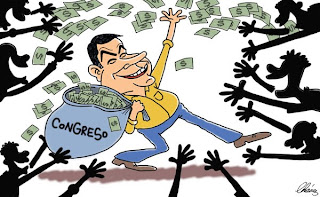
Congress raining moneyThe finances of Honduras are in dire straits. The government is unable to meet the ever-growing, exaggerated government payroll costs, and unwilling to cut expenses in this "government of austerity", which passes out jobs and cash bonos like money comes from a bottomless barrel. By one estimation, Lobo is desperate for funds because he has a failed government which has increased the bureaucracy and national budget while giving out Bonos Diez Mil without any idea of how to pay for any of it. In order to shore up the barrel before the Venezuelan funds come rolling in, Honduras will be holding two large auctions of public property in 2012. I'll bet you a dollar that we will never know who bought what or how much they paid for it!

Striking teachers

Honduras EducationTeachers' unions claim that 50% of teachers did not receive their vacation pay in December and they are already planning strikes in 2012. The Honduran public school year runs February through November and supposedly includes 200 days of classes, though most schools have not reached 200 days of classes yet in this century. Last year, some schools had as little as 80 days of classes due to teacher strikes. Even worse for the future of Honduras, high school graduates can become teachers with no university training at all. More deja vu.

Emergency!

In less than two years of his administration, President Pepe Lobo has declared 17 state of emergencies, on average an emergency every 38 days. Decoded, "state of emergency" often has nothing to do with true emergencies. It means that the government can make direct purchases and grant abusive contracts to friends, family members, convicted felons, and others without those pesky requirements to have an open bidding and qualification process as required under the Law of State Contraction. One of those recent emergencies resulted in a 16-year 100 megawatt multimillion dollar contract for electrical energy with a company (Westport Finance) who has no experience in the area of energy and had revenues in 2010 of about US $96,000 and two employees.

Misery in HondurasA 16-year emergency? Only in Honduras. "It stinks of corruption," said one congressman. Honduras government officials had the nerve to lead people to believe the contract was with the well-known Finland company Wartsilla, when in fact it was not. The contract itself was not even provided to congressmen until the night of the vote. So much for transparency.

Mañana

Henry SalgadoThe total of these emergency contracts in the past two years is said to be L.5.8 billion. Repeated complaints of fraud and corruption from citizens, congressmen, and other organizations have had no effect. Now the Anti-Corruption Prosecutor Henry Salgado (who I'm not sure has ever won a case) announced that they will be investigating whether there are any penal responsibilities related to these emergency contracts.

He also promises action in the ENP (port authority) corruption and the L. 80 billion fraud and corruption in INPREMA (teachers' retirement fund) cases within the next three weeks. Check out the reader comments on this article — no, don't bother. I'll save you the time and translate for you, too: "jajaja" (hahaha). A separate article reports that the Anti-Corruption unit has a backlog of 4,000 cases and between 10-15 attorneys to handle them! Pure show and more deja vu.

Unemployment

The unemployment rate in Honduras is somewhere around 30-40% according to various reports. However, coffee plantations, which need around a million seasonal workers, are required to fill about 100,000 of the jobs with Nicaraguans, Guatemalans, and Salvadorans because, they say, Hondurans do not want the work. Sadly, they also say that foreigners are better workers. Though this type of worker is paid by the piece (sack of coffee beans), they say that an average worker makes more than minimum wage (about L.250 per day vs. L. 183 per day) and a good worker makes almost twice that. So they say anyway. Some readers have different opinions.

Minimum wage

No work for youNegotiations between business and labor have not resulted in an agreement on the new minimum wage and it is likely that President Lobo will end up setting the 2012 minimum wage as required by law. Hopefully he won't wait until November like he did in 2010. This is a really complicated issue. While we always focus on the poverty in Honduras, the Honduran minimum wage is higher than all of the competing countries. Nicaragua and Guatemala in particular will be watching this issue and waiting for more businesses to pack up and move to their countries. (Click cartoon to enlarge.)

Taking security into the neighborhoods' hands
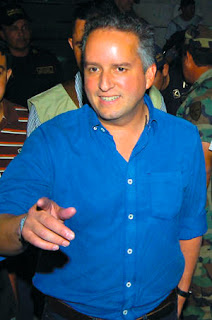
Ricardo Alvarez, mayor of Tegucigalpa, HondurasIn a program called Barrios Seguros (secure neighborhoods), the municipality of Tegucigalpa has been allowing neighborhoods to close various street entrances, leaving one or more secured or controlled entrance in an effort to slow crime. San Pedro Sula has been allowing something similar. A group of anti-corruption attorneys has filed a complaint with the Supreme Court saying this conflicts with the free circulation right provided by the constitution and laws which proclaim streets to be public property.

The Mayor of Tegucigalpa and presidential candidate, Ricardo Álvarez, says the measure is to protect lives in this wave of violent crime and that is what should be considered first. Well, why not? Honduran laws are made to be broken, though lately it appears that Honduran laws are made to protect the guilty, never the innocent.

Purification

The new commission, Dirección Nacional de Investigación y Evaluación de la Carrera Policial (DIECP), which was supposed to be the answer to our prayers about purifying the police department has done nothing except emit statements about how it isn't their job, they don't have the budget, and the law doesn't permit them to intervene anyway. It seems that in congress' rush to pass this law and appoint the commissioners in a big show to appease the public, they failed to note that the purpose of the new commission conflicts with the current internal police law as well as the constitution.

In a Diario Tiempo editorial, they wrote that those with experience knew since the beginning that the new commission would not function and that there has been no evidence of political will to intervene, purify, or restructure the justice system (police, military, judicial, and prosecutors), much less real capacity to do so. "The gangrene in the police organization, for example, starts at the base, in the police academy, and from there on up, no doubt induced at the top."

However, Pompeyo Bonilla, Minister of Security, announced this week (with no details) the upcoming separation of some unspecified number of police from the basic level to the highest levels in "important positions". Yesterday it was announced that 50 police agents and 25 officials would be fired by next week and some additional number would be rotated. That number was increased to "up to 100" today and then later an announcement was made that 52 police had been separated, including one commissioner general, two commissioners, and one sub-commissioner, and that another separation would occur soon.

Names were not given by police spokesman Ivan Mejía, who said that the law prohibits it and that the affected police could sue the state for damages, even though names have been given in the past. (I'll be watching for a leak.) These police were separated for grave faults (misconduct?), but the Minister of Security is taking no legal action against them as that is the duty of other organizations to investigate and make charges. Mejía refused to give more information despite prodding from the media. He did report that some of the fired personnel had 25-30 years with the police department.

In another blow (no pun intended), 28 new police cadets (5% of the total) were fired after their drug tests came back positive. Apparently the government is taking the position that new hires can be tested for drugs but current employees can not be forced to be tested. That isn't the way I read the law but I'm not an attorney. If that is what the law actually says, then of course it should be changed so that the public is protected, not drug-consuming police officers.

Honduras' Iron Lady

Julieta Castellanos, Honduras' Iron LadyJulieta Castellanos, Rector of UNAH and mother of one of the university students murdered by police in October [article in English], proclaimed the actions as a "fictitious purification" done to calm the public and evade real purification. Castellanos says that we need information about whether these are real firings, suspensions, or rotations, and whether these people are still receiving salary. In a strong statement in which she used words like deplorable, grotesque, and abominable, she said that the organization has had three months to destroy the evidence of police corruption, and she lamented the fact that honest police have not come forward out of fear or intimidation.

Asked by La Tribuna whether she fears being assassinated because of her constant denuncias against the police, she stated that she isn't looking for that, but that she does what she has to do. "If something happens to me it is the fault of the police, primarily señor Ramírez del Cid [National Director of Police], because there is no one more interested in something happening to me.... and no one more knowledgeable about corruption in the police since he was the former head of Intelligence."

She also pointed out that it should be easy to prove corruption of police agents and officials who live well beyond what their police salaries could provide, like with three US $25-30,000 cars and houses in wealthy areas. She also reported that as late as a few days ago, police were out in police vehicles in Tegucigalpa extorting businesses. One of those businessmen was expected to pay L. 350,000 because he was an undocumented foreigner, but when they took him to the police post to pay, he only had L.38,000.

New justice system

President Lobo announced Thursday that he will be sending a new packet of security measures to the congress soon to "make changes in the structure of the Judicial Power". I hope he reads the constitution first.

Washington Post is soooo mean

A Washington Post article, which was only the latest of many articles in the international media about Honduras' severe crime and criminal police problems, resulted in an uproar from some in Honduras about how unfair it was to write about the situation and possibly scare off tourists and volunteers.

Marco Cáceres of Honduras Weekly [article in English] called the complaints a cop-out.
"The negative publicity for Honduras worries me too, but honestly... not nearly as much as attempts by people within the Honduran government and business community to downplay the strife. The simple fact of the matter is: It is what it is; the numbers do not lie (at least not too much)."
False pride is a big factor in Honduras' failure to take action against corruption and impunity. As long as those in power are more worried about covering up the embarrassment to the country than taking action to do the right thing, nothing will change.

Stupid Capitalinos

In yet another vague and demeaning comment intended to divide the population, not reconcile it as he incessantly claims, yesterday in Comayagua, President Lobo said how good it was to be there talking about production because in Tegucigalpa (the capital), they only talk stupidities. Maybe he has a point, but by not naming names, he just insulted some 1.5 million plus Hondurans.


Phew! And that was primarily from the last 2-3 days of news. Can you see why I needed a break from the news? If you don't read or watch the Honduran news, I hope that you found this helpful.

September 15, 2011

Congress revised the security tax law

Honduran congress
Honduran congress


The Honduran Congress approved major changes to the controversial security tax law. The initial 5-year temporary law was challenged on constitutional grounds. The changes are a result of consensus among the business, banking, and political sectors and the law is estimated to collect L.2.2 billion annually (about US $79 million), of which L.1.5 billion will go to a security fund and 700 million will go toward social projects. Others from the private sector, however, project that the law could result in tax revenues of as much as L.3 billion per year.

President of the Congress, Juan Orlando Hernández, declared,"We are in a national emergency. The theme of crime is intolerable. We can't wait any longer to give a response to the people. With these changes we will assure that the Secretaries of Security and Defense, the Attorney General, and the Supreme Court will have the resources to improve their work." Honduras has the distinction of having the highest reported homicide rate in the world, with current 2011 estimates being between 78-86 per 100,000, compared to a worldwide average estimated at about 8 per 100,000.

According to the Congressional bulletin on Wednesday, some of the changes are:

  • The tax rate has been reduced from 0.3% (.003) to 0.2%.
  • The tax has been eliminated from savings accounts withdrawals of any amount for individuals (natural persons) but will be applied for debits to checking accounts with average balances above L.120,000.
  • Businesses (personas jurídicas - legal entities) will pay the tax on withdrawals on savings and checking accounts with average balances above L.120,000 or US $6,000.
  • A new annual tax will be charged on credit card renewals based on the amount of the credit limit, as follows:
  • L.40,000: no tax
  • L.40,000 up to L.50,000: L.500
  • L.50,000 up to L.100,000: L.600
  • L.100,000 up to L.200,000: L.700
  • L.200,000 up to L.1 million: L.800
  • L.1 million and over: L.1,000
  • The tax on bank loan disbursements has been reduced from 0.3% to 0.15% and will completely absorbed by the bank who emits the credit.
  • For bank transfers within the country, the base taxable amount has increased from L.10,000 to L.20,000.
  • Still excluded from taxation are international transfers (remesas).

La Tribuna additionally reports that persons or businesses involved in mining will be charged 2% (.02) on exportations, reduced from 5%.

The "Special Contribution" of mobile phone companies will remain at 1% of monthly gross income and that of casinos will remain at 1% of monthly income. International fast food franchises will be charged 0.5% on gross monthly revenue, making this the first time that fast food restaurants have been subject to tax.

~~~~~~~~~~~~~~~~~~~~~


See previous article about the Security Tax for more details: Dollars and lempiras, taxes and interest

June 9, 2011

Some days I envy ...

La Prensa Honduras headlines 06-08-11

Some days I envy people who don't read Spanish.

April 18, 2011

Translation of the Good Teacher video

To cleanse your palette after that last video, I'm including a translation of the Good Teacher video posted a couple of weeks ago. Thank goodness there are thousands more sensible Honduran teachers who put the future of the children before their own personal and political motives than there are teachers like Hector Cruz.


Lady in yellow shirt: ....to move forward. It is not fair that they [teachers] come to pull out students from school. They have to continue receiving classes.

Reporter: Have you received any threats that they might come and take them out?

Lady in yellow shirt: Yes, they have threatened us.

Reporter: Is that the reason why you are here? Are you taking care of your children?

Lady: Yes, we are taking care of our children.

Reporter: So, you have stopped your chores to come here and take care of them?

Lady: Yes, we always do that, the majority of the parents.

Lady Reporter: What responsibility by the teachers in Cerro Grande in the school with the same name! It is amazing that they have shared their sentiment with the parent association to make sure that their children attend school, even if they hear the contrary in the news. They also send a message to the union leaders in whom they have lost credibility.

Teacher Irma Lopez (Blue shirt): We are always working. First, for our own satisfaction, and second, because we see the problems in our teacher unions — as if they are making a “political salad” between politics and the union members. So what we want is that the union leaders make wise decisions during the negotiations. A negotiation is not done with the teachers on the streets. We have seen the problems that arise from violence. We have lost lives and the union leaders don’t make any decisions. I think that sometimes we can not solve problems on our own, that is why we have to seek help.

Irma Lopez: I consider that many have been given the wrong advice. I tell you this from personal experience as a teacher who has always been in the front of this struggle since 1972. Now, I do know we are going the wrong direction, going to the streets and violating the rights of the children, who aren’t to blame for wasting their time in their houses because we are on the streets.

Reporter: Do you still have confidence in the union leaders?

Irma Lopez: Well, I am going to tell you my personal opinion. Personally, I have no confidence in them [the union leaders]. These last actions have failed. These failures haven’t been evaluated. They have not given us a clear report. The truth is we are in limbo. They treat us like puppets. They bring us and take us here and there. I think many teachers get a thrill about protesting on the streets. It also happened to me during the 70’s. But I think that we don’t get success from those emotions. We get success from wisdom and good thinking in order to know how to lead. We are an enormous group. It is worrisome now that there are so few teachers who support the union leaders.


Related articles:

A very, very bad teacher

A good Honduran teacher

A very, very bad teacher


I showed you a video of a good teacher a couple of weeks ago. A translation of that video is posted here. This week, I'll show you a video of a very, very bad teacher. His name is Hector Cruz Moncada and he is not only a teacher, but a school director (principal) in Tocoa, Colón.

The news video is in Spanish, of course, but a Honduran friend translated and wrote a transcript of the video shown below — with collaboration on the slang from my Facebook friends. (Thanks, everyone!) I missed recording his interview shown on the news the day before in which Sr. Cruz warned that they were arming the students and teachers.

In this video, Maestro Cruz threatens the life of a brother of President Lobo, saying Lobo will be feeling the same things felt by the relatives of teacher Ilse Ivana Velásquez Rodriguez who was run over and killed by a press vehicle (Habla Como Habla) during a protest. He also indicates that they have gotten bomb-making material from "other Central American governments" and that engineering teachers will be building bombs in the school laboratories to be used to "burn Tegucigalpa", the capital city.

A few days afterward, Cruz issued an apology.

While I was waiting for the translation, I originally wrote that I would be willing to bet that Hector Cruz is still employed by the Department of Education and that no action will be taken to remove this violent man from a position of authority over children and teachers. But his name was included among the original 305 teachers who were suspended for not showing up to work on April 4. However, it now looks like President Lobo will be backtracking on the teacher suspensions. It will be hard for students to learn responsibility when they see that in the 'real world' of Honduras, no one is ever held responsible for anything.

I asked the translator what she thought of Cruz and she responded with this:
"He is going to continue brain washing the students. As a [Honduran] student myself, I was also exposed to that type of brain washing techniques. My husband was exposed to more severe and stronger individuals at the university level. This is not something new. While I was growing up, some of those teachers were communists and one of them was killed. Still I think that weak brains fall for those ideologies. We didn't because our values were well established. During that time, they [the teachers] offered us liquor and smoke. Nowadays, money and technology is taking great part as payment. A growing teenager might be capable of falling for an Ipod, money, computer.

But it is true that at the university (CURN/UNAH) students had to support or at least pretend to fall for the revolutionary ideologies to pass certain classes such as "El Hombre y la Ciencia". El Comandante Cero used to come at night and give lectures in the Centro Universitario Regional del Norte/Universidad Nacional Autonoma de Honduras. Mentioned lectures were given only to students and instructors that were recognized communist leaders. Those visits were only known after the fact of course.

My husband says there were also students that were government spies and in one instance he recognized one that worked for the DIN (now has a different name), he immediately made a "hush, hush" signal to my husband. My husband says that he always kept himself neutral to this because the less you knew, the less danger you were exposed to. Imagine this was in the 80s. There were always the students that were in "la la" land and never saw anything or opted out to just play safe like my husband.

I think that all those university students that during that time went to Russia/Cuba to study should ring a bell. "

Translation of video of Héctor Cruz Moncada,
school director in Tocoa, Colon


Cruz: The military is not gonna be able to put up with us. We have industrial mechanical experts and mechanical engineers. We have chemist, physicists, and pharmacists. You are going to see that we are going to prepare our own bombs made by our own chemistry and physics instructors in the capital of the republic (Tegucigalpa). And, what goes around, comes around, we are going to have to confront all those cops, just the same way they are disrespecting us.

Reporter: These are the declarations given by the director of the Froylán Turcios school in Tocoa, Colon. This was aired yesterday. We have more exclusive declarations given by this same principal. The following is a direct threat to the president’s brother.

Cruz: Through the Central American governments who have the raw materials [for bombs] and we are analyzing in the laboratories that we have in different schools, that I am not going to reveal the information to anyone, because that is our strategy.

Cruz: The president Pepe Lobo won’t even know what hit him. He is gonna get it directly ... he better remember that he has a dear brother named Ramón Lobo Sosa. That is the dearest brother who has supported him always. He is going to feel what the brothers and nephews of the teacher Ilse Ivana Velásquez Rodriguez felt. It is not enough for him for a teacher to get killed, that is inhumane. If they continue killing more teachers, more students and more family....watch out....the general strike is approaching.

Reporter: Now you heard a threat, a death threat. We don’t know if the attorney general, the police, and the president Pepe Lobo are already acting [on this threat]. Yesterday’s threat was against the security of the state: “We are making bombs, we are arming the students and we are going to burn Tegucigalpa”. Today’s threat is directly against the president’s brother, Ramón Lobo Sosa, who resides in the town of Bonito Oriental, Colon.

Reporter: Yesterday we also presented a legal complaint that the president made against some people who threatened his sister who lives in Juticalpa, Olancho. This is a situation that he is trying to deal with as a personal matter. These types of problems are not in his job description as president. He will have to go and talk to the people who are making the threats. Still, we can not ignore what is happening to the President of the Congress, whose mother was also displaced from her house due to strong threats as well. In what kind of country we are living? Where are we going with all this?

Reporter: We have clearly explained the responsibilities that a teacher should have and the rights that they can opt for but in no way the path they are following. Let’s hope that this will only be a teacher union battle trying to show their achievements, but not with the involvement of third parties trying to collapse the country another time.

~~~~~~~~~~~~~~~~~

Related news reports about Héctor Cruz (in Spanish):

La Tribuna
La Prensa

The original Good Teacher video and the new translation.

April 11, 2011

Talking to the owner of the circus

"I have always loved you"
(Banegas is one of the few cartoonists who can make me LOL)
Cartoon: Diputado Dario Banegas, La Prensa

After more than a year, Venezuelan President Hugo Chávez has recognized Porfirio "Pepe" Lobo as the legitimate president of Honduras.

Last week, when referring to the possibility of Honduras being readmitted to the Organization of American States (OAS), Enrique Ortíz Colindres said, "Let's face it. When you want to get something done, you don't talk to the clown. You go talk to the owner of the circus."

So that is exactly what Pepe Lobo did on Saturday in a surprise visit to Colombia where he met with Hugo Chávez, arranged by Colombian President Juan Manuel Santos. Circus owner Chávez, who has been blocking Honduras' acceptance to the OAS, has apparently given his blessing for Honduras to be readmitted. No need for further discussion with clown José Insulza, Secretary General of the OAS, since everyone knows who pulls his strings.

One website even claims that Lobo flew to Caracas, Venezuela, on Friday and met with both Zelaya and Chávez.

Reports say that there is a catch. President Lobo must somehow "annul" or get annulled the Supreme Court decision that Mel Zelaya must be tried for crimes of corruption. Separate but equal powers of state, none subordinate to another? No importa. Both the President and the Congress have been pressuring the Supreme Court for more than a year.

A telephone call was made to a "babbling and angry" Zelaya during the meeting. Resistance (FNRP) leaders were hard hit as well and are downplaying the significance of the meeting, denying that this means that Lobo is recognized by Venezuela, or even that Chávez had any knowledge that Lobo would be in Colombia.

Channel 10 news yesterday reported some "Tips confidenciales" from an unnamed source. Among those secret tidbits of the Saturday meeting were:

  • Chávez advised Lobo that he should not permit violent protests.
  • Chávez believes that only about 5% of the population support the Resistance (FNRP) movement.
  • Mel Zelaya was supposed to attend the meeting, but remained behind in Caracas.
  • Honduras no longer needs a constituyente since they have modified the referendum and plebiscite laws.
  • Chávez is very interested in Honduras rejoining Petrocaribe* and signing a fertilizer deal with Venezuela.

* We've had some interesting Facebook discussions recently about Petrocaribe which is misrepresented as meaning lower gas prices to consumers in member countries. This is absolutely false. Unfortunately, most of the major players in Honduras, government and businessmen, are perpetuated that myth to Hondurans, who starting this week are paying L.90 or higher at the pumps (US $4.65+).

~~~~~~~~~~~~~~~

Note: I often bring up current events on Facebook and it's sometimes hard to find the time to write about them here, too. If you are interested in following those discussions, which often have a lot of insight from Hondurans, too, you can friend me here. I also tweet current news as lagringalaceiba, but I'm less involved in Twitter.


Related articles in English:

Colombia Reports

HondurasWeekly
Older posts
Home

Related Posts Plugin for WordPress, Blogger...
