Showing posts with label plants. Show all posts

November 16, 2013

Honduras is a small world

This amaryllis gets up to 6 spectacular blooms at a time

Honduras is a small, small world! Every now and then something happens to remind me just how small Honduras is. The moral of the story is to be nice to everyone because you never know how it might come back to bite you.

These beautiful flowers (Amaryllis, I think) are a frequent reminder to me of that. Here is my story.

~~~~~~~~

El Jefe wanted to have some pants made. To a gringa, that seems an odd thing. Only the very rich have their clothes tailor-made in the US. But okay...I hope they turn out well because I know you're going to have to pay for them no matter what. What you do is go to a sastre (tailor) or costurera (seamstress), get measured for what you want, and then he or she tells you how much fabric, zippers, etc. to buy. You come back with the materials and a day or two later, voila!, your clothes are specially made just for you. J had heard about a good tailor and went to his house to get started.

As J was ringing the bell, a man walked up and asked what he wanted. "Who sent you?", he asked suspiciously. "I only take clients who have referrals from my current clients." He rattled off some important Ceibeño names from his client list. Needless to say, J was somewhat taken aback. We don't run with the "important" crowd. J mentioned his friend's name, and although the friend wasn't on the sastre's 'A' client list, he reluctantly agreed to make an exception, probably due to El Jefe's charm. Everyone likes El Jefe. The sastre made it clear that his prices are his prices and no exceptions!

August 10, 2011

The great garden clean up 2011

Potted untropical plants
El Jefe knows the way to my heart

We somehow missed the great garden clean up of 2010 and in this tropical climate, things can get really out of control during that period of time. You can click these photos to enlarge them a little.

Tropical plant, La Ceiba, HondurasWe bought one of these plants in, oh, say, 2007. This photo was taken in 2008. We moved some of the babies and now have several of these accent plants in different spots in the garden. I love the white and grey-green spiky contrast with so much green in the garden. These plants are totally carefree, never bothered by insects or too much or too little rain. Though they multiply, they are easily controlled and you can't beat free plants, can you? Anyone know the botanical name?
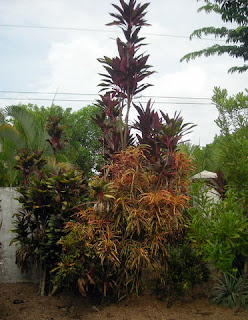
Tropical plants, La Ceiba, HondurasI think that one of the hardest things about tropical gardening is imagining how much space the little 6-12" plant you are looking at will need in the future, especially if it is one of those plants that doesn't like to be lonely and turns into 37 plants by the next year.

I couldn't resist these wild multi-colored plants — more accent colors! At the time we bought them they were maybe a foot high and now the tallest Ti plant (Cordyline terminalis, totally out of control) is about 16 feet tall or more. Now these colorful overgrown crotons seem a messy hodge-podge, so we want to cut them back and take some cuttings to plant in other locations where their wild colors and leaf shapes will shine through more and maybe, just maybe, we'll keep on top of the pruning tasks a little better in the future.

wild Dieffenbachias, La Ceiba, HondurasCuttings and starters from tropical plants are very easy. For stemmed plants, generally all you have to do is chop off the top, stick it into the ground, and water well. We do that every year for these wild Dieffenbachias in the jardinera in front of the terraza. If we didn't, they would soon block the view and fill the whole jardinera. They don't miss a beat, not even wilting from having their head decapitated from their body. You can even cut the long bare stems into foot-long lengths and plant those. For those that grow from rhizomes like Heliconias, just chop off the plants at about a foot high, dig up some of the rhizomes, and replant them in a new area. Before you know it, you'll have another new clump.

Can you see all the 'baseball avocados' hanging from the tree in the photo below? We'll soon see how bad was the mistake of planting two hybrid Hass avocado seeds. I'm really kicking myself for this. We are seriously thinking of chopping down one of the trees and replacing it with a better avocado from the agricultural university.

Mussaenda philippica, La Ceiba, HondurasThis peachy-pink flowered Mussaenda philippica is another totally out of control plant. We wanted it to be a bush, but failed to keep up with the trimming, and it wanted to be a tree. After a rainstorm, too heavy with water laden blooms, it would sprawl about 15-20 feet inside the garden all over the lawn and outside all over the sidewalk. These can grow into nice tree shapes, but ours had too many stems and none of them strong enough to support the weight.

During the beginnings of the great 2011 garden clean up, El Jefe asked me what I wanted to do about it. I said that I hated to lose all those glorious blooms (it blooms year-round), but obviously we had to do something. He came up with the idea to just leave the parts growing in the avocado tree, so now the "tree" has support. Not many people have a pink-blooming avocado tree, do they?

Heliconia rostrata, La Ceiba, HondurasThis Heliconia rostrata (Lobster claw) is another one where I bought one and now have several. Isn't that a spectacular bloom? Some of them are easily two feet long. It has had a hard life. When we first started landscaping the garden, one of my neighbors gave me several plants. While most were outstanding plants that I just love, one was a wild orange Heliconia that would take over the world if we let it. I have joked that the neighbor put a curse on our garden with that plant.
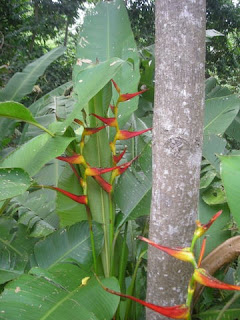
Heliconia from hell, La Ceiba, HondurasThis is the dreaded Heliconia from hell. If that sounds harsh, you should know that it spreads for miles and chokes out and shades out every plant it surrounds. We've spent five years trying to rid ourselves of every trace, every stem, every root, even to the point of sifting through the soil to find every little piece of root left behind. But it comes back and back and back again from the grave. At one point, this Heliconia latispatha had invaded the Parrot's beak area and out of frustration and unable to tell which plant was which without the blooms, El Jefe hacked it all back and pulled out all the roots that he found. I was disappointed, but thankfully, he missed a few roots and the good guy plant has returned. See also Unstoppable tropical plants for some of the lengths we've gone to to rid ourselves of some of the invasive plants.

Caladiums, La Ceiba, HondurasThese Caladiums suprise me every year. They seem to completely die away during the dry season but then return with the rains every year. I found the red and white splotched ones growing wild and dug them up from the side of a dirt road out in the country. I like to be prepared and take some pruners and a little shovel when we go out for drives. You never know what you might see or what someone will offer to you. ;-) The larger solid green leaf is an elephant ear which actually has an edible tuber called malanga and which needs to go before it chokes out everything else. And by the way, I am not denuding the natural tropical habitat when I collect these plants. The sides of the road are usually macheted at least once or twice a year, so I'm actually saving the ones that I collect.
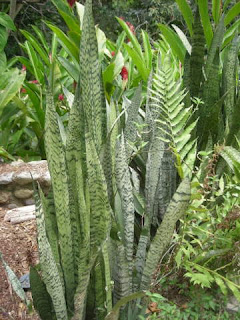
mother-in-law's tongue, La Ceiba, HondurasI've always called this plant 'mother-in-law's tongue'. I had one in Texas inside in an 8-inch pot for so many years and it never grew or multiplied. I can't remember where I got this but I thought the thin upright spikiness would make a nice contrast to the other sprawling tropicals. It has taken off like crazy and we are thinning it out to a ratio of about 10-1. It's former accent clumps have turned into thick hedges.

El Jefe found a good worker to help us with this mammoth task of garden clean up 2011. If I have my way, Josue's two week job may be closer to two months. "We" are also working on a humongous compost pile right now. (I'm gerente general of compost, so, of course, all I do is give orders. hahaha.) It is such a shame that more people don't compost instead of using chemical fertilizers. There is such an abundance of free natural materials that instead of being used naturally go to fill up the dumps and/or get burned or tossed into the creeks. Sometimes the materials even get bagged up and thrown out beside the roads. Even if you are dead set on purchased fertilizers, the compost is wonderful for potting soil and improving the texture and drainage of the soil.

Composting, La Ceiba, HondurasThis photo doesn't do the quantities of compost material justice. On the left is sheep manure (no smell!) and on the right are the yard trimmings to date, with much more to go. In the rear of this photo, behind the green plant in the center are our three built-in compost bins. Though they are large, obviously all of this is not going to fit when we start layering it in. Between the mountain of trimmings, a couple of pickup loads of sheep manure, and three big trucks full of wood shavings, we are going to be rich in 'black gold' before long.

Check out the plant topic for more photos from my garden. I'll stop now. This article started out as four photos with a few comments and ended up to be another one of my epic novels. ;-) Here are a couple of my favorite books; I love, love, love that first one but it is sometimes hard to find:


February 15, 2010

Bloom Day - February 2010

Pink ginger, La Ceiba, HondurasI finally remembered to participate in the Garden Bloggers' Bloom Day again! These are some of the flowers blooming in my La Ceiba, Honduras, garden today. I imagine this is a bit different than the snow-covered US right now.

Banana bloom, La Ceiba, HondurasBanana bloom

Alpina purpurata, Pink ginger, La Ceiba, HondurasAlpina purpurata, the pink ginger, blooms without pause 365 days per year. It smells good, too.


Hot pink and orange bougainvilleaBougainvillea, called Napoleon here in La Ceiba. It is a staple of most tropical gardens as it is such a spectacular bloomer.


blooming tree, La Ceiba, HondurasI need help identifying this blooming tree. It was a volunteer and came up in the narrow side yard between the concrete muro (fence) and the house. I'm afraid we'll have to remove it because of the location − which just shows how things can get out of control during the rainy season, not to mention 7 months of political distraction.

Alpinia purpurata, red ginger, La Ceiba, HondurasAlpinia purpurata, common name red ginger, grows to about 10 feet (3 m.) and blooms year round. It's a common plant, but there is none more dependable.

Pale yellow Ixora, La Ceiba, HondurasIxora is a very common shrub in La Ceiba, but this pale yellow is less common than the neon bright colors.

Hibiscus rosa-sinensisThis variegated Hibiscus rosa-sinensis is quite large, at least 10 feet tall. I don't know the name of the variety. It may be Snowflake or Snow Queen.

Clerodendrum thomsonae (Bleeding heart vine)Clerodendrum thomsonae (Bleeding heart vine) is looking particularly good. The zompopos (leaf cutter ants) which devastate the vine every few months by eliminating every single leaf on the plant must be on vacation.


Etlingera elatior, Torch Ginger, La Ceiba, HondurasEtlingera elatior, common name Torch Ginger. Here in Honduras, the pink Etlinger is called Bastón de la Reina (cane of the queen). They are of the Zingiberaceae (ginger) family and the flowers rise from the ground on their own stalks. These blooms are a favorite of hummingbirds. These plants get HUGE! Some of the flowers are at eye level for me (about 5' tall) and the plants themselves are at least 15' tall.

Heliconia rostrata (Parrot's beak), La Ceiba, HondurasHeliconia rostrata (Parrot's beak) is a huge plant that spreads like crazy. In June 2008, I mentioned that we were going to have to be a little more stern with this plant. Well, El Jefe got very stern with it he macheted every bit of down to the ground last year. It has come back and is just now starting to bloom again. I'm going to have to hide the machete. The blooms get much larger than this.

Lemons or limes, La Ceiba, HondurasLemons! Or limes! Who knows!


May 13, 2009

Eucalyptus trees in El Porvenir

Eucalyptus trees in El Porvenir, Honduras
El Jefe tells me that these Eucalyptus trees were planted to suck up the excess water from a formerly swampy area in El Porvenir.


Eucalyptus trees in El Porvenir, Honduras
Aren't those trunks amazing? I've never seen such colors on a trunk before.

July 19, 2008

Coconut update July 2008

Coconuts, La Ceiba, HondurasCoconuts

I counted 11 large coconuts, 17 medium coconuts, and about 27 small to tiny coconuts on this palm! I had no idea that coconuts were so prolific. It shouldn't be long now. I'm drooling. There is just so much you can do with coconut!

Yellow coconuts, La Ceiba, HondurasEven the yellow coconut palm has fruit. This tree isn't as healthy as the other. It has a black sooty mold on the palm fronds. It was infested with fire ants which made it difficult and painful to get near it to spray, so I'm surprised that it is producing. If anyone knows of an organic way to get rid of this mold, I'd like to hear about it.

You can see the coconut status at April 2008 and October 2007 and the first two that were picked in April with more information about cocos (coconuts). The October article includes a photo of both my coconut palms in May 2005 when they were about waist high. The growth has been amazing. Both palms are now as tall as our second story bedroom. The swaying palm fronds make for a nice view from our upstairs terraza.

Everyday, ho-hum stuff for some, but downright exciting for me!

July 15, 2008

B's Bloom Day in Honduras July 2008

Orange HibiscusOrange Hibiscus

Since my Garden Bloggers' Bloom Day post was sparse, I'm posting some photos of my cuñada's (sister-in-law) garden blooms. B has a tiny, tiny garden space but she's really done a lot with it. She keeps a lot of flowers in pots but also has a lemon tree, some palms, a huge orange hibiscus, two or three roses, and a couple of other trees. The orange hibiscus, shown above, is my favorite. The rest of the blooms are in the slide show below:


Garden Bloggers' Bloom Day in Honduras - July 2008

Banana bloomBanana bloom

All of the tropical blooms from my May and June Garden Bloggers' Bloom Day posts are still blooming (lucky me) so I won't repeat them. If you haven't seen them, you can see the photos at the links above. If you are new here, my garden is in La Ceiba, Honduras. That is in Central America for the geography-challenged. ;-)

Orchid, Myrmecophila tibicinis, La Ceiba, HondurasOrchid - Myrmecophila tibicinis

One of my orchids is in bloom again so that is exciting. A reader identified it as
Myrmecophila tibicinis. Last year it bloomed later in August. Better photos are at "My first time ever" where I reveled in keeping an orchid alive long enough for it to bloom.

Costus, La Ceiba, HondurasCostus

One bloom that I forgot to include previously is the Costus. Costus blooms year round. I'm not sure how I missed it in both May and June as I walked around the garden taking photos, except that the blooms are at the top, well above my eye level. We have it in three areas but the best one in right outside the sala familiar (family room). The windows are about 6 feet (2 meters) above the ground so the Costus is just the right height to be able to enjoy the blooms from the inside of the house. Costus has an interesting form of growth which you can read about here.


Guava, La Ceiba, HondurasGuavas

Not a bloom, but our guava tree is producing. If only we could beat the fruit flies to them. :-/ I did notice that the lower right corner of the photo shows another bloom which I've neglected to show before. The red and yellow bloom is Heliconia psitticorum.

We've been receiving an incredible amount of rain for this time of year. We are supposed to be in the dry season, but I'm not complaining. It's great for the garden.

June 15, 2008

Garden Bloggers' Bloom Day in Honduras - June 2008

Etlinger elatior, torch gingerCoral Etlinger elatior

This is my June entry in the Garden Bloggers Bloom Day for La Ceiba, Honduras. Luckily I took the photos and wrote most of the article last month, since I'm a little handicapped right now with ulnar tunnel syndrome. Just to keep it legal, I cross my heart and swear that all of these plants are still blooming in June!

It's wonderful to have such long-lasting blooming tropical plants but we don't have many of that thrill of new and different blooms each month that northern gardeners do. Oh, except for the orchids.


pale yellow Ixora
Ixora is a very common shrub in La Ceiba. Both the normal sized and the dwarf, though I see more of the dwarf. For some reason, both kinds are usually planted no more than 6 inches apart and the poor little shrubs always seem to be sheared into a boxed hedge at the first sign of blooms. These were started from a cutting that someone gave me. I like the pale, subdued color of this one.

Etlingera elatior, common name Torch Ginger
Etlingera elatior, common name Torch Ginger. Here in Honduras, the pink Etlinger is called Bastón de la Reina (cane of the queen) and coral Etlinger is called Bastón de la Emperador (cane of the emperor). They are of the Zingiberaceae (ginger) family and the flowers rise from the ground on their own stalks. These blooms are a favorite of hummingbirds. These plants get HUGE! Some of the flowers are at eye level for me (about 5' tall) and the plants themselves are at least 15' tall.

Parrot's beak, heliconia rostrata
Heliconia rostrata (Parrot's beak) is a huge plant that spreads like crazy. We are going to have to be a little more stern with this plant.

bougainvillea
Bougainvillea is called Napoleon here in La Ceiba. It is a staple of most tropical gardens as it is such a spectacular bloomer. This one serves just the purpose that I intended in that it obscures the tall concrete muro (fence) and provides a glorious view through the family and breakfast room windows. El Jefe was lucky enough to spot a toucan on the bougainvillea the other morning as he was reading the newspaper and drinking his coffee. He wasn't lucky enough to return with the camera in time to get a photo. Bougainvillea is another hummingbird favorite. I found several nests in the bougainvillea that I'll show you another time.

Red ginger, alpinia purpurata
Alpinia purpurata, common name red ginger, grows to about 10 feet (3 m.) and blooms year round. This is another staple of the tropical garden. It's a carefree plant that needs nothing in the way of attention other than occasionally trimming off the dead blooms and some drastic cutting back to keep in bounds.

Pink gingerPink Ginger. Both this and the red one above bloom year round. They never even take a pause.


Heliconia latispathaHeliconia latispatha is the scourge of my garden. Not that I don't like the flowers. I do! But it is so invasive. The original 3-4 plants were given to us by a neighbor and we've been digging them out for the past couple of years to no avail. They take over everything. Don't plant unless you have acres to fill!

You can see more photos of these and other plants in my garden here. There is also a nice slide show of bloom photos from my garden in June 2007 here.

bougainvillea

May 15, 2008

Garden Bloggers Bloom Day, May 2008

LilyHippeastrum striatum

I finally remembered to participate in the Garden Bloggers' Bloom Day again! These are some of the flowers blooming in my La Ceiba, Honduras, garden today. I'm saving some photos for next month (when they will still be blooming) since there are so many and concentrating on the ones which may not be blooming in June due to the climate or external forces (usually leaf cutter ants).


LilyThis is a double variety of the same bulb shown at the top of the article. I've guessed that this is Hippeastrum striatum, but would like to hear from anyone who knows. It was just called a lirio (lily) when I bought it. I love the orange color.

The bulb is prolific and produces tons of offshoots. I started with seven bulbs and have hundreds now - not bad for a $3.50 investment. Each plant produces 2-3 blooms which each last for only a day. I think that it blooms about twice per year but I haven't kept very good track of it. This flower is special to me simply because it isn't one of the ones that bloom year round. Absence makes the heart grow fonder.


AllamandaAllamanda cathartica 'Hendersonii,' common name Allamanda, Yellow Trumpet or Golden Trumpet. Allamanda is a tremendous bloomer. It blooms 365 days a year in my Honduran garden. This vine has gotten so large and heavy that it frequently tumbles over the iron support that it is growing on.


CaladiumSome caladiums grow wild in Honduras. The most common one that I've seen in the north coast area is a white-spotted one with red veins. They generally disappear during the dry season and return during the rainy season. I think that I bought this one, so it may be a hybrid. Botanical names? We don't do that in Honduras!

Mussaend philippicaMussaenda philippica is said to be a boring tree as it is covered with these huge extravagant blooms 365 days a year. ;-) I love the peachy color. The entire tree also has been completely denuded by leaf cutter ants on many occasions, as you can probably see in this photo. At least the ants leave the flowers. :-(


Shampoo ginger Zingiber spectabilis is called Shampoo ginger because the roots or flowers (I'm not sure which) are sometimes used for shampoo and are said to help grow the hair back.

Bleeding heartClerodendrum thomsonae (Bleeding heart vine) would be a reliable bloomer in this tropical climate if it weren't for the zompopos (leaf cutter ants) which devastate the vine every few months by eliminating every single leaf on the plant. As the flowers dry, they turn a pale pink color. The vine naturally grows so gracefully around the iron trellis. I wish all vines were so well behaved.


Red HibiscusThis variegated Hibiscus rosa-sinensis is quite large, at least 10 feet tall. I don't know the name of the variety. It may be Snowflake or Snow Queen. It has suffered from leaf cutter ants and neglect in pruning. I think that we need to take some drastic measures soon to get it into shape.

You can see more photos of these and other plants in my garden here. There is also a nice slide show of photos from my garden in June 2007 here.

Older posts
Home

Related Posts Plugin for WordPress, Blogger...
