skip to main |
skip to sidebar
 Bathroom sign
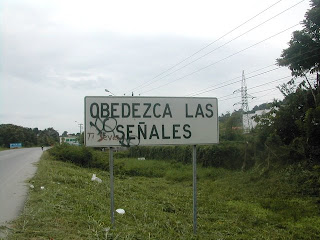 Can you come here on vacation without knowing Spanish? Sure. No problem. Most hotels and tour groups have people who speak English. They can hook you up with an English speaking taxi driver. A lot of restaurants have someone who sorta speaks English, but a lot don't. You can always hire someone to be your guide.
Living here is a different story. If you are going to go shopping, go to the bank, take a taxi, ride a bus, talk to your neighbors, read a newspaper, take a job, open a business, get a driver's license, buy or build a house, need a plumber, answer your door, get sick, hire someone to cut your lawn or clean your house, or ever run into any kind of problem (like that never happens in Honduras), then you'll probably need to know some Spanish.
 It's fine to learn "Dónde está el baño?" but what do you do when the answer is "idru &^$# ()gjeor% ufe#rgt wo*&#*cwst, señor!"? Sure, sometimes you luck out and someone will be around who speaks English. It may be fine to rely on that person to tell you what is going on with the bathroom, but do you really want to rely on someone else's translation when you invest in a house?
 Those of us with Honduran spouses have it a little easier, but do you want to be dependent on your Honduran husband or wife or friend or neighbor for even the simplest things? Will they always be around when you need a translation? Will they even be able to accurately convey what it is that you are trying to convey?
Adjusting to a new culture is difficult enough. If you don't have a clue as to what is going on around you, you'll really be lost.
 I just think that anyone who moves to Honduras without knowing at least a little Spanish is putting himself up for a very frustrating time. I know people do it, but I have to think that they must feel a little like an outsider looking in at the rest of the world around them.
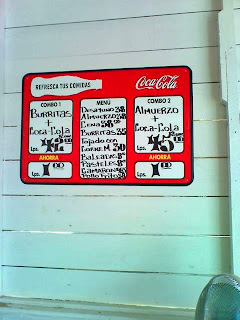 I regret that I didn't learn more Spanish before I came here. The first few years could have been much easier − for me and for El Jefe, too. Even now, though my Spanish reading ability is very good, my speaking ability leaves much to be desired, which still can cause frustration and misunderstanding. I want to have intelligent discussions about things that are beyond my Spanish vocabulary! Even with simple subjects that I know very well, like cooking or gardening, I find myself completely stuck trying to find the right word.
Some people can pick a language by hearing it, others need 'book learning.' So, my advice − if you want it − is to use whatever time you have before you move to another country to learn the language.
I regret that I didn't learn more Spanish before I came here. The first few years could have been much easier − for me and for El Jefe, too. Even now, though my Spanish reading ability is very good, my speaking ability leaves much to be desired, which still can cause frustration and misunderstanding. I want to have intelligent discussions about things that are beyond my Spanish vocabulary! Even with simple subjects that I know very well, like cooking or gardening, I find myself completely stuck trying to find the right word.
Some people can pick a language by hearing it, others need 'book learning.' So, my advice − if you want it − is to use whatever time you have before you move to another country to learn the language.
So, the simple answer to the question is: Yes. I think you'll be much happier. Just my opinion.
 Whoever would have thought that La Gringa in La Ceiba, Honduras, would need an official email policy? ;-) First of all, I want to say that I do enjoy hearing from (almost) :-o all of the Blogicito readers. I have to qualify that because, well, this is the internet and it takes all kinds. If it didn't take all kinds, I wouldn't receive 20 or so spams each day offering to enlarge my (nonexistent) instrument.
  I have until recently answered every email that seems to require an answer or just out of courtesy even if it didn't seem to need a reply. Hey, when someone writes to say that he enjoys or has been helped by my Blogicito or has been inspired to start his own blog, that makes my day, so I always write back to say thanks.
I've also made some good friends through email correspondence, but that is not to say that I always will be able to answer every email. Some days I do almost nothing else and something has to give! Lately, even before my recent maladies, my friends are waiting a week or more for a response while I'm spending time answering emails from strangers! Not to mention that El Jefe would like me to get away from the computer at least occasionally.
So, just in case you don't get an answer from me, if you have a serious interest in Honduras, some suggestions that I have for you are:
1. Join our Honduras Living Yahoo group. It's a high volume group with a lot of Honduras-knowledgeable people (expatriates and Hondurans) who will give you the straight scoop. It's always better to get several opinions rather than just one anyway.
2. Read my blog! You can use the Topics in the sidebar to narrow down the articles which interest you. Use the search function in the upper left hand corner or the Google search box at the top of the sidebar for other specific things you have questions about.
3. Check out the other Honduran expatriate blogs in the links section at the top. Next to living in a country (which you should do on a trial basis!), I know of no better way to learn about real life from the expatriate viewpoint. Expatriate blogs from other Latin American countries often write about the same challenges that we experience here in Honduras, too.
4. Do some internet research. If you are looking for a hotel or other touristy type things, I'm not going to be of much help for you anyway. Honduras Tips is a good place to start looking for answers to those questions. Keep in mind, though, that MANY of the Honduran-related websites are not kept up-to-date.
5. Try to be specific in your questions. If I know the answer, I'll give it to you or at least my opinion if I have one, but please consider how much time it will take to answer your question. You'll probably get a 5-minute answer for a specific question, but might not for something that requires an hour-long dissertation.
 I can't and won't answer questions like "What is it like living in Honduras?" I have a blog with almost 800 articles for that. There is just no way that I can summarize "life in Honduras" in an email or rewrite my previous articles for every person who asks, and honestly, I think it is a little lazy on the part of anyone who asks me to do so.
Often people write to me with comments about a blog article. Some have problems signing on, don't have a Google ID or OpenID, are just shy, or want to be anonymous. If I receive an email that I think will be interesting, funny, or helpful in some way to other readers, I reserve the right to post it anonymously on my blog. I also occasionally post emailed questions (also anonymously) to the Honduras Living forum if it is a question for which I have no answer.
When doing so, I ALWAYS remove any names, email addresses, or even the name of the country from which it came if I think it is appropriate. Heck, I once even removed a dog's name, just in case. ;-)
So, if you trust my judgment, keep writing. If you don't, ...well, then I would have to ask, why are you writing me to start with? Conversely, when someone writes a rude, demanding, obscene, or intrusive email, I reserve the right to post the whole thing on my blog, including your email address. Who is the judge of what is rude? When it comes into MY inbox, it's me.
 One last thing: A simple thank you is always appropriate when someone (me!) has taken her personal time to help a stranger (you). If I have answered or attempted to answer your questions, please at least let me know that you have received my email. It will encourage me to continue responding to others' questions. I couldn't tell you the number of times I've spent an hour or more answering detailed questions and the person NEVER WROTE BACK to say thank you. Yes, it takes all kinds.
Sorry if this sounds a little grumpy. I don't mean for it to, it is just that people need to understand that I am NOT a Honduran information desk, it isn't my job to answer your questions, and I don't get paid for this. Keeping that in mind, I'm sure that we'll get along just fine! I'm not selling anything but if you want to show your appreciation by checking out my Amazon wish list, click Presents! above. "Thank yous" really inspire me; presents will inspire me even more. ;-D
I really, really hope this doesn't come across the wrong way. It isn't that I don't want to help you, but honestly, I do not know if the property you found on the internet is a good deal, whether your husband is going to cheat on you, whether you can find a job (probably not), or whether you will be happy living in Honduras or not.
 Nice readers wrote to me with this information (below) about Honduras' senior citizen discount, called the tercera edad discount (third age). I wrote back to thank them and let them know that it is something I can look forward to in the future, but right now I don't qualify. They wrote back to say how happy they were that La Gringa responded to their email, but PUT IT ON THE BLOG! So, okay, R and G, here ya go:
When living in Honduras, you want to take advantage of any privilege the laws will give you. After all you have to put up with all the inconveniences (to put it mildly) of living in poor developing country. For Hondurans or residents of Honduras over 60 years (corrected by LG from 65) there is the law of "tercera edad." It compels businesses to give a wide range of discounts from 10 to 30%, like on health and dental care, hotel accommodation, bus fares, airline tickets, restaurant meals and others. In most cases you would have to prove your eligibility by showing your membership in the association of older people or your drivers license that you shows that you are 60 years of age or over.
It really depends on the businesses how strict they are or how willing they are to give the discount. There is usually no problem to get the discount for bus fares, airline tickets (also to the USA), health services, and buying prescription drugs. The law was made many years ago to give the necessary breaks to older people who have a very low or no income at all. The irony is nobody can prove how rich or poor you really are. Like with many laws in Honduras they are well intentioned but difficult to administer or simply ignored. The law of the Tercera Edad is one of them.
If you ask for a discount in a restaurant they may flatly refuse to give it or play ignorant. Ask before ordering. You can put up an argument saying that the laws of Honduras are above the business' policies. As a last resort a friend of mine threatens them that he is going to the local municipal police and complain. Then it becomes a matter of principle rather then saving a few lempiras. At fast food chains there is usually no problem as long as you do not ask for items on promotion or being discounted. Orders from the head office I guess.
Also my experience is, that you often do not get exactly what is shown in the full page advertising ad in the newspaper. As an example on a cup of Carne con Chile, the ads shows a generous sprinkling of cheese at top and only pointing at the picture makes them put the cheese on top. Who eats my cheese!!!
Of course, I never ask for a discount in small family run restaurants, they probably have a hard time to exist. Unfortunately, most of the food served at the fast foods outlets is outright unhealthy, because of the high fat, sugar and starch content. But this could be the title of another article. Did you have any experience with getting the discounts? Let me know.
Thanks for sharing that information and I was remiss not to mention it before. My mother-in-law always uses her discount whenever possible, especially for medicines, but I wasn't really aware of the details. I'm looking forward to a discount on airfare! I'm amazed at that. If this law is like most of the tax laws in the US, no doubt it will change right before I'm eligible to benefit from it.
Like R and G, I wouldn't ask for the discount at small mom and pop restaurants. It seems that most of those places have such a small profit margin as it is.
I did a little research (of course! − I just couldn't leave it so vague) and was amazed at what I found. The following senior citizen discounts apply:
Air, land or sea transportation: 25%
Restaurants: 20% on food
Health care: 20-30%
Drugs: 25%
Hotels: Monday through Friday, 30%; Saturdays and Sundays, 20%
Movies, theaters, museums, sports events, concerts: 50%
Telephone and electric bills: 25% on bills up to L.1,000 per month
Water bill: 25% on bills up to L.300 per month
Cable TV: 30%
Internet: 25%, but only for speeds of 256 kb or less
Mortgage loans: 2% discount on the interest rate, with some exclusions
Property tax: 25% on bills up to L.1,000
Airport exit fee: 20%
Technical or professional services of engineers, architects, and notaries: 25%
Note that there are a few exceptions and qualifications in the law, but not many. Restaurant discounts, for example, are required only for those restaurants classified as category 1 or 2 by the Ministry of Tourism, so I suppose this might exclude the tiny mom and pop places or street vendors.
Don't think that if you have three houses, you can get the discount on all three, because the law precludes that. The fines for fraudulent use or transfer of the discount are steep. The only discount that can be transfered to relatives is one not mentioned above: a 25% discount on funeral services, caskets, and burial plots for the senior citizens.
According to the law, the discounts should be granted for those of 60 years of age or more merely by presenting your Honduran ID card or your residency card in the case of expatriate residents. The law does not apply to tourists. The home and utilities must be in the name of the senior citizen to receive the related discounts.
The senior citizen discount is also something to consider if you are opening a business in Honduras. Denuncias (complaints) can be filed with the Fiscalía and first time offense fines can be approximately L.3,200 to L.9,600 and escalate from there up to losing your business license. The fines are based on the current legal minimum wage so will vary over time. The bright side for business owners is that they can deduct 50% of the discounts granted on their Honduran income tax.
In my search I found that PriceSmart states that they don't grant the senior citizen discount. Well! PriceSmart does sell drugs. How do they get away with that?
So now you know, and what I'd like to know from you senior citizens: Is it really that simple to obtain the discounts or is it a constant hassle having to demand them? I know it is easy at pharmacies.
If you have a hassle, one tip that might work is to make a great show of getting out a pencil and paper and looking for their business license on the wall. Ask whether the attorney listed on the license is still representing them. I have an idea that most businesses would rather give the discount than hear from the fiscalia. I'd love to hear how this works for you if you try it. :-)
Reference: You can find a PDF of law, Decree 199-2006, July 2007 (in Spanish, of course) at Global Legal Information Network.
(What great information. Thanks for twisting my arm, R and G. ;-D )
This post was originally published in January 2007 and was updated in April 2008. I receive many emails from people who are considering moving to/retiring in/investing in/looking for work in Honduras. I'm always a little surprised, thinking to myself, "Well, if you read my blog, do you really think I'm going to recommend it?" Life is hard in Honduras for so many reasons, even when you have the money to live a comfortable lifestyle. On the other hand, I appreciate your confidence in me to give you the 'straight scoop.'While I enjoy hearing from people and I've made some good friends through these correspondences, I'm just going to have to say that I can no longer give that kind of advice.First, I'm not qualified to answer many of the questions. Some need to be asked of an attorney or three, and you will probably receive three different answers. The residency rules have changed since I moved here and can change almost daily, depending upon which government worker you are dealing with at the moment.Second, it is absolutely draining to me to try to answer the numerous, very detailed questions. I've always tried to help as much as I can, especially when I see that people are talking of things that are risky, either financially or safety-wise, or clearly have on their 'rose-colored glasses.' But it has just become too time-consuming and I don't want to be responsible for life-changing decisions that someone might make.
 Here is the advice that I will give:1. When reading about Honduras online, consider the source. Is it from a real estate agent, travel agent, tourism agency, or anyone else who has something to gain? Is it from a tourist who spent a week in a luxury hotel or a backpacker who enjoys roughing it? I'm so amazed at some of the misinformation that I read about Honduras that sometimes I just laugh out loud.2. Always remember that the Bay Islands and the mainland are worlds apart. Information that applies to the Bay Islands may or may not be accurate for mainland Honduras. My experience is only with mainland Honduras. The Bay Islands may offer more of the comforts and conveniences that North Americans are used to, but the cost of living is much higher, too.3. If you want to know what it is like, come here and rent a house or an apartment for 6 months or more to see if you really like it long term. Don't sell everything you own and move here after a week's vacation or even two or three vacations here. Day to day living in Honduras is a lot different than being on vacation. According to the attorney who handled my residency, half of the expatriates return to where they came from within 6 months to a year.4. Learn Spanish before you come. Classes probably will be less expensive and more professional in your local community college. Online courses are available, too. Of course, once you are here, talking with native Spanish speakers will help to improve your Spanish and your accent, but without some basic Spanish abilities, learning by speaking will be very difficult. Don't believe those websites mentioned above that always say that English is widely spoken; it isn't on the mainland.5. Be prepared for culture shock. It is real and it will happen to you. Accomplishing the most simple things in your daily life can be so stressful. It isn't like moving to another state with a lower cost of living. Finding out that you can't trust anyone, even people who you thought were friends, leaves a very empty spot in the pit of your stomach. Check out these cultural differences articles, 47 of them as of April 2008, and that's only scratching the surface.6. Don't rely on what the Honduran Consulate offices in your country tell you about immigrating. They are wrong more often than right. Relying on bad information from the Houston Consulate cost us several thousand dollars and untold stress and worry. The newspapers are full of complaints by expatriate Honduran citizens about the bad service they receive from their own consulate. If they don't care about helping the Hondurans they are there to serve, think about how much they enjoy screwing up us gringos.7. Don't even consider buying property until you have found a trustworthy attorney and checked his references. There are many crooked attorneys and fraudulent land transactions. People, both gringos and Hondurans, lose their money on bad land deals all the time, even those with experience. I personally know two Hondurans who were cheated out of their property by their own attorney and another by the government. Don't rely solely on the US Embassy list of Honduran attorneys as it is rumored that there are crooked/incompetent attorneys on that list, too. And don't ever consider building a house unless you will be here full time to supervise the work.8. The government of Honduras wants immigrants who bring their money from other countries (US $2,500 per month for income residents or US $1,500 for retired residents) or who make investments here (US $50,000), not people looking for jobs. And even though they offer residencies to those with a proven, reliable outside income, it sometimes is extremely difficult and time consuming to obtain that residency. Most teachers, missionaries, and other volunteers that I know of come on a 3-month tourist visa and must leave the country every 3 months in order to renew their visa. Due to the time, expense, and red tape required to get a residency or special presence permit, it just isn't worth it for most people staying only one or two years.9. To the best of my knowledge, most expatriate residents may not legally take jobs, except for certain explicitly defined jobs, such as teaching, government contractors, missionary or other charity work. Those married to Hondurans may be allowed to work, but non-citizens must obtain Honduran work permits or "green cards" like in many other countries. Tourists are not permitted to work. Coming to Honduras looking for work is like going to the Sahara to look for water. Even if you could legally find a job, salaries are generally 10-20% of what is paid in the U.S. An average salary for a middle-class worker is around U.S. $300-$400 per month, minimum wage is around $150 per month.
10. If you are planning to immigrate, don't buy your airline ticket, ship your belongings, import your car or pets, or buy a house until you are clear as to what the residency rules are! It could be a very expensive and stressful lesson for you.
 Okay, so where can you go to get the information you need? I wish I could give you an excellent overall source like this one: The Real Costa Rica, but there just isn't a website like this for Honduras. I do suggest that you read this site − so much of the information is very similar in Honduras. Just multiply the negative things by two and divide the good things in half and you'll have a better idea of life in Honduras. After all, there are many more Americans in Costa Rica, Mexico, and Panama than there are in Honduras. There are logical reasons for this.Other websites that may be helpful:U.S. Embassy Consular Sheet for Honduras: Read this entirely. The dangers in Honduras are very real and anyone considering moving to Honduras should be aware of them.U.S. Embassy Regional Security: This page is a real eye opener. There are other topics on this US Embassy in Honduras site that will be of interest to you.US Embassy overview of the residency process: This site has some basic information about residencies. Unfortunately, the details of the requirements of the various types of residencies are in Spanish.Doing business in Honduras: A downloadable US government publication on doing business in Honduras is available by clicking on the link near the bottom of the page.US Library of Congress Country Study: A very detailed, but not currently updated history of Honduras.Honduras This Week Online: A weekly English-language newspaper. The site is not organized for research − for some reason they don't use permalinks and many of their page links don't work at all − but it is worth perusing. You can also sign up for a weekly summary email.Honduras media: If you read Spanish, check out the Honduran newspapers. If you don't read Spanish, try using the translation feature on the Google Toolbar for the articles in which you are interested.
8 Rules for Investor Survival in Honduras: Scary to read, but the advice is so true.
Blogs of Expatriates in Honduras: Check out Honduras-Blogs.com and the Honduran blogs that I read in my links section. Personally, I think there is no better way to get an understanding of what day-to-day life is like in a foreign country.Honduras Living Yahoo Group: A discussion forum about moving to and living in Honduras in January 2007. This is a very good resource for people thinking about moving to Honduras and for those already here. You can join by clicking the link above or read more about the group here. As of July 2011, our group has more than 1,200 members and YOU can help us to make it bigger and better!I hope that helps you in your quest for information and if I find any other useful information, I'll include it in my blog. If you know of other informative sites, please let me know so that I can include those, too.
A followup to this article: Do you disagree?
 I wish I had $10 for every time I was asked that question!
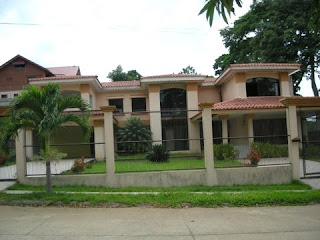 It can cost the same, or more, or less than it costs to buy or build a house in the U.S. How much does it cost to buy a house in Ohio? How much does it cost to buy a house in Dallas? It is impossible to answer to those questions either without knowing a whole lot more details.
The cost of a house, simply put, will depend upon what kind of house you want, what size of house, and where it is. The price of land varies tremendously. A tiny lot on the beach on the island of Roatan might cost vastly more than several acres in a secluded mainland location which, incidentally, might not have access to water or electricity.
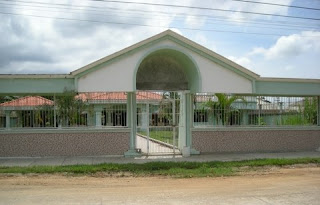 If you want a replica of an 'American' style house complete with all the quality amenities, you could pay even more than it might cost you in the U.S. as you might have to import those quality items that aren't available here and might even have to bring in experts to install them.
Living in or near a big city or popular area will probably mean that labor costs will be higher while living in a smaller remote town will probably mean that material costs will be higher (lack of competition plus transportation costs). So even cost per square foot will vary a lot depending upon what part of the country you are considering.
 I'm not a real estate agent and I don't have any reason to keep up with prices. Right now in La Ceiba, judging by the ads in the newspapers, there are many houses available in the US $50-60-70,000 range. As to whether those houses would suit your needs or whether you would want to live in those areas, I have no idea.
 There are houses even less expensive than that, but if you are partial to electricity, like to have water at least most of the day, want a kitchen with more than 18 inches of counter space or a lot with more than a postage stamp-sized yard, you might have to increase your price range.There are just too many variables for me to even attempt to guess! I would say, however, that if you are thinking you can build or buy a house for US $10-20,000, it ain't gonna happen! US $100-200,000 is more likely to get you a house like you are used to.
 I have included a few articles on my blog about some of the colonias (neighborhoods) around La Ceiba. I plan to do more of that just because so many people seem to be interested in houses. I enjoy looking at houses and because we have so much new construction going on, there is a lot of material out there. In fact, I'll add a "Housing" topic in the sidebar to make the articles easier to find.
 For those of you serious about moving to Honduras who want to see what is available, I have a few suggestions.
1. First and foremost, do not ever consider buying property in Honduras without seeing it in person (especially during rainy season), talking to neighbors, hiring a good attorney, and doing all the other due diligence (plus some) that you would perform anywhere else.  2. I always recommend that everyone come down and rent for 6 months to get familiar with the area and find out if living here is what you really want. Renting is cheap and much less expensive than finding out later that you've made a terrible mistake.3. Google "Real Estate Honduras" or "Real Estate La Ceiba." Not all real estate companies have websites in English, so also Google "Bienes Raices Honduras."
  4. The online Honduran newspapers include the classified advertisements (under Bienes Raices). Many properties are sold by owner. Ads won't tell you much, but may give you an idea of prices. (Here are the newspaper links.)5. If you are taking my advice from #2, while you are here, drive around. See what areas you like. Talk to several agents. Look at as many houses as you can to see what is available in your price range. Talk to people that you meet. They may know of something available or may know of problems in the area that you are considering.If you are interested in seeing a particular colonia, let me know. If it is close by and if I can, I'll do an article and take some photos of the houses and neighborhood in general. I won't do your due diligence or make appointments with real estate agents, though!
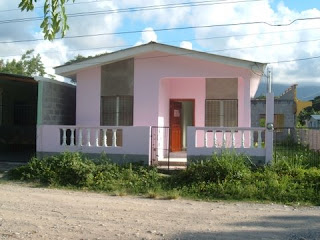
Now here is a house that you might be able to get for under US $10,000, but chances are that the homeowner does not own the property that it is sitting on.
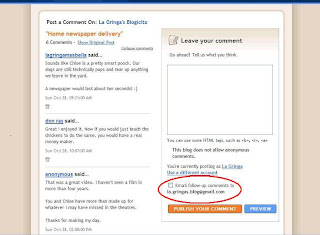 The comment page: Just click the box to receive follow-up comments
(Click on any of these images to enlarge them)
Receive follow-up comments on one article by email:
When leaving a comment, just click the little box "Email follow-up comments to [your email address]" on the comments page (in the red circle shown above) and you'll receive an email of any later comments that are posted on that particular article.By the way, you will see your own email address on the comment page (where mine is shown above), but no one else will see it. There is no spam or ads involved with the email notice.I tried it out yesterday and it worked well. A nice feature is that the email includes a direct link if you want to post another comment. The email also includes an unsubscribe link so that once you have your answer, or don't want to receive future comments on that article for any reason, it is easy to unsubscribe. One drawback is that you have to leave a comment in order to subscribe.Subscribe to comments on one article with a feed reader:
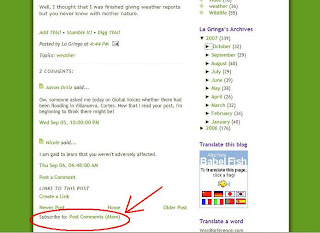 To read the comments on an individual article in a feed reader instead of email and without leaving a comment, click on the article title and it will open a new page with the article and any related comments. At the bottom of that page, there is a link "Subscribe to: Post Comments (Atom)" (in the red circle at right). Personally, I wouldn't want to fill up my feed reader with a lot of subscriptions that will soon be inactive so I don't like this option too much.Subscribe to ALL comments with a feed reader:If you are really, really interested in the Blogicito's reader comments, you can subscribe to all reader comments. Click on "Subscribe to reader comments" in the right-hand sidebar under the "Subscribe to La Gringa" heading. You'll see all comments for all articles in your feed reader.
How to leave a comment on the blog:
 A basic tip: Every now and then, I receive an email from someone new to blogs who doesn't know how to leave a comment. If you are on the main page of the Blogicito, beneath the article you'll see a link that says "View xx comments" (in the red circle at right). Click that link and you'll see the comments page (picture at top) where you can read the current comments and/or leave a comment.
If you are on an individual article page (described above), after the latest comment, you'll see a link that says "Post a comment." Click it and it will take you to the comments page. You'll need a Google ID (not necessarily a Google email address) to post a comment.
How to leave a comment from your email subscription:
Just one more basic tip: If you read the blogicito through a Feedburner email subscription, you can comment on an article by clicking on the article title link. It will take you to the article page. Look for the "Post a comment" link after the latest comment.
Reading over this article, it sounds a tad confusing! It's really much harder for me to explain than it will be for you to do it. Most bloggers love hearing from readers, so I hope that you'll give it a try. Don't be shy!
Let me know if you try this new feature and how it works for you. I think I'll be using it a lot on the blogs that I read, since my blog reading has been sporadic at best lately and I like to know when the blogger responds to my comment.
 I had to bring my antique clocks
One of our Honduras Living members asked for advice about what to bring or not bring when moving to Honduras next year. I started replying but as the message got longer and longer, I decided I should turn it into a blog article instead.
I've heard lots of people − mostly men! ;-) − suggest to get rid of everything, bring a change of clothes, and buy everything you need here. Ha ha! I think in general that is easier for men to do than women. Especially if you are a "nester" like me.
There is no doubt that you will want to reduce your stash of "stuff" because if you are moving to Central America, it is likely that one of the things you are looking for is a simpler life. On the other hand, if you really appreciate the difference between, say, good quality bed sheets or a well balanced chef's knife and the lesser quality ones, you might want to consider bringing them. If your china gives you joy every time you sit down to dinner, bring it!
 One of the first questions would be, are you planning on shipping a full container? That will make a big difference in how I would answer your question. If you are shipping a container, you don't have to worry about the cost of sending heavy or bulky things and there is always a little space where you can stash those special items that you were on the fence about bringing.
Another question is whether you will be eligible for a dispensa or will have to pay import fees and taxes on everything you bring. You'll need to weigh the cost of shipping and import costs against buying here with a 12% sales tax and in some cases, higher prices and lesser quality.
If you've taken my advice about coming to visit for 6 months or so, then you'll have a much better idea of what is available and it will be easier to decide if the things you would be looking for are available here and whether it is more economical to bring or buy here.
One of Jen's questions was whether she should bring her clothes dryer. I think she will need a dryer. Line drying is fine when the weather is good but it takes a lot of line space to hang a load of clothes and if you have 3 or 4 loads at a time, you'll need a lot of lines. There are times when it rains every day for a week or two and it might be awfully hard to get clothes dried during those times. Also, you may find that as a spoiled U.S. American − aren't we all? oh, don't kid yourself! ;-) − that you like the soft feel of towels and some other things dried in a dryer better than line drying. I line dry lots of things but I still use the dryer as well.
One of the first questions would be, are you planning on shipping a full container? That will make a big difference in how I would answer your question. If you are shipping a container, you don't have to worry about the cost of sending heavy or bulky things and there is always a little space where you can stash those special items that you were on the fence about bringing.
Another question is whether you will be eligible for a dispensa or will have to pay import fees and taxes on everything you bring. You'll need to weigh the cost of shipping and import costs against buying here with a 12% sales tax and in some cases, higher prices and lesser quality.
If you've taken my advice about coming to visit for 6 months or so, then you'll have a much better idea of what is available and it will be easier to decide if the things you would be looking for are available here and whether it is more economical to bring or buy here.
One of Jen's questions was whether she should bring her clothes dryer. I think she will need a dryer. Line drying is fine when the weather is good but it takes a lot of line space to hang a load of clothes and if you have 3 or 4 loads at a time, you'll need a lot of lines. There are times when it rains every day for a week or two and it might be awfully hard to get clothes dried during those times. Also, you may find that as a spoiled U.S. American − aren't we all? oh, don't kid yourself! ;-) − that you like the soft feel of towels and some other things dried in a dryer better than line drying. I line dry lots of things but I still use the dryer as well.
Good quality major and small appliances are available. If your appliances are relatively new, if you qualify for a dispensa, and if you are shipping a container, you might consider bringing them. Otherwise, you can probably find what you need here. Hopefully you aren't the type of person who needs the latest and greatest new technology in your appliances because it is likely that you will have a hard time finding repairmen. That's not to say that we don't have modern appliances; I'm just saying that the more bells and whistles your appliances have, the more likely that if something goes wrong, you may not be able to have it repaired.
 Having spent all day yesterday furniture shopping in La Ceiba with a friend, I would say that there are lots of selections in dining room sets but much less so for big families. Most of the larger dining room sets were extremely ornate and formal in style. If that is what you want, great. If you want a rustic farmhouse style table, you might need to have one made.
In upholstered furniture, it's going to depend upon individual taste. Most of the styles here in La Ceiba are not to my taste. The Honduran style is very big furniture, often ornate with formal fabrics (brocades, etc) and almost always sold in a set with a sofa, love seat, chair, and 2 or 3 tables, all perfectly matched.
Another thing to think about is that, in general, rooms are smaller, especially bedrooms. Your 5-piece king-size bedroom set may not even fit in your new house or apartment.
Quality varies widely. We like good quality furniture but formal and ornate is not really our style. We are looking for more of a casual or tropical look. Lots of the wood furniture is lacquered to a brilliant shine, includes mirrors (!) and gold trim, or is stained so that the wood grain is completely covered, like with paint. I think the beauty of wood is seeing the wood grain but obviously the fashion is quite different here.
We are still sitting here with an empty sala principal (living room)* and will need to do some shopping in San Pedro or Tegucigalpa or the US if we are ever going to fill it to our tastes. So, all I can say is that it really depends on what you like and what you can live with.
 I have lots of advice and personal opinions on the matter of what to bring. I'm glad I brought lots of books, especially my cookbooks, craft and do-it-yourself books. I'm glad I brought my hobby and craft things, nice linens, and kitchen stuff (although I sold tons of that before we came also). Kitchens are generally a fraction of the size that they are in the US with much less cabinet and counter space unless you build to your own specifications or buy a really big house.
Definitely bring pots and pans. I haven't found quality pots and pans anywhere, including San Pedro. A few places which had some medium, not good, quality pots and pans were extremely expensive to my mind. I think that I could get a much better quality for a lesser price in the U.S. Guys should bring their tools because quality tools are hard to find and expensive.
Bring some insulated mugs and glasses. You'll appreciate not having your drink drip condensation all over your clothes, lap, and furniture.
 Computers and electronics are more expensive here than in the U.S. Computers will often come with pirated software which make it difficult to impossible to keep updated.
Cars are more expensive, but importing a car is expensive and can be a nightmare getting through customs, too. Finding parts for cars that aren't popular here can be unbelievably frustrating, expensive, and time consuming. Can you imagine being without your car for 3 to 6 months while someone tries to repair it? It happens.
In many other areas, the variety and quality of stuff available in La Ceiba has increased tremendously in the past few years. I was very pleasantly surprised at two of the stores that we went to yesterday. The larger cities of San Pedro Sula and Tegucigalpa will offer much more variety and probably better prices, too. La Ceiba prices for many things are generally higher than in the big cities.
I'm sorry I brought my oriental rugs and much of the clothes that I brought. I really regret bringing two leather chairs. I don't regret bringing a lot of the sentimental things and favorite kitchen stuff that I did. We had room in the container and I think that if something makes you feel happy or more at home in your new surroundings, why not?
So, I can't really answer what is best for you because everyone is different, but I will say that there are a lot of adjustments to make in starting a new life in a strange country and if you have a few things around you that just make you feel good or more comfortable, I think it makes the adjustment a little easier. If you are looking forward to starting fresh, particular brands or styles aren't important to you, and you're willing to adjust to what is available, then leave it all behind.
~~~~~~~~~~~~~~
*Update: After six years of looking on and off, we finally found the perfect, tropical style furniture for our sala principal. Not only was it just the style we wanted, but it was made in Honduras and was the exact colors that we needed for our orange room:
Pull up a chair and sit a spell
By the way, reading this article two and a half years later, I wouldn't change a thing.
By the way again, reading this article again three and a half years later, the only thing that I would add is that if you are only coming for a year or less, don't bring much at all. The hassles and cost of shipping, importing, and transporting are only worth it for your most indispensable items. I've heard from others that it is near impossible to ship your things back to the US or other countries without paying a fortune.
 Santa Lucia, Honduras
In an effort to try to avoid some of those loooong email answers (and a lot of hard work), Don Godo and I started a Yahoo discussion group called Honduras Living. Lots of those questions could be better answered there, by people living in the area you in which you are interested or just to get a broader range of opinions which is always important.
Our group really kicked off with a bang! We started the group on January 4, 2007, and by January 9th, we already had 50 members. We currently have almost 300 members and are averaging more than 800 messages per month! (My plan to reduce my email backfired.) 2010 update: Honduras Living now has 1,100 members.We have a really helpful bunch of members. Ángel, Patty, Andrew, David and so many others are just a wealth of information. Everyone is so darned nice, with the possible exceptions of me, who nags about the rules all the time, and Dennis, our group curmudgeon, but then every group has to have a curmudgeon to keep things real, don't they? (Oh, Dennis knows he is our curmudgeon, so I don't think he'll mind me saying so. He doesn't mince words, so I'm sure he'll let me know if he does mind!)If you stumbled upon this blogicito trying to find out more about living in Honduras, I suggest that you join our Honduras Living group and check it out. There are other membership options, such as a daily digest or web access to the messages, if you don't have time for 800 messages in your inbox.
First, a little about our group's purpose:
Honduras Living was created as a gathering spot for anyone interested in living, retiring and/or investing in Honduras. Whether you are living in Honduras now or just considering your options, join us while we explore life in Honduras for expatriates as well as returning Catrachos (nickname for Hondurans).
We hope to provide a central location where people can find up-to-date information on Honduras and unbiased (noncommercial) feedback. We talk openly about the good, the bad, and the ugly, so if you only want to hear about a tropical paradise and turquoise waters, keep talking to your travel and real estate agents. ;-) Second, with 800-plus messages per month and our special circumstances of having many members in Honduras who do not have regular or particularly speedy internet connections, we (heh, heh, meaning me as list-owner) are pretty strict about our guidelines. If you join, you'll receive a copy of the guidelines and you will be expected to follow them. The rules are nothing onerous. They just require some common sense and consideration for other members.
Third, if you are planning a vacation or a short-term volunteer trip to Honduras, Honduras Tips, although not completely up-to-date, is a good place to start your search for information. If you are looking for Yahoo groups, the Travel to Honduras or the Roatán and Bay Islands groups will probably fit your needs much better. It's not that we don't want you. It's just that the focus of our group is mostly on other things and you probably won't be interested in the majority of the topics.
So, if you are still interested, you can join Honduras Living now by clicking the link below:

Click to join honduras_living
We look forward to "meeting" you...and don't forget to read those rules!
Since the blogicito has a bilingual audience (about 6% have their computer set to other than English as their official language − and I admire you for reading in English by the way!), and since some of my references and links are in Spanish which is difficult for many of the English speakers, I thought I would pass along some tips for online translation if you ever need it.First of all, to translate this blog, you can use the Alta Vista Babel Fish translator in my sidebar to translate any page to another language. Sometimes it quits partway through the page so to translate an individual article, click on the article title to open it in a separate page, and then click on the flag of the corresponding language that you want. Spanish is the red and yellow flag, in case you don't know.
It doesn't work well at all for writing that includes two languages as mine often does since it tries to find Spanish translations for Spanish words and gets really confused. Colloquialisms are often a problem.Also, language is human and computers are, well, computers. Smart as they are, they haven't quite gotten to the point of thinking like the human brain. As a result, sometimes the translations are a bunch of gobbledygook. Usually, though, you can get the gist of the article if you ignore the grammatical errors.If you just want to translate a word, a Word Reference translator box is also in the sidebar. Just type the word in the box, select the language you are translating from and to, and click "go".
Word Reference is an excellent online dictionary and discussion forum. Don't just quit after reading the definition. Below the definition, most words will also have a list of links to related discussions by the forum members. Since dictionary definitions don't always help because words are often used differently in different countries, the forums are a great place to find out how a word is really used in day-to-day language or how a word might have a different meaning in Latin America vs. Spain or South America, for example. I can read pretty well in Spanish but I use Word Reference almost every day to translate a word or two.To translate other web pages, Google Translate allows you to translate a block of text (copy and paste it) or a complete web page (type in the url). It also has a basic dictionary.Alta Vista Babel Fish also can translate a block of text or website. The results are very similar with both of these sites − sometimes good, sometimes not so good.Freetranslation.com is a professional paid translation (human) service but also provides a free (computer) translation of a block of text.Langenberg.com is a translation portal to Google, Alta Vista, and several other translation sites. Paste a block of text and you can view the various translations from several sites. This can come in handy when a particular site gives you a nonsensical translation.
All of these sites can perform translations to and from English from and to many different languages in addition to Spanish.
The official dictionary of the Spanish language can be found at the Real Academia Española but you'll need to know Spanish to understand the definitions.
Just for fun, I used FreeTranslation.com to translate this article to Spanish. I then corrected many things that didn't look right to me using WordReference, and probably missed many more things that should be corrected.
Ya que el blogicito tiene una audiencia bilingüe (acerca de 6% tiene su computadora configurados a de otra manera que inglés como su idioma oficial y yo le admiran para leer en inglés!), y desde que algunos de mis referencias y las enlaces están en español que es difícil para muchos de las personas de habla inglesa, yo pensé que pasaría de algunas sitios para la traducción en línea si usted jamás lo necesita.
Ante todo, para traducir este blog, usted puede utilizar al traductor de AltaVista Babel Fish en la columna derecha para traducir cualquier página a otra idioma. A veces deja parcialmente la página. Para traducir un artículo individual, haga el clic en el título de artículo para abrirlo en una página separada, y entonces clic en la bandera del idioma correspondiente que usted quiere. Español es la bandera roja y amarilla, en caso de que usted no sepa.
No trabaja bien en todo para escritura que incluye dos idiomas por que trata de encontrar las traducciones españolas para palabras españolas y consigue realmente confuso. Las expresiones familiares son a menudo un problema.
También, el idioma es humano y las computadoras son, bien, las computadoras. Inteligentes como ellos son, no han conseguido absolutamente al punto del pensamiento como el cerebro humano. Como resultado, a veces las traducciones son palabras revoltijos. Generalmente, aunque, usted puede captar lo esencial del artículo si usted ignora los errores gramaticales.
Si usted sólo quiere traducir una palabra, una caja de traductor de Referencia de Palabra (Word Reference) es también en la columna derecha. Escriba a máquina la palabra en la caja, escoge el idioma que usted traduce de y a, y el clic "go".
La Referencia de la Palabra (Word Reference) es un foro en línea excelente de diccionario y discusión. No deje apenas después de leer la definición. Debajo de la definición, la mayoría de las palabras tendrán también una lista de enlaces a discusiones relacionadas por los miembros del foro.
Desde que las definiciones de diccionario no siempre ayudan porque palabras a menudo son utilizadas de forma distinta en países diferentes, los foros son un gran lugar de averiguar cómo una palabra es utilizada realmente en el idioma diario o cómo una palabra quizás tenga un significado diferente en Iberoamérica vs. España o Sudamérica, por ejemplo. Yo puedo leer poco bien en español pero utilizo la Referencia de Palabra casi cada día para traducir una o dos palabras.
Para traducir otras páginas web, Google Traduce le permite traducir un bloque de texto (copia y lo pega) o una página web completa (ponga el URL). Tiene también un diccionario básico.
AltaVista Babel Fish puede traducir también un bloque de texto o sitio de web entero. Los resultados son muy semejantes con ambos de estos sitios − a veces bueno, a veces no tan bueno.
Freetranslation.com es un servicio profesional la traducción pagada (del humano) pero proporciona también un traducción libre (de la computadora) traducción de un bloque de texto.
Langenberg.com es un pórtico de la traducción a Google, a Vista de Alta, y a varios otros sitios de la traducción. Pegue un bloque de texto y usted puede ver las varias traducciones de varios sitios. Esto puede usar cuando un sitio particular le da una traducción absurda.
Todos estos sitios pueden realizar las traducciones a y de inglés de y a muchos idiomas diferentes además de español.
El diccionario oficial del idioma español puede ser encontrado en la Academia Real Española pero usted necesitará saber el español para entender las definiciones.
¿Entonces? ¿Como está la traducción? ¿Mejor que nada o mierda?
By the way, I think I wore out WordReference so you might want to let it rest and recuperate for a while.
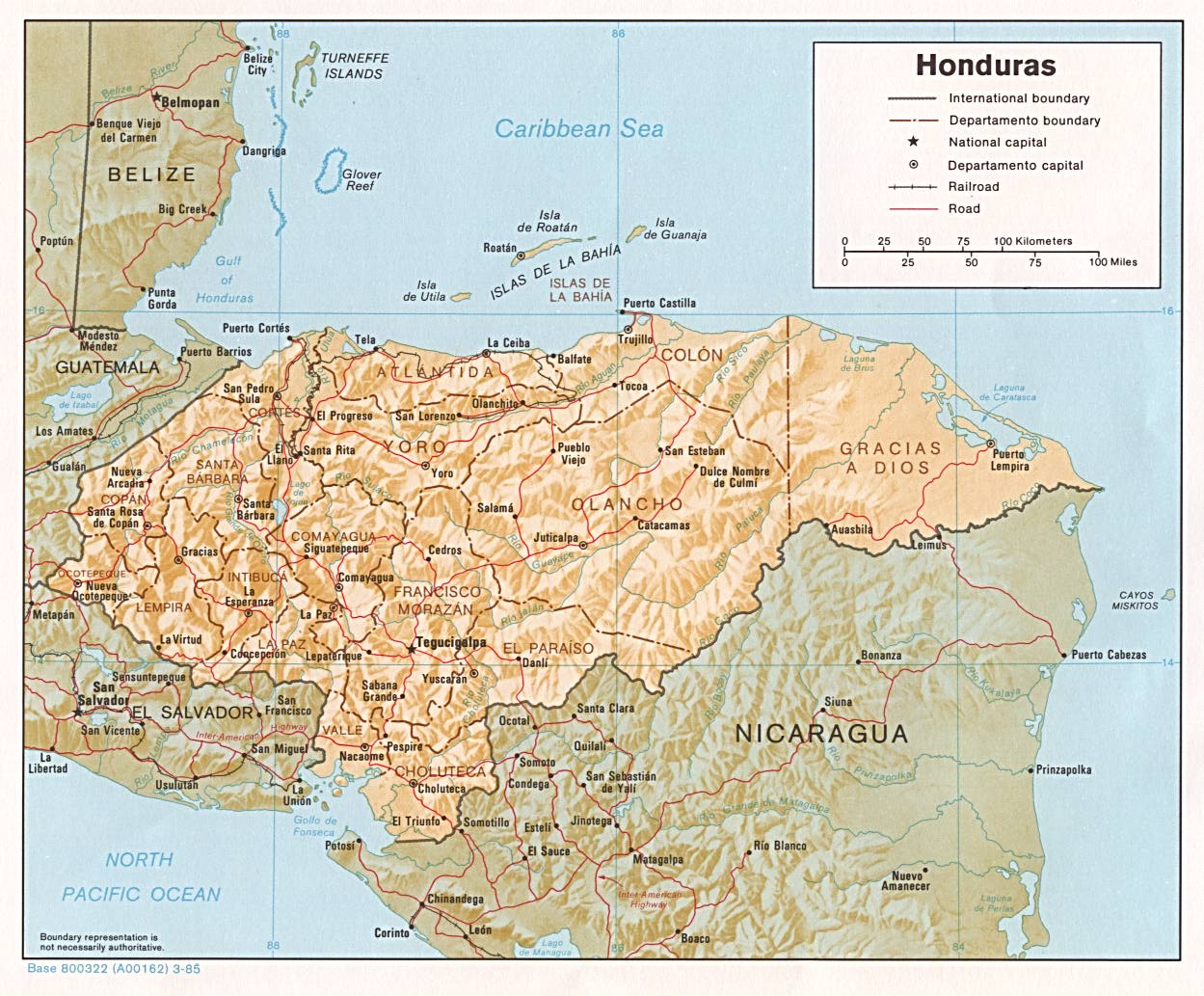
 Topographical map of Honduras
There aren't a lot of good updated maps of Honduras. We had a large map which had some handy street maps of the larger cities. Someone stole it out of our car! I was able to find these maps on the internet which I thought might be of interest to you.
Most of these are from (of all places) the University of Texas Library. The site indicates that these are in the public domain so it is okay for me to use them and okay for you to copy them if you wish. You might get a better copy if you go the link below each map though.
You can see that most of Honduras is mountainous. The large flat area to the east called Gracias a Dios is primarily swamps or wetlands and is only sparsely inhabited. It includes the area variously called La Moskitia for the native Miskito indians, La Mosquitia in Spanish, or the Mosquito Coast in English that was the setting of the Harrison Ford movie by the same name.
The CIA Factbook states that Honduras contains 112,090 sq. km. (43,278 sq. mi.), about the size of Tennessee. The major roads are marked in red on the above map. You can see that there aren't many.
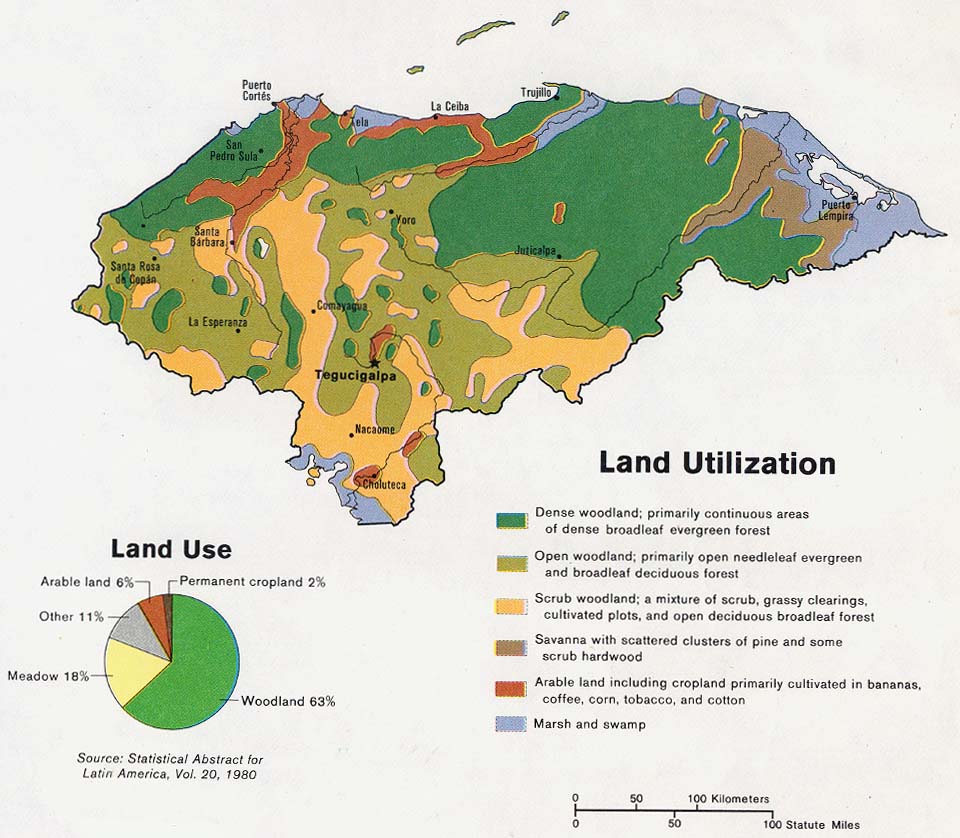
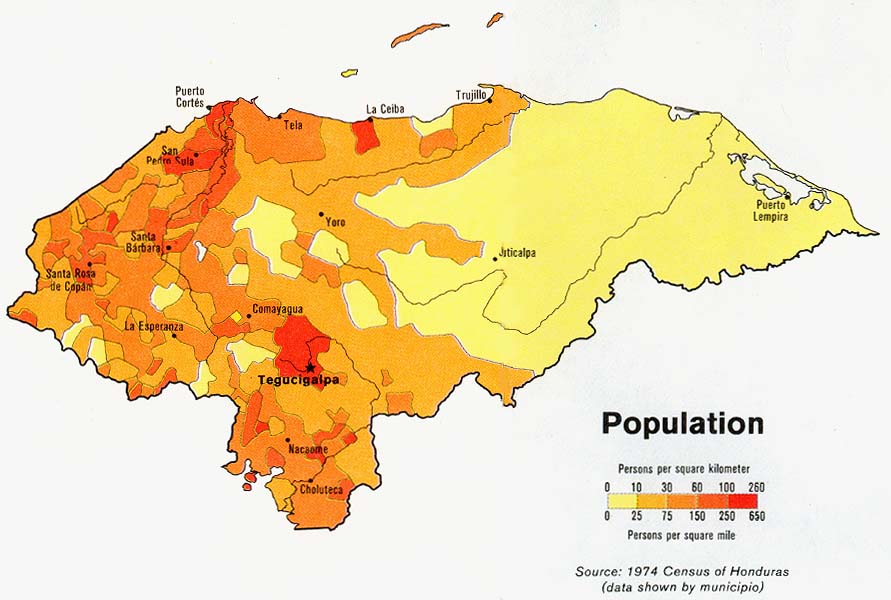
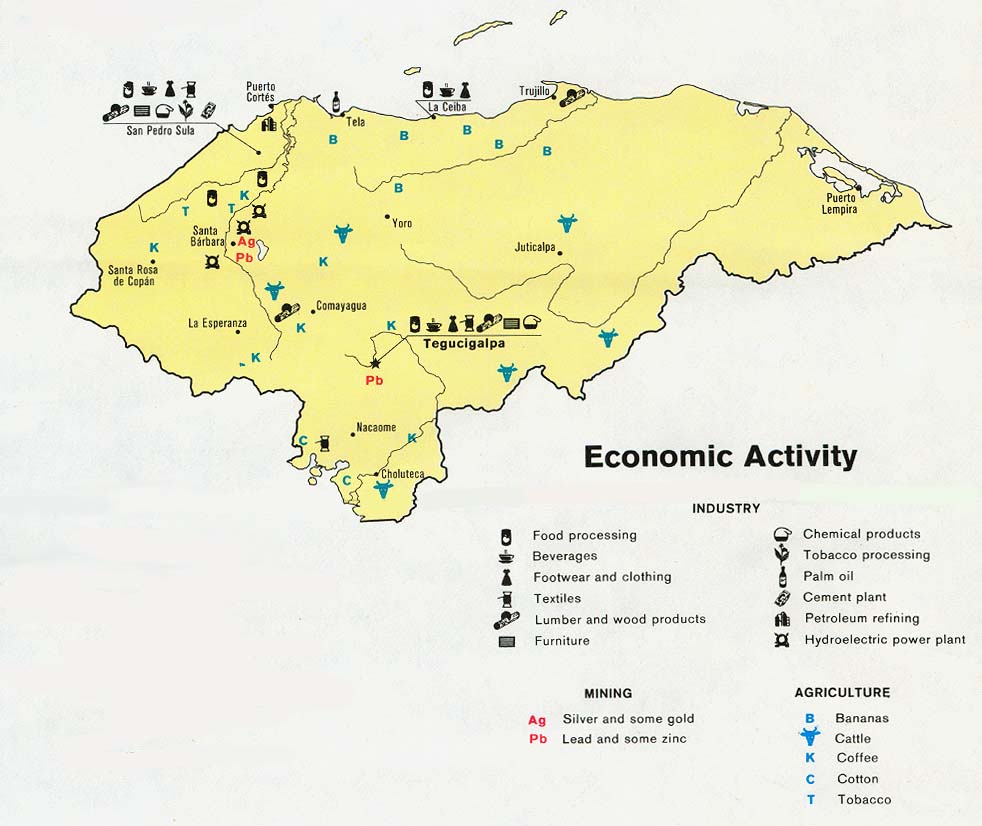
You will probably have to click these maps and enlarge them to be able to read them.
Amazing that only 6% of the land is considered arable. Much of the country is covered with mountains.
 Completely, horribly outdated, but it will still give you an idea of how the population is distributed across the country. I imagine that many of the small towns haven't changed a whole lot, while the larger cities have become much more populated. The CIA Factbook estimates the current population to be 7.3 million, of which 40% are under the age of 15. The median age is 19.5.
Population estimates vary widely but just to give you an idea, the capital city of Tegucigalpa has an estimated population of about 1.5 million, the industrial capital San Pedro Sula about 1 million, and La Ceiba, the third largest city, about 250,000 including the surrounding aldeas (villages). This is very old data (1983) but ....
There are many more maquillas (factories) now than there were in the 1980's, especially in and around San Pedro Sula, El Progresso, Puerto Cortes, and other areas.
 This is one of the only Honduran government issued map that I could locate. Honduras is divided into 18 departamentos (states). The yellow one at the top is Atlantida and that's were La Gringa lives.

 Bathroom sign
 Can you come here on vacation without knowing Spanish? Sure. No problem. Most hotels and tour groups have people who speak English. They can hook you up with an English speaking taxi driver. A lot of restaurants have someone who sorta speaks English, but a lot don't. You can always hire someone to be your guide.
 It's fine to learn "Dónde está el baño?" but what do you do when the answer is "idru &^$# ()gjeor% ufe#rgt wo*&#*cwst, señor!"? Sure, sometimes you luck out and someone will be around who speaks English. It may be fine to rely on that person to tell you what is going on with the bathroom, but do you really want to rely on someone else's translation when you invest in a house?
  Those of us with Honduran spouses have it a little easier, but do you want to be dependent on your Honduran husband or wife or friend or neighbor for even the simplest things? Will they always be around when you need a translation? Will they even be able to accurately convey what it is that you are trying to convey?
 I just think that anyone who moves to Honduras without knowing at least a little Spanish is putting himself up for a very frustrating time. I know people do it, but I have to think that they must feel a little like an outsider looking in at the rest of the world around them.
  I regret that I didn't learn more Spanish before I came here. The first few years could have been much easier − for me and for El Jefe, too. Even now, though my Spanish reading ability is very good, my speaking ability leaves much to be desired, which still can cause frustration and misunderstanding. I want to have intelligent discussions about things that are beyond my Spanish vocabulary! Even with simple subjects that I know very well, like cooking or gardening, I find myself completely stuck trying to find the right word.


 Welcome to my Blogicito —