Showing posts sorted by relevance for query drug ties. Sort by date Show all posts

July 8, 2009

US Congress wants to know: Does Zelaya have drug ties?

The US Congress has sent a letter to President Obama asking for his assurances that the US government has no knowledge of drug connections of former Honduran President Mel Zelaya. Highlighting is mine. A copy of the original letter can be found here.
~~~~~~~~~~~~~

July 2, 2009
President Barack Obama
The White House


Dear President Obama:

We write to seek your explicit personal assurances that U.S. intelligence or law enforcement agencies have no information implicating officials of the Honduran administration of Manuel Zelaya, including Mr. Zelaya himself, in the transit of illegal narcotics through Honduran territory or in any other ties to drug trafficking.

On June 30, the Associated Press published an accusation by a current Honduras official that Mr, Zelaya's government "allowed tons of cocaine to be flown into the Central American country on its way to the United States." Honduran Foreign Minister Enrique Ortez is quoted saying, "Every night, three or four Venezuelan-registered planes land without the permission of appropriate authorities and bring thousands of pounds ... and packages of money that are the fruit of drug trafficking.... We have proof of all of this. Neighboring governments have it. The DEA has it."

In light of your personal, public demands that Mr. Zelaya should be restored to power, we believe that you must assume personal responsibility for ensuring that our government is not aware of any information that suggests that Mr, Zelaya or his associates have been complicit in the trafficking of cocaine or any other illegal substances to the United States.

We are certain that the American people would be shocked to discover that the United States government is playing or has played any role in restoring to power any official who U.S. intelligence or law enforcement agencies suspect of any ties to the deadly illicit drug trade.

Obviously it is always wrong for the military to displace a democratically elected president. In this case, the situation is much more complicated because the political leader in question was in the process of violating the Constitution of his country in order to maintain personal power. Furthermore, Mr. Zelaya was replaced not by a general but by an elected member of the parliament, who was selected by a vote of parliamentarians. The Supreme Court of Honduras, as well as many political people in Mr. Zelaya's own circle, were opposed to his efforts to eliminate certain constitutional restrictions on his presidency. These complications should suggest that the United States be cautious and deliberate in response, as compared to challenges in other countries where dictatorial regimes brutally repress democratic elements. In this case the military action that was taken was done so to ensure the constitutional and democratic process in Honduras, rather than destroy it.

Sincerely,

Thaddeus G. McCotter
Member of Congress

November 1, 2009

Thomas Shannon, the US State Department 'cleaner'

Zelaya and Thomas Shannon
Photos: La Prensa, Honduras


How did Thomas Shannon, US Assistant Secretary of State, works such wonders in two days after four months of standoff? We'll probably never know completely, but some of the tactics are coming out. I don't think he'll be getting the Nobel.

My source in Tegucigalpa reported that Shannon "scared the living hell" out of everyone. We are talking about people who have stood up to the OAS, the UN, the US, Hugo Chávez, and virtually every country in the world for four months, but in one day, Thomas Shannon scared the hell out of everyone. My source also reported that that Shannon was pressuring Congressmen.

The Spanish newspaper La Vanguardia reports that Thomas Shannon threatened to prosecute Zelaya's son Hector, who now lives in the US, with drug trafficking if Zelaya did not sign the Accord. [google translation]

Thus Zelaya authorized signing of the Accord, but it is just another example of how the US really does not know Zelaya. He began recanting a day later. The US should have known better, since back in August, within hours of telling Hillary Clinton that he agreed to the old San José Accord, he was in an interview with CNN saying he would continue with the constitutional assembly.

Zelaya has already made it crystal clear that he has no intention of abiding by the Guaymuras Accord unless it results in his restitution to office. As a result, despite the agreement, nothing has really changed. In or out of office, Zelaya will continue to try to destabilize the country with the help of his followers. Jose Cardenas writing for Foreign Policy agrees. Martha Alvarado, Vice Minister of Foreign Affairs, believes as many do that Zelaya is trying to destabilize the elections. [google translation]

Even Jorge Arturo Reina, Zelaya's Ambassador to the UN, has announced that the agreement is broken if Zelaya is not returned to office. Reina has been named as Zelaya's representative to the Verification Commission. Jorge Reina's US visa was suspended several years ago because "he was implicated in alleged terrorist activities".


Speaking of drugs, have those US Congressmen ever gotten an answer from President Obama about whether or not the US has any intelligence about Mel Zelaya's narcotrafficking connections?

So the US is protecting a known drug trafficker in order to force a country to reinstall a corrupt president who possibly also has drug ties in order to....save face? cover their error? Nice.

In a special report from Tegucigalpa, El País reported that Thomas Shannon struck a deal with Pepe Lobo, the Nacionalista presidential candidate.

El País reports that Shannon told Lobo that he needed a guarantee that the restitution would take place, so he needed for Lobo's congressmen to vote 'yes'. Lobo reportedly agreed but asked that whatever happened with the vote, the US in particular and the international community in general would validate the elections − to which Shannon agreed. [google translation, but note that it isn't a great translation]

The Wall Street Journal reports that Shannon denies that this occurred. Of course he denies it.
I did not get a good feeling from Shannon's press conference in which he danced around the issue of Zelaya's restitution and never really gave a concrete answer. Pepe Lobo also denies that the private meeting occurred. Lobo has not taken a position on whether or not Zelaya should be restored.

The US believes that Pepe Lobo is going to win the election and are putting all their eggs in one basket. Personally, I do not think that the US has a good grasp of ANYTHING about Honduras. The US treatment of Honduras and Hondurans has been demeaning and it won't be forgotten soon. Neither will congressmen who vote for the restoration of Zelaya be forgotten on election day.

~~~~~~~~~~~~

Mary Anatasia O'Grady wrote in the WSJ: "Clearly no one in Washington expected it to be so hard to break the will of Hondurans." Why was their will so strong? Everyone here in Honduras knows that we don't have a dictator, even the people who call Micheletti that, so that wasn't the reason. The reason is that for once the government, the businessmen, the churches, and yes, the majority of the people, were fed up with corruption and were proud that they had done something about it. They were united in a cause as never before.

I have a better idea: How about if all the drug traffickers and corruptos are arrested, no deals are made with anyone, and the US quit digging themselves deeper in this hole to cover their butts for a bad decision. Let it really be a Honduran decision. Making amends is going to take a lot more than a beer for the harm that has been done to Honduras.

Hondurans finally feel empowered to stand up against corruption, something the previous US Ambassador Charles Ford always said was needed. Why does the US now want to crush that?

Update: Everyone and his dog has denied everything. Of course they have.

~~~~~~~~~~~~~~

I am reminded again of US President Barack Obama's pledge to Latin America:
"While the United States has done much to promote peace and prosperity in the hemisphere, we have at times been disengaged, and at times we sought to dictate our terms. But I pledge to you that we seek an equal partnership. (Applause.) There is no senior partner and junior partner in our relations; there is simply engagement based on mutual respect and common interests and shared values."

Nice words.

October 21, 2011

Drug Trafficking in Honduras (Crime Part III)

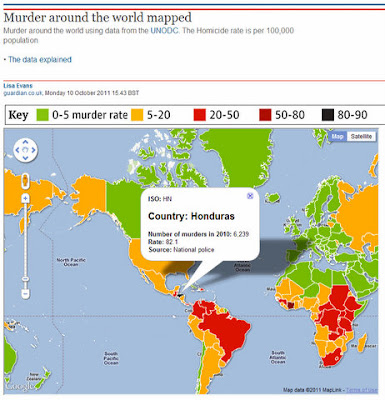
World murder rate map
Murder rate around the world
Go to Guardian UK for interactive map


"We are clear that these [homicide] statistics are high" said the police commissioner José Luis Muñoz Licona, who pointed out that one of the causes of increased violent deaths "is the product of confrontations between criminal groups, especially between narcotraffickers in the north coast, in the departments of Colón and Atlántida" without putting aside the departments of Cortés, Yoro, and Copán. "We are practically talking about all of the north, west, and Atlantic zones".

A reader sent me a report from the Woodrow Wilson Center: Organized Crime in Central America: The Northern Triangle (El Salvador, Guatemala, and Honduras). It's a frightening collection of four studies commissioned "to understand more fully how organized crime has evolved in Central America, and to examine the links between organized crime and traffickers in Central America, Mexico and Colombia and the role played by Central America in the supply chain for illegal goods." (Note: try this link if you are unable to open the PDF directly in your browser.)

Since most of my readers will not have the time to read all 245 pages, I'm including some excerpts related to Honduras that I found most fascinating.


Chapter 1. Drug Trafficking Organizations in Central America: Transportistas, Mexican Cartels and Maras

Central America's Transportistas

page 25
Not since Juan Ramón Matta Ballesteros have Central American
organizations played central roles in drug trafficking. They serve one central purpose: to transport drugs between South America and Mexico. For that reason, they are known in the region as transportistas. Increasingly, however, these organizations have also taken on the role of local distributors and, in some cases, the suppliers of marijuana and poppy, for the production of heroin, as well as importers and suppliers for the raw ingredients of synthetic drugs that are manufactured in Mexico, Nicaragua and possibly Honduras.

Increasingly in Honduras, some [transportistas] are reportedly emerging from the landed classes—sons of large cattle owners and other agri-business.

page 26
Narco landing strip, HondurasIn Honduras, the transportistas are, by and large, locals who have some experience trafficking contraband, stealing automobiles or rustling cattle. Although several intelligence sources mentioned that large landowners are increasingly entering the business, these landowners appear to be more important as infrastructure than personnel. Nonetheless, as in Guatemala, it is usually a family trade. Two of the more infamous transporters are Nelson and Javier Rivera, former car thieves and cattle rustlers. They run the so-called Cachiros gang, which stretches from Colón along the northern coast to the Gracias a Dios province in the East and the Olancho province to the south. Other, lesser known groups appear to operate in Yoro, Olancho and Cortés.
[See this Wikileak cable for specific reports of narco activity at the site of prominent Honduran businessman]

DTOs [drug trafficking organizations] in Central America

page 30
These two countries also see the most trafficking: In 2009, an estimated 200 metric tons passed through Honduras, and an estimated 250 tons went through Guatemala. The two main Mexican DTOs operating in these countries are the Sinaloa Cartel and the Zetas.

A Sinaloa Mayor in Honduras. Honduran police intelligence say El Paraiso, Copan Mayor Alexander Ardon works with the Sinaoa Cartel. Ardon has built a town hall that resembles the White House, complete with a heliport on the roof, and travels with 40 heavily armed bodyguards. Cameras monitor the roads leading in and out of the town, intelligence services say. And there are reports that the mayor often closes the city to outsiders for big parties that include norteña music groups flown in from Mexico.

page 31
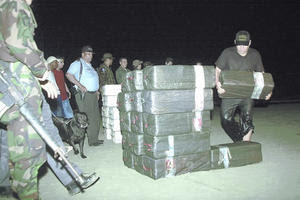
cocaine, HondurasIn Honduras, these agents say that Sinaloa factions work closely with transportistas in Olancho and near the Gulf of Fonseca. Sinaloa Cartel members are also reportedly buying land, building houses and co-opting local officials in the Copan, Santa Barbara and Cortés provinces along the Guatemalan border, areas they are also using for storage and trafficking activities

Penetration of the Government Forces and Institutions

page 34
To varying degrees, international DTOs and local transportistas have penetrated portions of the police, treasury, customs, military, attorney general’s offices, jails and court systems in Central America. They regularly finance pubic works and bankroll political campaigns. Their abiity to outspend the governments frustrates the local authorities and thwarts efforts to slow the DTO's growth. This is particularly true in Guatemala and Honduras, two governments that have seemingly lost control over large swaths of their territory.

page 37
In Honduras, in addition to the Copan, Santa Barbara and Cortés provinces alluded to earlier, authorities say the Cachiros’ control the local police in Colón, Gracias a Dios and parts of Olancho. Penetration into the police was evident July 2009, when ten members of the elite anti-narcotics Operation Group were arrested transporting 142 kilos of cocaine. The Cachiros have also attempted to control policy at a national level. When their liaison failed to secure their pick for vice-minister of security, they killed him. The would-be vice-minister is now a representative for congress.
[Los Cachiros also operates in La Ceiba.]

page 39
narco submarine, HondurasAn uptick by authorities in interdictions of fishing trawlers and cargo ships – “stateless vessels” – has pushed DTOs to rely more on go-fasts and the so-called semi-submersibles. The use of what are essentially mini-submarines is a relatively new phenomenon dating to the late 1990s when a clandestine factory for the first subs was discovered in rural Colombia. Today’s semi-submersibles are 45 to 82 feet in length and are made of fiberglass or steel. They have a range of 2,000 miles and can carry up to seven metric tons of cocaine. U.S. officials estimate that over 60 submarines move over 300 metric tons of cocaine per year.

page 40
Infrastructure abounds in Honduras to facilitate these landings, in particular in the Yoro and Olancho provinces. There are hundreds of clandestine landing strips and numerous old air fields in Yoro courtesy of the banana exporting companies that once dominated the economy. Yoro’s relatively flat terrain also permits airplanes to land on highways and sparsely trafficked roads. Olancho, meanwhile, seems to be a relative newcomer to the drug business. While the infamous Juan Ramón Matta Ballesteros bought large quantities of land in the department, it appears as if enough local agri-business kept drug running activities to a minimum until relatively recently when a so-called “new generation” began “lending” their large haciendas for drug airplanes. Farm owners are reported to receive $50,000 per flight.
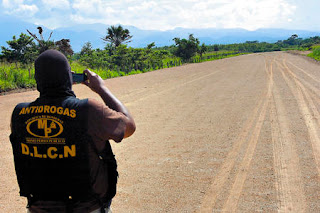
Narco landing strip, HondurasThe infrastructure needed to operate these landing strips is minimal. In just a few hours, teams of 25 to 30 men can cut the grass and trees, open up the fences and set up the lights to receive the airplanes. The airplanes are hollowed out and the drugs are packed in what are called fardos, which can weigh as much as a heavy suitcase (about 50 pounds) but are still easily manageable. The amount of drugs the planes carry vary, but one Honduran official said that traffickers found the shorter distance to Honduras gave the DTOs an opportunity to pack more drugs into each airplane. Once a plane lands, it takes between 20 and 30 minutes to offload the cargo into the waiting vehicles. As extra insurance, police are sometimes hired to provide protection and escorts for these drug shipments, for which the commander can receive between $2,500 to $5,000.

Money, Efforts and Challenges

page 52
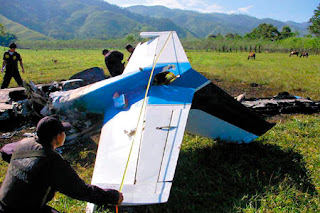
Narco plane, HondurasOverall, despite tough talk from its presidents, the region seems ill prepared to face what is arguably a bigger threat to regional security than the civil wars of the 1980s. In many ways, Central American countries are fighting against simple economics. An estimated $38 billion in cocaine flows from South to North America. The U.S. Government estimates that 42 percent of these drugs, representing $16 billion, pass through Central America, more than national government expenditures of Guatemala, Honduras and El Salvador combined in 2009. Fifty-nine percent of Hondurans live below the poverty line; 56 percent live below the poverty line in Guatemala; and 31 percent live below the poverty line in El Salvador.121 The poverty, mixed with the lawless environment that presides over the region, makes it an ideal place for the DTOs to operate. Murder rates in the northern triangle are some of the highest in the world. Impunity reigns. Few crimes are investigated. Fewer are resolved. In Guatemala, for instance, of the 6,451
murders in 2009, investigators resolved just 256.

Chapter 2. Honduras, Organized Crime Gained During Political Crisis

page 63
The public security situation in Honduras is among the worst in the world, ranking among the top five nations with the highest number of violent crimes and murders per capita. The government estimates that one person is killed every 88 minutes. The 2010 UNODC reported that the province of Atlántida, which includes the port city of La Ceiba, was among the most violent in the Western Hemisphere, with 1 person out of every 1,000 killed in violence crimes.
[Based on the 2010 UN report. Current UN statistics are higher.]

The Sinaloa Cartel

page 65
Police intelligence reports suggest the Sinaloa Cartel has installed operations in the states of Copán, Santa Bárbara, Colón, Olancho, and Gracias a Dios. In late 2009, the U.S. Department of Treasury froze the assets of Agustín Reyes Garza, “Don Pilo,” a member of the Sinaloa Cartel operating in Honduras.

In 2007 and 2008, it is believed that the cartel began buying off or killing potential local rivals. A top cartel leader was sent down to Honduras with a group of Mexican sicarios, or hitmen, over a 15 day period to kill off Honduran rivals. That leader then set up a “sicario school” in Honduras that recruited local operatives to continue providing security and protection for Sinaloa operations.

page 67
Minister of Security Óscar Álvarez has warned that the Sinaloa Cartel is attempting to buy off mayors and municipal officials while corrupting police officers. In that way, it is trying to create “parallel government structures” at local levels that will allow it a greater freedom to operate.

Reporting on the Sinaloa cartel’s activities, particularly its corruption of government officials, has become dangerous for Honduran reporters. Journalist Nahun Palacios of Radio Tocoa and Canal 5 in Colón was killed in March 2010. David Meza was killed near the port of La Ceiba after reporting on Sinaloa cartel activities in the area. Both had received threats from the drug trafficking organization prior to their deaths.

The Zetas

page 67
With the break between the Gulf Cartel and the Zetas in Mexico, the Zetas took over many of the operations inside of Honduras. They maintained ties with corrupt officials and kept track of the land titles and routes landing air and sea shipments in Honduras.

page 68
Narco plane, HondurasLike the Sinaloa Cartel, the Zetas have begun managing clandestine runways and transportation networks in Honduras. The country has become a key transfer point to take control of the cocaine as it heads northward into Mexico and then the United States. While some of the Zetas’ land routes overlap with the Sinaloa Cartel’s, the organization appears to prefer trafficking by sea, leaving from the area in or around La Ceiba and going to Guatemala, where they have better control of land routes, or all the way to Mexico.

From South America to Honduras

page 72
Nearly all of the world’s cocaine is produced in three countries in South America: Colombia, Peru, and Bolivia. The cocaine destined for the North American market must travel by boat or air to Central America and the Caribbean and onward to the United States.36 Approximately 90 percent of cocaine going to the United States travels through Central America and/or Mexico, though some analysts believe there has been a slight shift to the Caribbean route in the past year as Mexico has cracked down on drug trafficking in its territory.

Other Illegal Activity Linked to Organized Crime

page 77
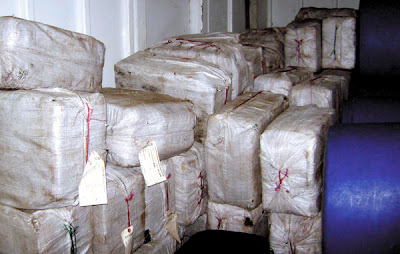
la cocaina, HondurasWhile the bulk of organized criminal money in Honduras is made from drug trafficking and extortion, a number of other illicit services occur as well. Some of these, like money laundering, are directly linked to the drug trafficking operations.

Honduras has a money laundering task force, but according to local authorities money laundering is less of an issue in Honduras than in some of its neighbors. The bigger issue concerns the large amounts of bulk U.S. cash smuggled through the country. As exchanging a large amount of U.S. dollars into Honduran currency (lempiras) is not particularly easy, most criminals and their related networks functioning in the gray and legal market prefer to work in U.S. dollars in Honduras. With limited government capacity to investigate financial crimes, criminals do not always feel the need to launder the money. In a country in which many crimes are never investigated or prosecuted, criminals who decide to keep their profits in Honduras can spend ‘dirty’ money with impunity without going through the time, effort, and cost of laundering the money.

Bulk cash smuggling is largely done over land routes or by air, often on legal flights from major airports. For example, in early October 2010, the Honduran police arrested four Colombian citizens attempting to traffic nearly US $1.5 million from the San Pedro Sula airport.

The effects

page 80
The influence of organized crime is evident in many locations, but no criminal organization “controls” large swaths of territory. Mexican DTOs have varying degrees of prevalence across the country, but there are few areas where analysts can clearly say, “this is Sinaloa territory” or “this is Zeta territory” in the way that areas of Mexico or Guatemala can be identified and mapped. Rather, there is a significant amount of overlap among the Mexican groups. There are indications that some gangs (maras) exercise significant control over neighborhoods (colonias) of the capital and San Pedro Sula, but these are more local phenomenon than transnational crime.
Impunity for crimes remains a problem.

Corruption within the Honduran political and security system is widespread due to the influence of organized crime. Drug trafficking organizations are willing to pay a month’s wages to a police officer or solider for one or two nights worth of work. Current and former police officers have been recruited to provide security. The corruption also creates a level of distrust within the institutions of government. Civilian and military organizations are more reluctant to share information outside their organization when they believe that it may be leaked to the criminals.

Politicians have also been linked with organized crime. For example, in 2003, a member of the Honduran Congress, Armando Ávila Panchamé of the Nationalist Party, was sentenced to 20 years in prison after being caught operating with a Colombian group bringing cocaine into the country. There is also strong evidence that at least one local mayor near the Guatemalan border, Alexander Ardon of the town of El Paraiso, has been corrupted by the Sinaloa cartel. Authorities suspect the number of mayors who receive a plata o plomo [silver or lead] style threat from the cartels is growing.

page 81
While the issue of human rights is generally discussed in the context of government actions or obligations, it’s worth noting that the criminal organizations in Honduras are a key violator of human rights in the country, depriving citizens of their right to life and security and indirectly violating their rights to fair and impartial institutions of justice by undermining the government institutions that do investigative and judicial work

page 91
Too often, government officials suggest that victims of crimes have been involved with DTOs or maras before full investigations are completed, which likely harms the ability to investigate organized crime and end impunity.


~~~~~~~~~~~~~~~~~~~


Even if you don't read the entire study, just from the excerpts that I posted, I think you can see that the situation looks pretty dire for Honduras.

I don't want to imply that I believe that narcotrafficking is responsible for all of the crime in Honduras, but there is no question that it plays a major part in it.

You might also be interested in these Blogicito summaries of a 2008 La Prensa exposé on Narcotrafficking in Honduras

July 2, 2009

More articles about the crisis in Honduras

"Proud to have a true democracy"
Photo: La Prensa, Honduras

More articles on the Honduran crisis that you may wish to read, Digg, or pass on to your friends:

Investor's Business Daily:
Banana Democrats

Front Page Mag: Defeating Chávez Democracy in Honduras

National Review Online: Ousting a Chávez wannabe

Reuters: Honduras rules defy world pressure to restore Zelaya

National Public Radio: The new republic: The fetishizing of the President?

The Devil's Excrement (2005 best Latino, Carribean, or South American blog): Why is Zelaya's constitutional coup attempt ignored by the world?

Yahoo news AP:Deposed Honduran prez accused of drug ties

China South America: The current situation in Honduras

~~~~~~~~~~~~~~~~~~~

Now, for an opposing viewpoint: see CNN en Español 24 hours per day

July 4, 2009

Honduras, alone against the world

Citizen support for the new government

If there are deaths in Honduras tomorrow, it will be the fault of false reports on the part of CNN en Español, particularly Krupskia Alis. CNN is called Chávez News Network here in Honduras.

CNN has a segment called 'keeping them honest'. Who checks on CNN? They will call my claim ridiculous, but there are hundreds of thousands of people in Honduras who know the truth because they watch CNN even though up until tonight's report, they have claimed that CNN was blocked from view in Honduras. Check CNN's iReports and all over the internet and you will read the same plea, "tell the truth about what is happening here!"

Equally responsible will be the United Nations and the Organization of American States. Those organizations claim to be concerned about democracy, yet they have judged and condemned Honduras without any chance to explain what happened or why the government officials believe what they have done was constitutional. None.

It's ironic that on the very day that US Americans celebrate their independence, their government was party to forcing a tyrant upon the Republic of Honduras.

Can people in the United States be condemned with the judge and jury denying a defendant a chance to defend himself? Can you imagine if the OAS told your Supreme Court to reverse a decision or told you that you had to keep a corrupt president? This action is as barbaric as they claim the golpistas are.

Those organizations also claim to be concerned about the human rights of Honduran citizens, but they, with the support of the United States of America, ignore the wishes of the Honduran citizens by trying to force upon them an inept, corrupt, drug-taking president who is said to have ties with narcotrafficking. How can this be? Isn't the United States against drug trafficking?

Also, it seems that if they were truly concerned with the human rights of our citizens, they would not stand by silent while Hugo Chávez of Venezuela threatens to spill blood in our streets. Oh, well, I guess they think that as long as we have TV and no curfew, we'll be free!

The Secretary General of the OAS, José Manuel Insulza, is much more concerned with the damaged dignity of one person, than damaging the future security of 7.5 million people in the second poorest country in this hemisphere. In only six days, our new leaders have uncovered US $31 million of misused funds and found that the President has put the country into a level of debt never seen before. In the six days that he was gone, he ran up a debt of US $80,000 on his government credit card. That amount alone would have fed 32 families for a year.

Our new president has told us that no citizen is above the law in our country. That hasn't been true in the past in Honduras, but this time citizens feel empowered and they are going to hold their president to his word. Despite the threat from Ecuador and Nicaragua, our leaders have said that Mel Zelaya will be arrested tomorrow when he lands in Honduras.


But it won't happen without violence. Groups of criminals and thugs, some who have entered the country illegally from Nicaragua, have been terrorizing Tegucigalpa, encouraged by the CNN en Español reporter, who ignores the hundred thousand peaceful marchers all over Honduras, just as CNN in the US ignores the thousands of internet postings from Hondurans asking for fair coverage. Unless the Honduran military can perform a miracle, people will be hurt or killed tomorrow, July 5, 2009.

Hondurans thought of the United States as a friend. Most thought that they would be supported, not condemned, for their fight for democracy against a tyrant who ignored the laws and constitution and called our highest court "the Supreme Court of Injustice".

Honduras is small, but proud, sovereign country. Honduras will stand alone against the world for as long as it can. Its citizens will be prouder of themselves and their government than they ever have been before. And they will find out who the true friends of democracy are.

November 26, 2011

From the 'too odd to believed' criminal cops files

Poll: International invention in corrupt cops, Honduras
Poll: Do you agree or disagree that international organizations supervise the purification of the police?
79% agree, 14% disagree, 7% don't know or no response.
The chart on the right shows the political parties of the respondents who agree.
Image: La Prensa, Honduras


Kidnapper cop

On his day off last Saturday in San Pedro, police agent Adonis Faustino Romero Banegas accelerated to avoid a military road block. A soldier fired a warning shot in the air and Romero stopped further on, but two other suspects in his vehicle fled before soldiers reached his car. Though he tried to use his police position to avoid search, he was caught carrying two weapons without documentation, one of which was verified to have been stolen in 2007. The VIN numbers of the vehicle he was driving had been altered and a complaint was made that he had been lent the vehicle and failed to return it. [all links are in Spanish]

Furthermore, it was discovered that Romero had an unexecuted order of capture against him issued by a Copán court in January 2002 for the crime of kidnapping. The article didn't mention whether he was hired by the police before or after the kidnapping charge or why the police were unable to capture a suspect for 9 years who is on their own payroll. In the initial hearing for the charge of carrying an illegal weapon and abuse of authority, Romero was released by the judge and must voluntarily report to the court periodically until the trial. Apparently the kidnapping warrant was still not executed. "The investigations continue and if he is found culpable, he should be castigated.....", said the police spokesman.

Is this an example of change and police purification that Minister of Security Pompeyo Bonilla and President Pepe Lobo have promised?

Top level narco-cop "investigated" since 2002

In another police exposé, apparently tipped off by a high level official, El Heraldo has exposed massive corruption and criminality of a high-level police officer who has been 'under investigation' by the DLCN (anti-narcotrafficking department of the MP) and the Anti-Organized Crime prosecutor since September 2003. During the 8-year period of 'investigation', not only was the official not criminally charged or even suspended, EH says that the unnamed official has accumulated great wealth and has been promoted from comisario through the upper ranks, and is now head of one of the five directorates of the police department.

In the voluminious report of which EH has a copy, it was shown that the official and a relative of his have ties to organized crime and narcotrafficking through a female relative of narco Manuel Antonio Avilez Durón, who was captured in Panamá in 2002 and extradited to the USA. The investigation began when this official was comisario in Copán, later transferred to Gracias, Lempira, only 45 kilometers away.

Accusations include drug trafficking, including selling drugs out of his own heavily secured and walled house, personally passing on shipments of cocaine and heroin to Guatemalans, transporting drugs from Colón and Olancho to Santa Rosa de Copán, as well as distributing drugs within Copán. Through his police connections, he was also tipped off to operativos, which might help to explain why even when massive amounts of drugs are confiscated, there are almost never any narco suspects captured in Honduras.

Other accusations include that, along with a police chief in Santa Bárbara, he participated in robberies of shipments of goods by truck. His personal vehicle was a F-150 truck originally owned by Avilez Durón. He and his relative have suspicious financial activity that could point to money laundering and illegal enrichment. The investigations also pointed to contacts with "influential persons in the current [at that time] government" as well as involvement in a 12-person gang of auto thieves.

In a response to DLCN in February 2004, Coralia Rivera, then director of the police and now Vice-Minister reporting directly to the top police official, stated that they had knowledge of the situation and that is why he was transferred to a different position.

The case was initially opened in September 2003 under the direction of Julián Arístides González, head of the DLCN, who was assassinated in a drive-by shooting in December 2009 while dropping off his daughter at school. In a new report in 2010, the DLCN gave a summary of the advances in the investigations. It was noted that the official took out large long-term loans, but then paid them off in 3-4 months, and that all three suspects had large bank accounts with suspicious financial activity.

Though not naming the person, EH concludes the article by listing the five commissioners who are the current heads of the five police directoratives. A few days later, Proceso Digital through a source in the president's office, announced that Transit Commissioner Randolfo Paguaga Medina had been suspended [alternately spelled in the news Paguada, Pagoaga, and Pagoada]. That rumor was quickly and firmly denied by police authorities.

Under investigation for 8 years! Not fired, not charged with crimes. Instead transfered here and there spreading the corruption, and then ultimately promoted to one of the highest levels in the police organization.

Minister Bonilla's response

You aren't going to believe this: On a morning talk show on Monday, the day after EH's exposé was published, Minister Pompeyo Bonilla asked El Heraldo to provide him with the investigative report and tell him who the commissioner is because Bonilla doesn't know. "My door is open and when we know, we'll take action in this case." — this despite 8 years of investigation, including stakeouts outside the suspect's home, the detailed information about where he was assigned when, information about his vehicle including his license plate number, and confirmation that Bonilla's number two official was cognizant of the investigation in 2004! If El Heraldo would only tell him who it was, Bonilla promised a "profound investigation" and if anyone has committed "indecorous" or criminal acts.... well, you know the rest of that line. "Indecorous"?

I was going to write that that 'Bonilla disingenuously asked....', but let's call it what it is: 'Bonilla deceitfully asked....'. The seriousness of the police scandal has been in the headlines for a month. Bonilla has promised thorough investigation and purification of criminal cops including at the highest level. There are only two choices here: Either the top cop and his immediate command are completely incompetent or he is being deceitful about what he knows. I guess we'll be looking at another several years of profound investigation until this pops to the limelight again as this unnamed official is obviously one of the 'untouchables'.

Inspector General of the police, César Augusto Somoza, also affirmed that he has no knowledge of any member of the police leadership involved in organized crime.

In an interview with El Heraldo reported on Friday, Minister Bonilla made the amazing comment that he has not even asked his top cops if they are the one in question. Additionally, he says that he has asked for reports from the prosecutor's office, DLCN, the courts, and others but implies that he has not received them yet. He has not spoken directly to DLCN. He basically implies there is nothing he can do until and if the official is charged and tried at which point he "will ask for the official's resignation". Wonder if he will receive it.

When asked directly where were ex-director José Luis Muñoz and the other officials who were replaced on October 31, Bonilla evaded the question by saying, "I haven't had the pleasure of communicating with them in the past days. They are in a condition of availability". When asked about other separations, he blamed the employment laws as preventing him from taking action, adding that the laws protect the rights of a few people at the detriment of the majority of society. He says that he needs the legal tools... but when referring to the law proposed by former Minister Alvarez, Bonilla also states that they can't be dictatorial. He also has been unable to find a diagnostic report about the police department performed by Colombian experts in the past few months.

Is this an example of transparency and police purification that Minister of Security Pompeyo Bonilla and President Pepe Lobo have promised to complete within the next six months? Is this an example of the authorities promises over and over again to the public that they will not cover up for any police officers? Why must whistleblowers leak information to the media in order to for the authorities to admit anything?

Narco police raid or police narco raid

In another one of cases from the 'too-odd-to-be-believed' file, in July of 2009, 12 Tegucigalpa police agents, some of them on vacation and another suspended from duty, traveled to La Mosquitia in the remote state of Gracias a Dios either to a) rob a narco's home of 143 kilos of cocaine (estimated value US $1.1 million) or b) perform a secret police operativo unknown to their supervisors, the local police, prosecutors, the DLCN, or the Minister of Security.

In addition to no one in authority knowing anything about this 'operativo', a few other pesky details were that the raid occurred at 4 am (an illegal hour for such activities), these officers were assigned to areas such as homicide and auto theft, some were on vacation at the time and one was suspended, the cocaine was not turned over to higher authorities but instead was hidden and was being guarded by a civilian, the officers used illegal weapons such as AK-47s and grenades, they stole two boats to transport the drugs upriver, and one of the officers was found hiding out in a hotel room with a kilo of cocaine and two AK-47s.

Neighbors alerted local police to the early morning home invasion by armed strangers. The suspects were later captured by a joint operation of local police authorities, DLCN, DNIC, and navy officials. The ten police could not justify being in the area and had no paperwork authorizing the operativo. They were charged with eleven administrative and criminal offenses, including trafficking of drugs, illegal weapons, and theft of two boats.

Captured were Mario Guillermo Mejía Vargas, head of the Homicide unit, Marvin Mauricio Zavala, sub-chief of the auto theft unit, Karil Alexis Romero Maldonado, Wilmer Fiallos, Josué David Villalobos, Jorge Luis Borjas Valladares, Miguel Ángel Cerna y Víctor Hernán Ortiz. The other two, injured in the operativo/robbery, were subinspector Juan Francisco Sosa (who was at the time suspended from duty) and agent Carlos Díaz, who were sent to the capital for treatment and later escaped.

The operativo was supposedly unilaterally ordered by José Francisco Murillo López, then commissioner of DNIC (criminal investigation), who was initially suspended and investigated for the suspicious anti-drug operative. He was returned to duty in November 2009. He said that he had only sent the sent the agents to gather information, not perform an operativo, and he produced a memorandum to that effect, some believe after the fact.

Julián Arístides González, now deceased director of the DLCN, described the entire situation as totally irregular and said it was evidence that the DNIC was infiltrated by narcotraffickers.

At their initial hearing, they were ordered to prison pending trial. That decision was confirmed by the appeals court in May 2010, and the Supreme Court in February 2011. This was celebrated as one of the few times that the justice system seemed to work against corrupt cops.

The case seemed pretty clear, but alas, in March 2011 the La Ceiba sentencing court chose to believe option b) and not only absolved the suspects from any wrongdoing, but ordered them back to police duty. Police authorities were able to hide from the public the fact that these agents have been back at work since May 2011.

This may have been around the same time that former Minister Oscar Alvarez became more vocal, but still vague, about police corruption and judges forcing the department to reinstate bad cops. In September, he proposed a law which would allow the Minister the discretion to fire police officers. He was asked to resign shortly after that. Both President Lobo and Minister Bonilla are blaming him for the poor administration within the department.

From the President

Times of horror, HondurasMeanwhile, President Pepe Lobo tells the public that the police will be purified within six months and that we'll all be living in peace and tranquility in nine months. In somewhat of a contradiction, Lobo stated to media directors in a meeting on Friday that "We stand practically in zero on the police investigations; we don't have the capacity to investigate".

Cartoon titled "Times of horror", by Dario Banegas, La Prensa.
Home

Related Posts Plugin for WordPress, Blogger...
