December 24, 2008

Feliz Navidad by video from Santa's elves

Send your own ElfYourself eCards


Feliz Navidad
from La Gringa and El Jefe!


I hope this gives everyone a laugh!


(I hope this video works. It is hilarious! If you don't see the video, try this link. It will only be available until January 15th. Yes, that is exactly what we look like! Heheheh)

December 15, 2008

Culture or customs?


Dictionary.com gives a long page of definitions of culture. Here are some excerpts:
culture: The sum of attitudes, customs, and beliefs that distinguishes one group of people from another. Culture is transmitted, through language, material objects, ritual, institutions, and art, from one generation to the next.
cul⋅ture 1. the quality in a person or society that arises from a concern for what is regarded as excellent in arts, letters, manners, scholarly pursuits, etc. 3. a particular form or stage of civilization, as that of a certain nation or period: Greek culture. 5. the behaviors and beliefs characteristic of a particular social, ethnic, or age group: the youth culture; the drug culture. 6. Anthropology. the sum total of ways of living built up by a group of human beings and transmitted from one generation to another.
I often hear or read about people saying that they love the Honduran culture. I wonder which parts of the culture they are referring to. If someone is picking and choosing what they like by referring to the art, language, food, or personalities of some of the people that they have met, maybe that is a fair statement. In most cases, if they are referring to "the sum total of ways of living", then I have to believe that they are not very well informed about Honduran culture today.

Honduras has one of the highest crime rates in the world, the highest rate of violence against women in Latin America (translated version), one of the highest poverty rates in the western hemisphere, and one of the highest rates of mistrust among the people. Rates of alcoholism, child abuse, teenage and other out-of-wedlock childbirth, and incest are off the charts. Honduras corruption is renowned and not just within the government but within all layers of society.

If such actions and traits are so widespread, aren't they a part of the culture, too? When is 'culture' just a custom or even just a bad habit?

And when should culture change?


It's funny and maybe backwards thinking, but to me, those who patronize and blame some serious, harmful flaws on the 'culture' are stereotyping. I think it reflects the typical U.S. superior attitude that "these people" are different and just can't learn and need to be coddled and taken care of like children. You could say that many of those customs are part of the culture or you could say that they are merely a lack of education or awareness of what it takes to get by in the world today.

No. I don't agree that people can't change or learn or that any culture should be revered in its totality, including and maybe especially USA culture. I imagine that there are good and bad things about every culture. There are some people in every country who will be losers no matter where they live or what opportunities they are given. Most people, however, are capable of learning, whether it is learning a job and doing it responsibly or taking care of their children properly. It's just a matter of whether they a) have the opportunity, and b) are motivated to do so or not.

An estimated 1.2 million Hondurans (of an estimated population of 7.6 million), have left Honduras and presumably the majority have adapted and succeeded in varying levels in their new countries. I hear from a lot of expatriate Hondurans who revere the old culture and lament the culture (or customs) of Honduras today. I also hear and read a lot of comments from Hondurans living in Honduras today who lament the changes in the country.

Some say that they love the Honduran culture of "family". I wonder if they have any idea how many children are born each year who will never know a father, how many fathers who have children by multiple women with no thought to ever providing support or taking responsibility for their children, or how many teenage girls pop out a baby by a different guy every year until they finally find one who will stick around. These behaviors were not part of the culture 30 or 40 years ago, so that shows that cultures do change and not always for the better.


Other people come to Honduras believing that they will be the saviors. They seem to think that all they have to do is to teach someone how to do a job or start a business or about the importance of hygiene, health, good eating habits, clean water, saving the environment, and on and on up to the subject of God, and all will be right with the world.

Nope. If only it were that simple, Honduras would have changed a long time ago.
The culture gets in the way. Whether it is a result of generations of ignorance and poverty or apathy instilled from birth, that desire for change is often severely lacking in the people who need it most. More often those visitors go home saying that their lives were changed, not the Hondurans with whom they dealt.

Some other examples of customs or culture have to do with health. A simple thing like leaving food sitting out in homes and restaurants, for example, is a custom that probably results in a lot of food poisoning and diarrhea problems. The Honduran media does a really good job of informing the public about the causes diarrhea, dengue, AIDS, and other diseases and the Honduran customs that need to change to prevent them. Parents are told the importance of vaccinating their children (which is free) and eating healthy foods. Thousands of missionaries and international aid organizations do the same every single year.

Are these people trying to change the culture, which we are always told is a politically incorrect no-no? Or are they just trying to educate the population to some of the beneficial things that we've learned in the modern world?

Children playing with fire crackers is definitely part of the culture
, for example, being shot off at children's birthday parties and holidays. But hundreds of kids get their fingers blown off every year so some local governments have started outlawing it. They are trying to change the culture (or custom) for the safety of the children.

Dental hygiene is not part of many poor Hondurans' culture. Should it be? Are dental and medical missions who pass out toothbrushes and try to teach the importance of brushing teeth trying to change the culture or just trying to improve the lives of those children? Is it okay for parents to say "si Díos quiere" and hope their kids' teeth won't rot out from eating candy and drinking Cokes all day? Or should parents have some responsibility to start changing some of the customs for the sake of their children?

Some of these customs may be part of the culture or maybe they are merely a result of a lack of education. I happen to believe that the lack of work ethic among many Hondurans is primarily a lack of education as are a lot of the unhealthy habits.

Honduras has wholeheartedly embraced change with the advent of the cellphone. You would be hard-pressed to find anyone who doesn't have one, even if it means that their children don't eat properly or can't go to school. Television, especially cable TV, is important to those who can afford it and have electricity. But in many, many other ways, there just is no desire for change, not if it means making an effort to learn something new or changing one's ways merely because it will benefit the children, the family, or the country rather than the individual.

Often, sadly, people are not motivated. "Cuesta!" is something I have heard frequently. "Cuesta!" means "It costs!" and in the context I'm referring to, it doesn't have to do with money, it has to do with putting forth an effort, taking those extra steps to do a good job, or striving for success. Pride in workmanship is so very lacking.

Once upon a time, none of us knew all the things we now know about health and foods and chemicals and the environment and a million other things. The world changes, don't people have to change, too? Is it okay to keep harming your children and your environment just because you always have − it's in your culture?

Now if there were some idyllic, untouched paradise where the "old ways" were still providing health and happiness to its population (by its own standards), I would say "Fine! Leave it the way it is." But with 60% of its population living in extreme poverty, many in poor health, many just plain hungry, and most in ignorance which severely affects their quality of life and ability to find or hold a job,
Honduras clearly does not fall into that category.

In many ways, it is hard to even find a Honduran culture, so much of it has been replaced with the US culture. The sad part is that Honduras seems to have picked up the materialistic, unimportant, and even harmful parts of the US culture without picking up the good parts that could help to pull it out of the third world category.

The following is a quote from an old article in Honduras This Week (link no longer available), the English-language newspaper of Honduras:
Culture, therefore, should be a life-enhancing process, not some semantic refuge in which boors, barbarians and miscreants can hide. Moreover, history strongly suggests that "cultures" that do not adapt to external models and influences stagnate, atrophy and die. The inclination to absorb and be stimulated by such influences is encoded in cultures that survive and thrive. It's their nature to accept change and evolve. It's the key to their very survival.
This paragraph really struck me and I saved it knowing that sooner or later, I'd write an article where these ideas would fit. Lorenzo D. Belveal had these thoughts about patronizing Central America:

Our (US) national policy toward this region is largely unchanged from the approach that Franklin Roosevelt fashioned under the canopy of his "Good Neighbor Policy."

This unfortunate notion essentially called for patronizing Central America as one might indulge small, somewhat mentally deprived children. As long as they were "nice," the goodies kept coming in the form of non-repayable loans, grants, technological missions, and a variety of other direct and indirect "payoffs" for good behavior.
An even tougher question is "How can destructive aspects of a culture be changed?" I have no answers to that one.


December 13, 2008

La Gringa finally gets her rain gauge

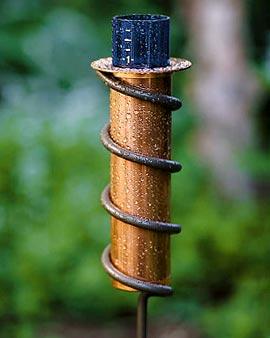
La Gringa's tropical-sized rain gauge, La Ceiba, HondurasLa Gringa's tropical-sized rain gauge

I can't help myself, I like facts and figures. It annoys me that there is no official recording of rainfall amounts for Honduras. Why? Panama has measurements! Of course, it varies a lot by area, so even if there were "official" measurements at the La Ceiba airport, I would want to do my own. It often rains in town when it doesn't here and vice versa.

rain gaugeI searched the internet for ages looking for a tropical-sized rain gauge with no luck. Some gauges are very large but still only measure 5-6 inches (13-15 cm.) of rain. I fell in love with this copper design in August 2006 but it was too small. When you are in the midst of a tropical storm, you don't exactly feel like going out in the rain to empty the gauge two or three times a day.

Then in March 2007 I joked about my 55-gallon drum rain gauge. While functional, I was looking for something just a bit more attractive than that. I was going use a 12-inch straight-sided vase that I had and have a base made similar to the copper one. Anxious to get started with my gringa-obsession of measuring, one day I stuck the vase out in garden, partially obscured and protected from dogs, I thought. But nothing escapes Chloe in her domain. Need I say more?

One day we saw these huge 24 inch (61 cm.) straight-sided vases at a hardware store and bought two of them − one will get broken, right? So, half the problem was solved. I was still talking about "my" rain gauge in March 2008. Who says I don't have patience? It only took us 28 months to get this rain gauge made.

El Jefe talked to several iron workers about making it. Some didn't have the right equipment to do the curves, some didn't want to bother with a small job, and two took our drawing and measurements and just never bothered to make it and lost the drawing. (When will we learn to keep a copy?)

La Gringa's tropical-sized rain gauge, La Ceiba, HondurasWe finally found someone willing to do it. Of course, he completely ignored our drawing and measurements but it turned out nice just the same. The base is about 5 feet (1.5 meters) so that it goes into the ground very deeply and is secure even when the ground is saturated.

El Jefe painted it for me and he was so eager to put it out that I didn't get a chance to mark the inches on it. I'll do that when this rain stops (check back with me in 6 months or so) and in the meantime, I'm carrying a ruler out there to measure.

I like it. I'm happy.

By the way, from sometime early Thursday morning until Friday morning, we had a whopping 16 inches of rain (41 cm.)! And that is a fact, not a guess.
Newer posts Older posts
Home

Related Posts Plugin for WordPress, Blogger...