
Last month I wanted to start some vegetable seeds. I missed the right moon phase and didn't want to wait for the next time so I went ahead anyway. I used my usual method of pre-sprouting in paper towels (sometimes called the baggy method). I put the plastic bag on top of some newspapers on a heating mat instead of my usual place, on top of the water pump. 100% failure. Not one single seed sprouted!
The problem could have been the heat mat but I really don't think it was too hot. It was only set at 85°F (29°C) and the seeds were protected by the newspapers and paper towels. Don't even think that it was too cool − this is Honduras! It could have been the moon phase, but since I'm not completely convinced of that yet (but getting there), I thought maybe my seeds supply had succumbed to the tropical heat and humidity and were no longer viable. I've never had 100% failure of 40 seeds before!
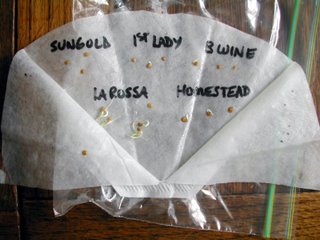 According to my moon calendar, last Wednesday was a good day to start annuals, so I tried again. This time I used coffee filters; the idea came from Rob's Plants (lots of good information in both of these links). Ooh! I really like this better than paper towels. Much neater and I imagine the paper will hold up longer than paper towels for seeds that need more time to germinate. The paper towels always start falling apart after 6-7 days of unfolding and refolding the wet towel.
 I slit open one side of the filter, wrote the names of the seeds with a permanent marker and then moistened the filter before placing the seeds on it. The flat basket type of coffee filter might be better, but since I had these cone filters and no longer have that type of coffee maker, I thought it would be a good use for them.
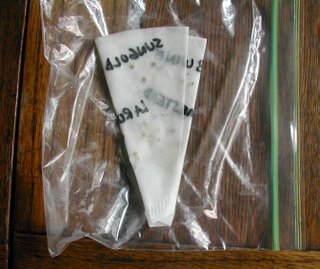 After placing the seeds, I folded the cut sides back to the center, firmly pressing them against the seeds. I then folded this up a couple of times more and placed the filters in a plastic zip lock bag. I placed the plastic bag on the water pump.
First I'm going to tell you what should be done: Check the seeds daily by opening up each filter. This also lets a little air into the bag. As each seed germinates and sends out its tiny little root, the seeds should be planted or potted up immediately to prevent the roots growing tangled together or growing through the paper. For seeds that take more than a week to germinate, you may need to remoisten the paper.
 Now I'll tell you what I did: I checked the seeds the next day; nothing had germinated. The second day, I forgot to check. The third day I checked, but not until late at night so I didn't get these babies planted until the fourth day. As you can see, the squash and cukes were way past time for planting.
 If a root grows through the paper, it is best to tear off that part of the paper and just plant it with the seed. It will disintegrate and won't harm the roots at all. It's better to do that than to risk damaging the roots by separating them from the paper. The Homestead tomato seeds in the top photo are at the perfect stage for planting.
 I potted up the smaller seeds in cellpacks, labeled each cell, and then covered the cellpacks with a clear plastic cover. I love that little stainless steel tool for picking up seeds and pricking out seedlings. It's much better for me than using my fingers. I always end up dropping the seeds or damaging the seedlings.
I potted up the squash and cucumbers in 4" (10 cm.) pots. I usually plant the pre-germinated squash and cuke seeds directly into the ground, but we have had very hot weather alternating with heavy rain storms lately. Since the roots were already so long, but still so delicate, I thought they will have a better chance in pots.
 The remaining ungerminated seeds were folded back up in the filters, put back in the plastic bag, and placed on the water pump, to be checked tomorrow.
Another time I think I'll do an experiment, planting some seeds with the moon and some in the wrong moon phase to see what happens. It will have to be with my jalapeño seeds, of which I have thousands, because the rest are too precious to waste! I've done some experimenting. Even though it hasn't been very scientific, I have to tell you that I'm really starting to think there is something to this moon phase business!
The problem could have been the heat mat but I really don't think it was too hot. It was only set at 85°F (29°C) and the seeds were protected by the newspapers and paper towels. Don't even think that it was too cool − this is Honduras! It could have been the moon phase, but since I'm not completely convinced of that yet (but getting there), I thought maybe my seeds supply had succumbed to the tropical heat and humidity and were no longer viable. I've never had 100% failure of 40 seeds before!
 According to my moon calendar, last Wednesday was a good day to start annuals, so I tried again. This time I used coffee filters; the idea came from Rob's Plants (lots of good information in both of these links). Ooh! I really like this better than paper towels. Much neater and I imagine the paper will hold up longer than paper towels for seeds that need more time to germinate. The paper towels always start falling apart after 6-7 days of unfolding and refolding the wet towel.
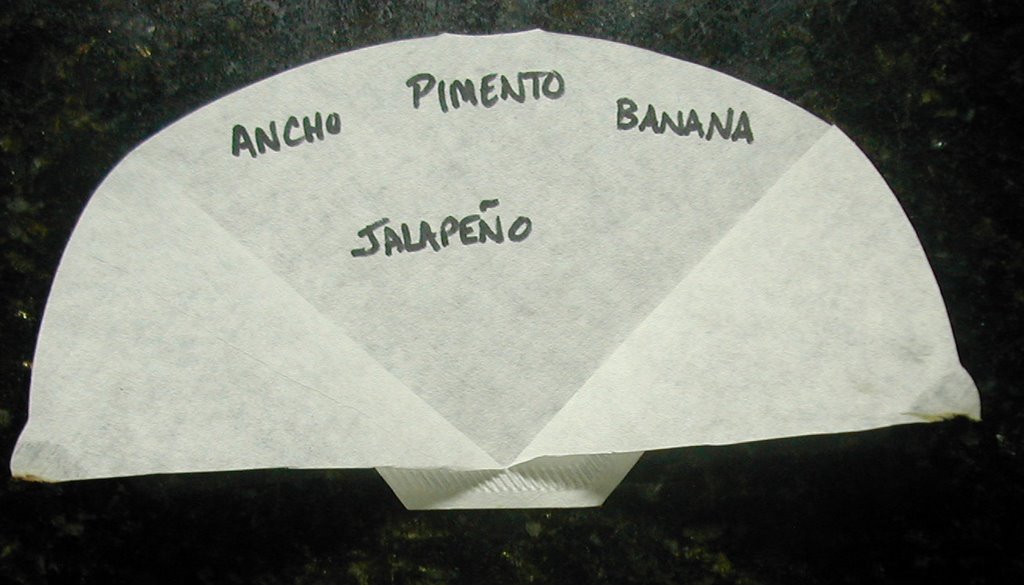 I slit open one side of the filter, wrote the names of the seeds with a permanent marker and then moistened the filter before placing the seeds on it. The flat basket type of coffee filter might be better, but since I had these cone filters and no longer have that type of coffee maker, I thought it would be a good use for them.
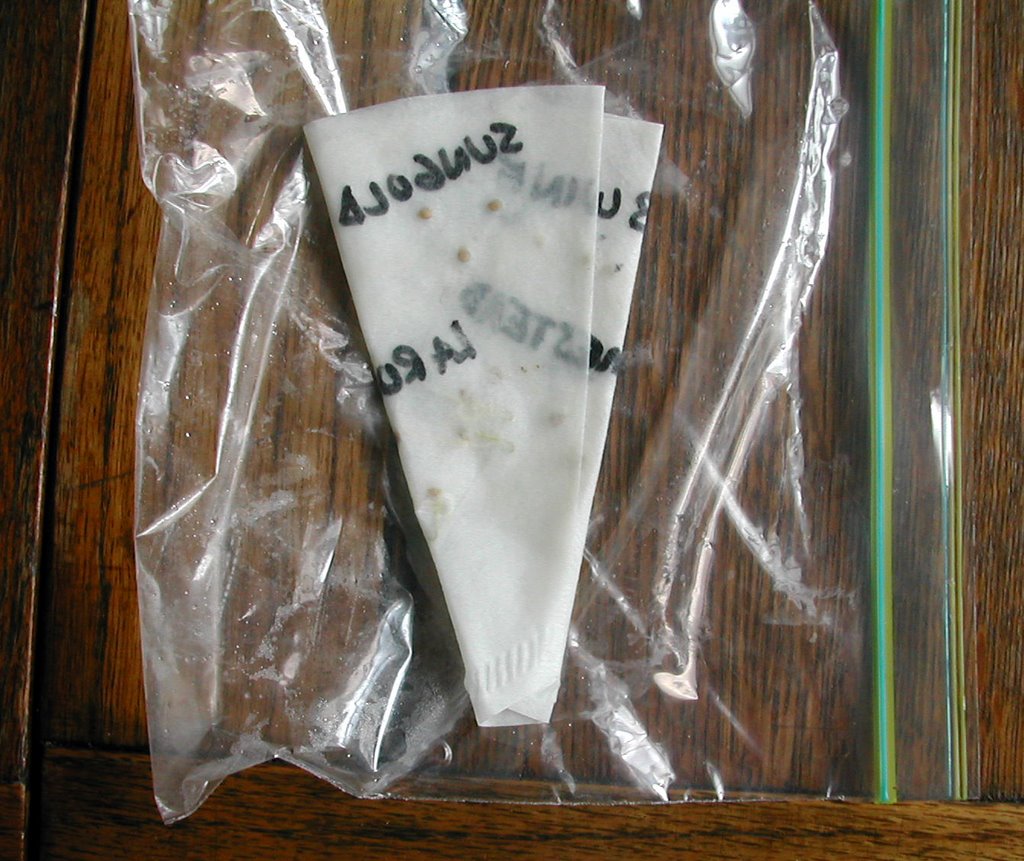 After placing the seeds, I folded the cut sides back to the center, firmly pressing them against the seeds. I then folded this up a couple of times more and placed the filters in a plastic zip lock bag. I placed the plastic bag on the water pump.
First I'm going to tell you what should be done: Check the seeds daily by opening up each filter. This also lets a little air into the bag. As each seed germinates and sends out its tiny little root, the seeds should be planted or potted up immediately to prevent the roots growing tangled together or growing through the paper. For seeds that take more than a week to germinate, you may need to remoisten the paper.
 Now I'll tell you what I did: I checked the seeds the next day; nothing had germinated. The second day, I forgot to check. The third day I checked, but not until late at night so I didn't get these babies planted until the fourth day. As you can see, the squash and cukes were way past time for planting.
 If a root grows through the paper, it is best to tear off that part of the paper and just plant it with the seed. It will disintegrate and won't harm the roots at all. It's better to do that than to risk damaging the roots by separating them from the paper. The Homestead tomato seeds in the top photo are at the perfect stage for planting.
 I potted up the smaller seeds in cellpacks, labeled each cell, and then covered the cellpacks with a clear plastic cover. I love that little stainless steel tool for picking up seeds and pricking out seedlings. It's much better for me than using my fingers. I always end up dropping the seeds or damaging the seedlings.
I potted up the squash and cucumbers in 4" (10 cm.) pots. I usually plant the pre-germinated squash and cuke seeds directly into the ground, but we have had very hot weather alternating with heavy rain storms lately. Since the roots were already so long, but still so delicate, I thought they will have a better chance in pots.
 The remaining ungerminated seeds were folded back up in the filters, put back in the plastic bag, and placed on the water pump, to be checked tomorrow.
 Another time I think I'll do an experiment, planting some seeds with the moon and some in the wrong moon phase to see what happens. It will have to be with my jalapeño seeds, of which I have thousands, because the rest are too precious to waste! I've done some experimenting. Even though it hasn't been very scientific, I have to tell you that I'm really starting to think there is something to this moon phase business!



 Welcome to my Blogicito —



